Where Slot Machine Design Meets Apps
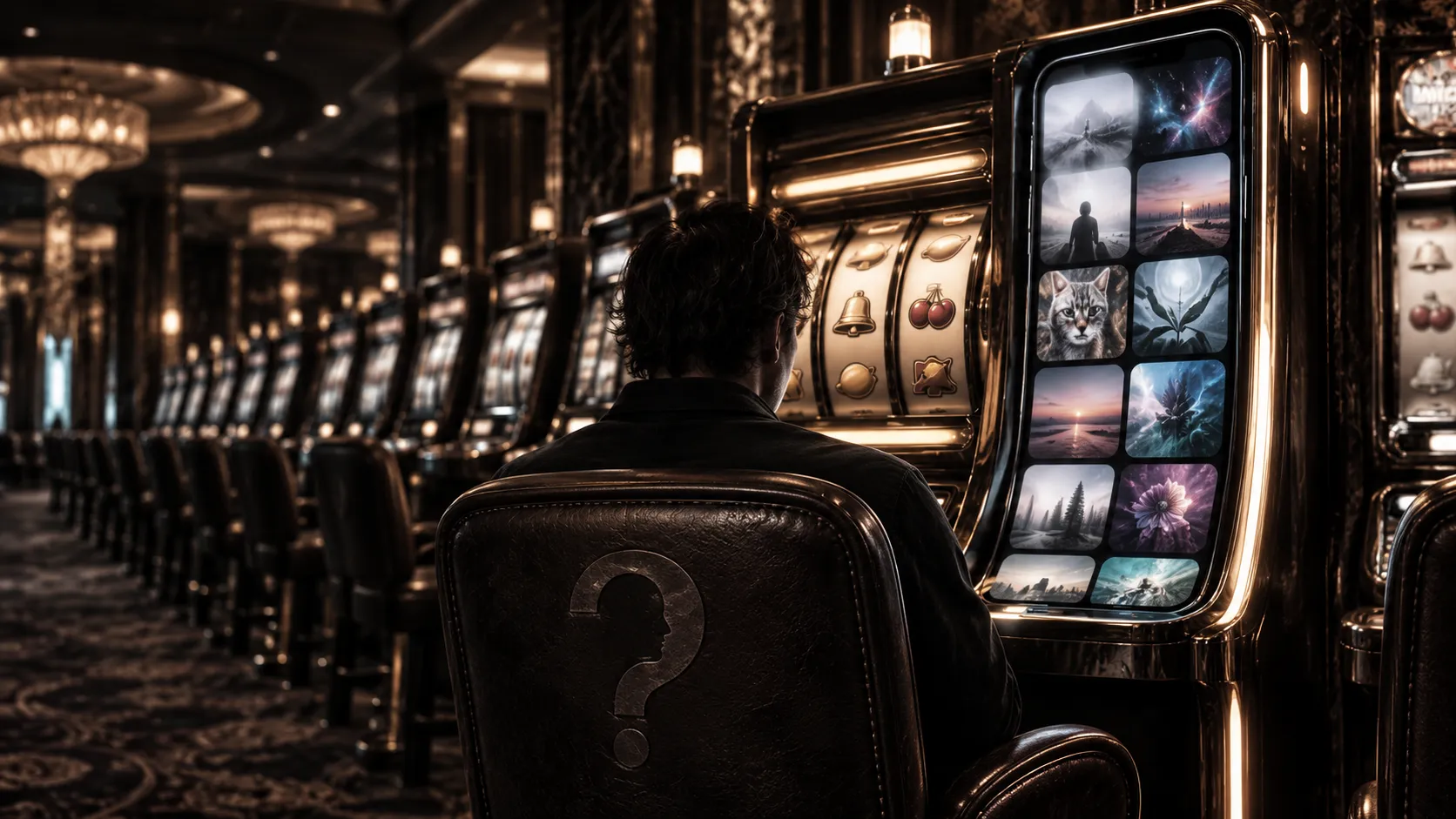
The comparison between slot machines and apps is usually made about payouts. The stronger version is about what the machine is built to hit, and that claim has more support than the stake or the schedule do.
Answer to the question
Do slot machines and apps share one design?
In part. A slot machine takes money against a fixed edge and most apps take none, which is a real difference. They share a target, time on device, and some apps share a payout schedule. No study used here has tested whether an app's rewards work like a loss disguised as a win.
Key takeaways
- Natasha Dow Schüll's 2012 fieldwork describes the machine zone, in which players want to keep playing and not to win, and casinos design for time on device.
- In Mike Dixon's 2010 study of 40 novices, disguised losses (17.1 per cent of spins) produced skin conductance responses similar to real wins (15.6 per cent), and both exceeded ordinary losses.
- The stake is the real difference: a slot machine takes money against a fixed edge and most apps take none, so Adam Alter's test of net harm over time, not resemblance, should decide a given app.
- What the two share is the target. CNBC reported in April 2017 that Netflix's chief executive described the company as competing with sleep, and a 2021 meta-analysis of 15 studies found a small to moderate link between loot box spending and problem gambling.
- Check any comparison row by row: stake, payout schedule, target, disguised losses. Each row has a different answer.
On a fifteen-line slot machine, a spin that returns less than it cost can still play the lights and sounds of a win. In a laboratory study of novice players, these spins came up more often than real wins, and the body answered them much as it answered wins. It is the best-measured fact about slot machine design, and it comes from a gaming machine, not from an app.
Whether an app shares slot machine design depends on which part of the design is meant, the stake, the payout schedule or the target. The evidence is different for each.
What is the machine built to produce?
The fullest account of the target comes from the anthropologist Natasha Dow Schüll, whose Addiction by Design: Machine Gambling in Las Vegas (Princeton University Press) draws on her years of fieldwork among machine gamblers. She reports a state that players call the machine zone, a trancelike absorption in which daily worries, social demands and awareness of the body fade. Players in it want to keep playing for as long as possible. Winning is not what they describe seeking.
Two cautions belong with this. Schüll's work is ethnography, which describes a mechanism in close detail and does not measure how large its effect is. Alter himself calls the trade's own labels for slots, among them crack cocaine and electronic morphine, "sensationalized", while holding that they capture how easily people become hooked. And Alter, whose book the argument here draws on, retells some standard studies without returning to the primary paper, so only claims checked against their sources are used in this piece.
the longer the average player stays seated at the machine, the better the machine
The industry's side of the arrangement has a plain name. Slot machine design is judged by time on device, the longest possible stretch of play on each machine. Adam Alter, in Irresistible, reports the same measure: the success of slot machines is measured by time on device, and "the longer the average player stays seated at the machine, the better the machine". Since most players lose more the longer they stay, the metric works as a stand-in for profit.
A loss the body counts as a win
The best-measured feature of slot machine design is a payout the machine presents as a win when it is not one. Modern machines let a player bet on many lines at once. A spin can return less than the total staked while still winning on one line, and the machine then plays its usual lights and sounds. Researchers call this a loss disguised as a win.
Alter's worked example makes the arithmetic concrete. On a fifteen-line machine charging ten cents a line, a spin costs $1.50. If one line pays $1, the player has lost fifty cents, yet the lights and tunes that follow a win still play. Alter notes that a casino is content to have players spread bets this way, since it beats them fifteen times faster.
A team at the University of Waterloo led by Mike Dixon tested what the body does with it. Their 2010 paper in Addiction recorded skin conductance, a standard measure of arousal, from 40 novice players on a multi-line machine, betting 15 lines at 5 credits each. Wins came on 15.6 per cent of spins and disguised losses on 17.1 per cent. Skin conductance responses to the disguised losses were similar to those for real wins, and both were larger than for ordinary losses.
Heart rate separated them, though only slightly: genuine wins alone produced a larger deceleration, and only at one measured interval. The authors suggest the heightened arousal may matter for problem gambling.
The study is small, uses novices and a single machine, and measures arousal, not later play. It says something about slot machine design and nothing yet about apps. The studies drawn on here concern gaming machines, and none of them tests an app. A reward that costs nothing also has no stake to fall short of, so the app version of a disguised loss, if one exists, would need a different definition.
A further detail comes from the paper's Table 1. At fifteen lines the 2010 figures show disguised losses slightly outnumbering real wins. The table, which works out the outcomes of the game used, shows disguised losses first outnumbering regular wins at six lines wagered, 10.7 per cent of spins against 8.7 per cent, and staying ahead at every higher count. At five lines the order is reversed, with real wins on 11.9 per cent of spins and disguised losses on 6.0 per cent, so the more lines a player bets, the more of the machine's apparent wins are losses.
Which differences between them hold up?
Three differences hold. The first is money. A casino's machine pays back less than it takes, on average, by design, and the player's loss is the machine's income. Most apps take no stake per use. The odds are also bound by rule: Alter notes that in the United States they must stay consistent across every spin, a constraint with no obvious counterpart for a free app, whose designer is not held to a house edge at all.
The second is the ceiling. Alter quotes the chief executive of the Game Show Network saying that a game without real winnings can pay out more than it takes, which no casino could do for more than a week. Alter's point is that such a game can continue indefinitely because the player never runs out of chips. That is one executive's statement as retold by a book with a mixed record, so it is offered as the book's argument and not as a measured result.
The third is the definition of harm. Alter defines addiction as "a deep attachment to an experience that is harmful and difficult to do without", and he makes net harm over time the deciding criterion. By that test, a machine that drains a household's savings and a feed that eats an evening are different cases, and resemblance in slot machine design does not settle which one a given app is. Alter also notes that video-game designers use a measure similar to time on device but are often more concerned with making a game fun than with making money.
Four rows to check in any comparison
The table sets out four components of the comparison and what the evidence in this piece supports for each.
| Component | Slot machine | App | What the evidence supports |
|---|---|---|---|
| Stake | Money, against a fixed edge | None or optional | A real difference |
| Payout schedule | Variable, fixed in advance | Variable, set by ranking or design | Argued by Voinea and colleagues, not tested head to head |
| Target | Time on device | Time held, as with Netflix and sleep | Shared in intent, not tested for effect |
| Disguised losses | Measured arousal, Dixon 2010 | Not tested in the sources used here | Machine only |
Each row gets a different answer.
One claim cannot carry all four. Read row by row, the claim that an app shares slot machine design fails on the stake, is argued on the schedule, holds for the target and is untested for disguised losses.
Where do the two designs meet?
The philosophers Cristina Voinea, Lavinia Marin and Constantin Vică made the structural case in a 2024 paper in Topoi, which argues that social platforms work as attentional scaffolds, digital slot machines. The payout schedule at the centre of that claim is the subject of why people cannot stop scrolling; this piece is about the target instead.
Where the two designs literally meet, the evidence is consistent and correlational. In loot boxes, paid packages in games with random contents, a 2021 meta-analysis pooled 15 studies and found a small to moderate link between loot box spending and problem gambling. The authors do not claim a causal direction, and the correlational loot box evidence is set out in a separate article.
The wish to continue without enjoying also fits a better-established result. Kent Berridge's work on wanting and liking, reviewed in 2025, separates the drive to pursue something from the pleasure of having it. Schüll's players describe the first without the second. Her fieldwork does not measure either, so this is consistency and not proof.
The clearest shared element is the target. CNBC reported that Netflix's chief executive said on the company's April 2017 earnings call, in answer to a question about Amazon's growing streaming competition, that it was "competing with sleep, on the margin". A product measured by the hours it holds is aiming at what Schüll saw on the casino floor, continuous use, whatever it charges and whatever it pays. That is the part of slot machine design that crosses over from the casino floor to the phone, and it does so whether or not any money is staked on the outcome.
Common questions
Do slot machines and apps share one design?
In part. They differ on stakes, since a slot machine takes money against a fixed edge and most apps take none. They share a target, time on device, which casinos design for and which CNBC reported Netflix's chief executive describing as competing with sleep. Whether the payout schedule is shared is argued, not settled.
What is the machine zone?
The machine zone is Natasha Dow Schüll's term for the trancelike absorption that machine gamblers describe, in which worries, social demands and awareness of the body fade. Players in it say they want to keep playing as long as possible, not to win. It comes from her ethnography, so it describes an experience and does not measure an effect.
What is a loss disguised as a win?
It is a spin on a multi-line slot machine that returns less than the player staked but still wins on one line, so the machine plays its win sounds and lights. In a 2010 study of 40 novices by Mike Dixon and colleagues, skin conductance responses to these spins were similar to those for real wins.
Sources
Alter, A. (2017). Irresistible: The Rise of Addictive Technology and the Business of Keeping Us Hooked. Penguin Press. ISBN 978-0-7352-2284-7.
Schüll, N. D. (2012). Addiction by Design: Machine Gambling in Las Vegas. Princeton University Press (paperback 2014, ISBN 978-0-691-16088-7).
Dixon, M. J., Harrigan, K. A., Sandhu, R., Collins, K., & Fugelsang, J. A. (2010). 'Losses disguised as wins in modern multi-line video slot machines.' Addiction. doi:10.1111/j.1360-0443.2010.03050.x.
Voinea, C., Marin, L., & Vica, C. (2024). 'Digital Slot Machines: Social Media Platforms as Attentional Scaffolds.' Topoi.
Garea, S. S., Drummond, A., Sauer, J. D., Hall, L. C., & Williams, M. N. (2021). 'Meta-analysis of the relationship between problem gambling, excessive gaming and loot box spending.' International Gambling Studies, 21(3).
Robinson, T. E., & Berridge, K. C. (2025). 'The Incentive-Sensitization Theory of Addiction 30 Years On.' Annual Review of Psychology, 76, 29-58. doi:10.1146/annurev-psych-011624-024031.
CNBC (17 April 2017). 'Amazon, HBO: Netflix thinks its real competitor is sleep.' Report of the Netflix first-quarter 2017 earnings call.