Social Eating and the Cue to Stop
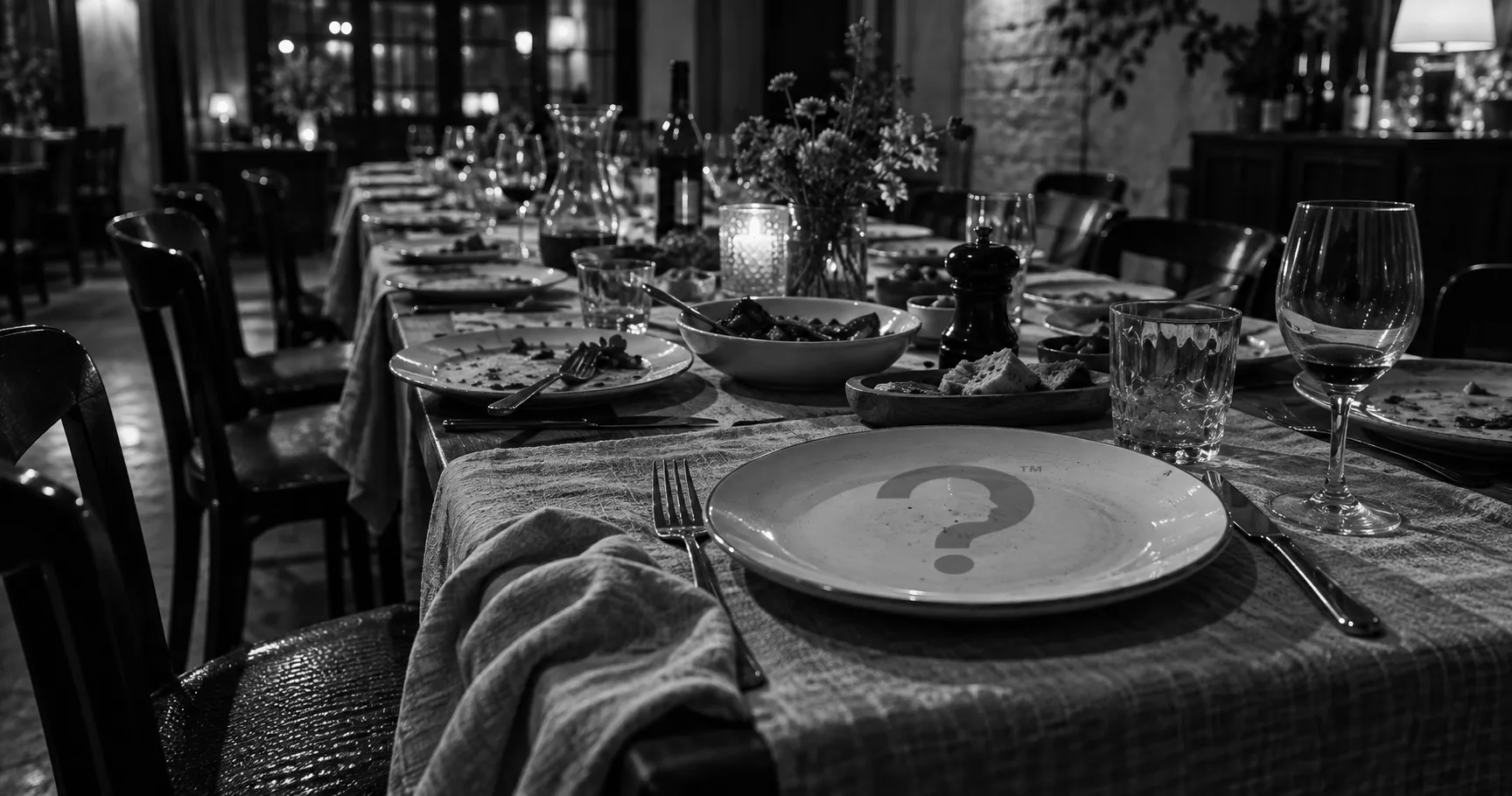
Why the same person eats differently at a long dinner, a client lunch and a meal with a light eater, and what a 2003 review says decides the moment you stop.
Key takeaways
- Peter Herman, Deborah Roth and Janet Polivy (2003) argued that eating in company follows inhibitory norms, rules about when to stop taken from the setting.
- The rules matter most when food is tempting and fullness is unclear.
- The model reconciles three older findings: people eat more in groups, less when they want to impress, and in step with a companion.
- Our practical reading: decide the amount before you arrive, and notice whose plate you are matching.
You've eaten the same dish on three evenings this month. At a long dinner with old friends you kept going well past the point you'd planned. At lunch with a new client you left half of it. Eating opposite a colleague who stopped early, you stopped early too. The food never changed. The company did, and research on social eating suggests that's where much of the difference came from.
Where your stopping point at a meal actually comes from
The explanation that fits all three evenings was set out in 2003 by Peter Herman, Deborah Roth and Janet Polivy in Psychological Bulletin. Their argument is that eating in company is governed by inhibitory norms, which are socially supplied rules about when to stop.
The condition attached to it matters. In the presence of tasty food, and without a clear signal of fullness, people look outward to cues from their surroundings to decide when they've had enough. Social eating supplies those cues. A relaxed dinner says carry on. A setting where you want to make a good impression says hold back. A companion with a visible portion offers an amount to match.
Inhibitory is the important word. The norms in question don't make you hungry. They tell you when it is acceptable, or expected, to stop. In a setting where nobody signals that the meal is over, the brake is simply weaker.
That puts the effect at the end of a meal rather than the start. It isn't mainly about hunger. It's about the moment when you could stop and nothing inside you is deciding, and whatever the room seems to expect fills the gap.
The client lunch shows the model at its clearest. Nothing about the food or your appetite is different. What has changed is that you want to be seen well, and in that setting eating sparingly is part of how people present themselves. The stopping rule arrives with the occasion, and you follow it almost without noticing.
It also explains why restraint feels effortless on some evenings and hard on others. On our reading of the model, holding back at the client lunch takes little willpower if everyone at the table is doing the same. Holding back at the long dinner is harder, because there you are the one departing from the norm.
Three older findings that used to disagree with each other
Before the 2003 review, research on social eating seemed to point three ways at once.
Studies of social facilitation found people eating more in company than alone. The idea that other people change how we perform is one of the oldest in social psychology. Adam Alter traces it in Drunk Tank Pink, in his chapter on the mere presence of other people, back to Norman Triplett's 1898 study of cyclists who rode faster against others than alone. Triplett was measuring effort, not appetite, so his paper is the history of the idea rather than evidence about food, but the eating studies inherited its central claim: company changes behaviour.
Studies of impression management pointed the other way. People ate less when others were present and they wanted to make a good impression, the first date or the lunch with someone whose opinion of you matters.
Modelling studies complicated both. The presence of others could raise or lower intake depending on how much those others ate. Next to a hearty eater people tended to eat more, and next to a light one, less. Social proof usually means a signal about what to choose, a busy restaurant or a popular product. Here it worked as a signal about how much is normal.
Each tradition had a sensible account of its own result. Facilitation researchers pointed to company itself. Impression-management researchers pointed to the wish to be seen well. Modelling researchers pointed to the companion's example. Each account fitted its own studies and failed to explain the other two.
Read separately, the three traditions contradict one another. Read through the review's model they become three settings that supply three different stopping rules, and nothing has to be thrown away. A good review does what a single experiment cannot: it gathers studies run by other people, with different methods and in different decades, and asks what would make all of them true at once.
Using the model at the table as guest or host
None of this needs to be resisted at every meal. Most of the time the norms of good company are part of the pleasure, and eating more at a celebration is not a failure of anything. The model is useful when you would like the choice to be your own, and it shows where the choice is being made.
Restaurants are the obvious application. Courses arriving in sequence, plates shared across the table and a host who never hurries you all plausibly weaken the cue that a meal is over. That reading is ours, an inference from the model rather than something the review tested, and none of it needs bad intent. Generous, unhurried service is what hospitality is.
If you'd like to eat less in company, two steps follow from the model, and both are our inference rather than the authors' advice:
1. Decide the amount before you arrive. The model operates where no internal signal is deciding, so a decision made beforehand fills that gap with something of your own.
2. Notice whose plate you are reading. If a companion's portion works as a reference point, it helps to know whose amount you're matching, and to choose it.
The model also says something about eating alone, again as our inference. With no company there is no social cue, so the stopping point falls back on habit, the size of the portion in front of you and whatever else is in view, a screen included. Social eating hands the decision to the room. Solitary eating hands it to the plate.
Hosts set much of the norm too. The size of the serving dishes, whether plates are refilled or cleared, whether the meal has a visible end: guests who are unsure when to stop may well look to the host first, which is our inference rather than a tested finding. Social eating at your own table is partly something you design, whether or not you mean to.
What the 2003 review does and does not settle
The model explains direction, not size. It tells you which way a setting should push intake, but not by how much, and it doesn't rank a companion's plate against a sociable mood.
It's a review, so its contribution is a model that fits findings other researchers produced. Fitting three sets of results is a strong start and not the same as passing a test against a fourth. We cite the review rather than the individual studies beneath it, which means we rely on the authors' reading of a literature this publication has not audited study by study.
There is also a gap between where the evidence was gathered and where people actually eat. Studies are run under controlled conditions, and a family dinner or a wedding banquet is longer, looser and more crowded than most study settings. The model's logic should carry over, because it rests on cues rather than on the details of any one setting, but the size of any effect in real social eating is not something the review can tell you.
And it is from 2003. The everyday logic has aged well, because tasty food, unclear fullness and company are hardly new, but the studies behind it were run in the conditions of their time.
What social eating comes down to, on this account, is a handover. When your own signal for stopping is quiet, the room supplies one, and it may not be the one you would have chosen.
Common questions
Does social eating make you eat more?
Sometimes. Facilitation studies found people eating more in groups, impression-management studies found them eating less when trying to impress, and modelling studies found intake tracking a companion's. On the 2003 review's account the direction depends on the norm the setting supplies.
Why does it matter who you eat with?
Because a companion's portion can act as a reference point. Modelling studies found intake rising or falling with how much the person beside you ate.
Do people eat less when they are being watched?
Often, when they want to make a good impression. Impression-management studies found people eating less in company in exactly that situation, which is one of the three findings the 2003 review set out to reconcile.
How can I avoid overeating in company?
Deciding the amount before you arrive fills the gap the model describes with your own decision. That is our inference from the model, not a recommendation the authors make.
Sources
Alter, A. (2013). Drunk Tank Pink. Penguin Press. Ch. 4, The Mere Presence of Other People, pp. 77-100. Read in full by this publication, 2026-08-31, with the caution recorded that much of the book's priming material did not survive replication.
Herman, C. P., Roth, D. A., & Polivy, J. (2003). 'Effects of the presence of others on food intake: a normative interpretation.' Psychological Bulletin, 129(6), 873-886. Reviews social facilitation, modelling and impression-management literatures and reconciles them through a model of inhibitory norms: in the presence of palatable food and the absence of clear satiety signals, people look outward to environmental cues to determine when to stop eating, and socially derived inhibitory norms can account for either increased or decreased intake. Verified at the published record 2026-10-06. doi:10.1037/0033-2909.129.6.873
Triplett, N. (1898). 'The dynamogenic factors in pacemaking and competition.' American Journal of Psychology, 9, 507-533. Cyclists' times were faster paced or in competition than riding alone against the clock. Cited as history of the social facilitation idea, as Alter retells it in Drunk Tank Pink, Ch. 4, not as evidence about eating; citation checked at the Classics in the History of Psychology text, 2026-10-06.