The Zeigarnik Effect at the Credits
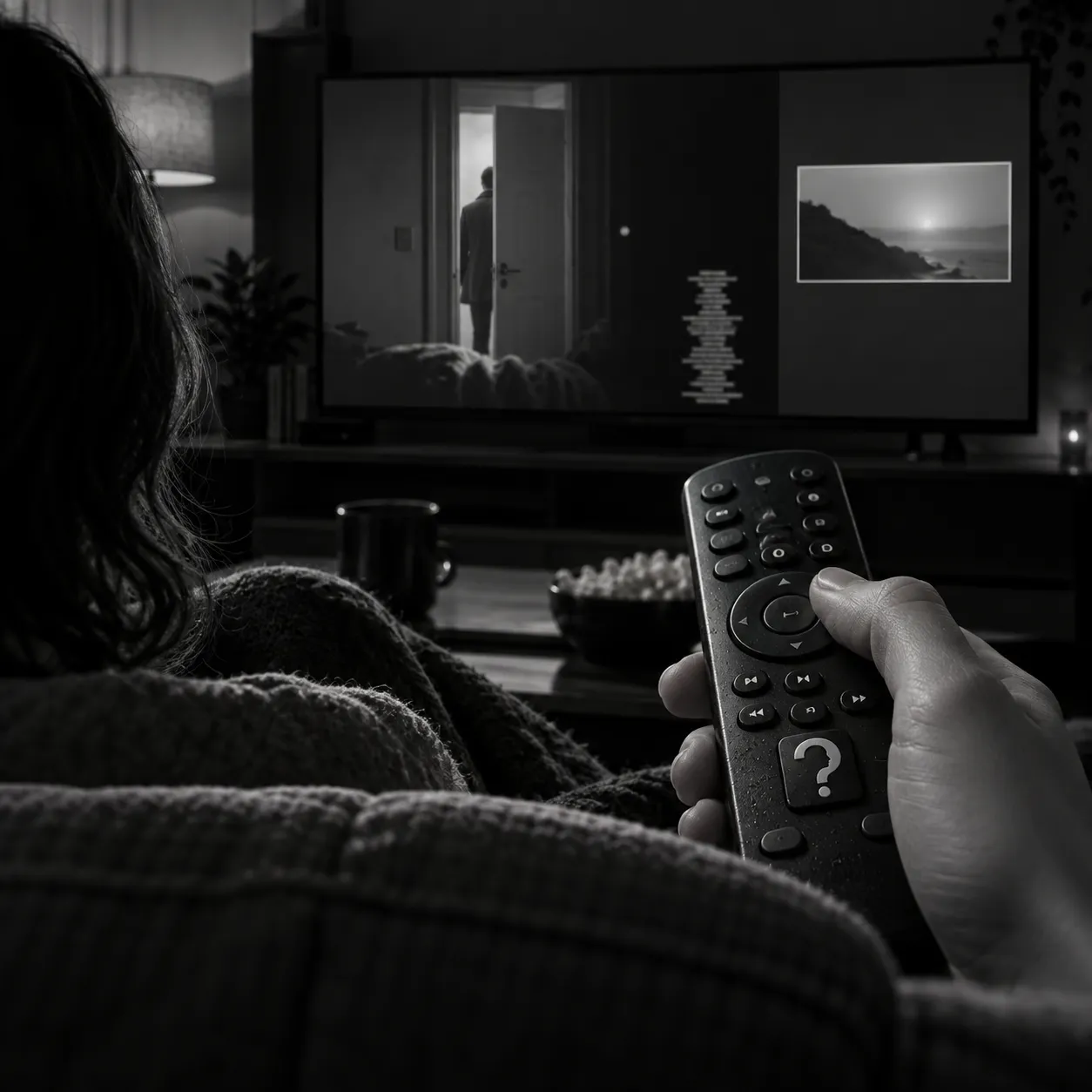
A cliffhanger is said to keep you watching because unfinished business lodges in memory. The pull is genuine, and it comes from wanting to resume the story, which is a different mechanism with a different name.
Answer to the question
Do unfinished tasks really stick in your mind?
They nag, but they are not better remembered. A 2025 meta-analysis by Romain Ghibellini and Beat Meier found no memory advantage for interrupted tasks across 38 publications. What the evidence supports is the urge to go back, with people resuming interrupted tasks about two times in three, and a specific plan quietened the intrusive thoughts in 2011 studies.
Key takeaways
- In Bluma Zeigarnik's 1927 study of 164 people, interrupted tasks were recalled about 90 per cent better than finished ones.
- A 2025 meta-analysis of 38 publications by Romain Ghibellini and Beat Meier found no memory advantage for interrupted tasks.
- The same meta-analysis found that people resumed interrupted tasks about two times in three, the Ovsiankina effect.
- In 2011, E. J. Masicampo and Roy F. Baumeister found that a specific plan for an unfinished task removed its intrusive thoughts.
The last scene ends on a door opening and nobody walking through it. The credits shrink into a corner, a small box in the other corner starts counting down, and the next episode begins before you have decided anything. You meant to sleep an hour ago. Now you are watching a stranger cross a room.
Adam Alter's Irresistible explains that pull with the Zeigarnik effect, and it does so early and with conviction. Its eighth chapter, "Cliffhangers", tells the story of the psychologist Bluma Zeigarnik and sums up her finding as "incomplete experiences occupy our minds far more than completed ones." The chapter then applies it to the podcast Serial, to the cut to black that ended The Sopranos, and to Netflix's decision to start the next episode for you. The pull Alter describes is familiar to anyone who has owned a television. The memory claim he puts underneath it has fared less well.
What did Bluma Zeigarnik find?
She ran her experiment at the Psychological Institute of the University of Berlin. She worked with people one at a time, students and teachers as well as children, and gave each a run of about twenty short tasks, some practical and some mental. Some tasks they were allowed to finish. Others she stopped partway, and moved them on. Afterwards she asked each person to name as many tasks as they could remember.
On her own measure, the interrupted tasks were recalled close to twice as often as the finished ones. She put this down to a kind of tension: starting a task sets up a need to complete it, and the need stays live until the task is done.
This finding gave the Zeigarnik effect its label, and it has a lovely simplicity. A cliffhanger is an interrupted task. The story stops before the need is met, so the story stays with you.
The trouble is that the result was always easier to retell than to reproduce. Laboratories kept running versions of the experiment through the twentieth century, and the memory advantage proved hard to find again.
Are interrupted tasks remembered better?
Romain Ghibellini and Beat Meier, at the University of Bern, gathered those attempts in one place. Their meta-analysis of the Zeigarnik effect and its sister effect, which pooled the published experiments statistically, set Zeigarnik's own experiments alongside the later ones and ran each comparison with and without her data.
The paper appeared in Humanities and Social Sciences Communications in July 2025 and covered 59 publications, 38 of them on memory. The original it was testing, published in 1927 with 164 people tested individually, had reported interrupted tasks recalled about 90 per cent better than finished ones.
The question at the heart of it was whether people recall interrupted tasks more often than completed ones.
Compared directly, average recall of interrupted and completed tasks came out level, with or without Zeigarnik's own data. Of all the tasks people recalled, just under half were interrupted ones, which is what you would expect if interruption made no difference. The authors write that Zeigarnik's original figures look "inflated" against the pooled evidence, and they warn that her own ratio measure is easily swayed by a handful of extreme scores, which is why they prefer the simpler comparison. Their abstract states: "We found no memory advantage for unfinished tasks but found a general tendency to resume tasks."
They do not say Zeigarnik invented anything. They suggest her result may have depended on conditions that were common in 1920s laboratories and are rarer now: an experimenter with real authority, and participants absorbed in the task in front of them. They add that task involvement "has become more difficult as we are increasingly faced with interruptions." If so, the Zeigarnik effect is something that can happen under the right conditions, and not a general law of memory. The paper's phrase is that it "lacks universal validity".
The claim at the centre of the cliffhanger chapter, and of most popular accounts of the Zeigarnik effect, that unfinished business is held in memory better than finished business, is therefore the part the evidence does not support.
So what keeps pulling you back?
The second part of the same 2025 paper concerns a sister effect from the same Berlin series of studies. Maria Ovsiankina reported in 1928 that people who are interrupted tend to go back and finish the task when they are given the chance. Across 21 publications, the meta-analysis found that people resumed interrupted tasks about two times in three. The tendency was stronger when the task was an attractive one.
That makes resumption a common response to an interruption, rather than a curiosity of one Berlin laboratory.
This matches the sofa far better than the Zeigarnik effect does. Nobody forgets which episode they were on. What happens is that the story feels unfinished and you want to finish it. The Ovsiankina effect is about doing, and it is the part of this literature that the evidence supports.
Nobody forgets which episode they were on. What happens is that the story feels unfinished and you want to finish it.
A third line of work suggests where the nagging comes from. In 2011 E. J. Masicampo and Roy F. Baumeister, then at Florida State University, asked students to write about important tasks they had not yet finished. During an unrelated reading task, those students reported more stray thoughts about their tasks and understood less of what they read. Students who had also written down a specific plan, how, when and where they would get the tasks done, showed none of that interference. In a later study, simply listing possible actions without committing to one did not help; the plan had to be a decision.
In the first study, about two in three of the unfinished-task group reported their minds wandering, against one in three of those who had planned. The researchers measured intrusive thoughts and attention, not recall, and their conclusion is careful: "Once a plan is made, the drive to attain a goal is suspended." A plan works as a kind of temporary finish.
The pull of the unfinished episode is genuine. It works through the wish to resume, and through the way an open task keeps intruding, rather than through any special place it holds in memory.
What does this mean for autoplay?
Netflix introduced the feature Alter describes in August 2012 and called it Post-Play. When the credits began, the player shrank them and previewed the next episode in the series. Before that change, watching another episode was a decision. Afterwards, stopping was the decision.
Before that change, watching another episode was a decision. Afterwards, stopping was the decision.
Seen through the evidence, the design does two jobs, and neither of them depends on memory.
A cliffhanger leaves a story interrupted, which invites the urge to resume. The countdown then removes the pause in which you might have weighed that urge against sleep. Neither job needs the Zeigarnik effect in its memory form. Both rest on the parts of the research that stood up to pooling.
Alter's best example points to the urge as well. He describes how nearly fifty thousand fans of Serial argued over the case on a forum on Reddit, and predicts that if the murder were ever solved the loop would close and the forums would wither. That is a prediction about the urge to finish, and it is a fair one.
The Sopranos example in the same chapter reads the same way once the memory claim is set aside. When the final episode cut to black in June 2007, Alter writes, searches for "Sopranos final episode" began at 10.02 that evening and ran well into the night. Viewers were not struggling to recall the scene. They wanted it finished, and they went looking for someone who could finish it for them.
Both examples describe people trying to close something, which is the behaviour the 2025 meta-analysis did find.
The planning result suggests something you can try. If an unresolved story keeps tugging at you, deciding when you will watch the next part may quiet it in the way a plan quieted the students. A plan cannot resolve the plot, but the evidence suggests it can take the urgency out of the countdown.
None of this requires interrupted stories to be easier to recall the next morning, and the evidence says they are not. The pull that exists is the wish to resume, and the planning studies are the best lead on quietening it.
Common questions
Do unfinished tasks really stick in your mind?
They nag, but they are not better remembered. A 2025 meta-analysis by Romain Ghibellini and Beat Meier found no memory advantage for interrupted tasks across 38 publications, which is the core claim of the Zeigarnik effect. What the evidence supports is the urge to go back: people resumed interrupted tasks about two times in three.
What is the difference between the Zeigarnik effect and the Ovsiankina effect?
The Zeigarnik effect, from Bluma Zeigarnik's 1927 study, is the claim that interrupted tasks are remembered better. The Ovsiankina effect, reported by Maria Ovsiankina in 1928, is the tendency to resume interrupted tasks. The 2025 meta-analysis supported the second and not the first.
Can making a plan stop an unfinished task nagging at you?
In a set of studies published in 2011, E. J. Masicampo and Roy F. Baumeister found that writing a specific plan for an unfinished task, saying how, when and where it would be done, removed the intrusive thoughts and the drop in reading comprehension that the unfinished task otherwise caused.
Sources
Zeigarnik, B. (1927). 'Das Behalten erledigter und unerledigter Handlungen.' Untersuchungen zur Handlungs- und Affektpsychologie III, Psychologische Forschung, 9, 1-85. doi:10.1007/BF02409755. Full text read (German original, scanned PDF): Psychological Institute of the University of Berlin; 164 individual participants (students, teachers and children) plus two group experiments; mean ratio of interrupted to completed tasks recalled 1.9, stated as unfinished tasks being retained 90 per cent better.
Ghibellini, R., & Meier, B. (2025). 'Interruption, recall and resumption: a meta-analysis of the Zeigarnik and Ovsiankina effects.' Humanities and Social Sciences Communications, 12, article 962. doi:10.1057/s41599-025-05000-w. Full text read: 59 publications; ratio of average recall, interrupted to completed, 0.99 across 38 publications with or without Zeigarnik (1927); proportion of recalled tasks that were interrupted 49.43 per cent (14 publications); Cohen's dz 0.15 across 8 publications; Zeigarnik's original values judged inflated; Ovsiankina resumption rate 67.00 per cent across 21 publications, 66.79 per cent without Ovsiankina (1928); resumption related to task attractiveness. Ovsiankina, M. (1928), Psychologische Forschung, 11, 302-379, doi:10.1007/BF00410261, is cited as reported in this meta-analysis.
Masicampo, E. J., & Baumeister, R. F. (2011). 'Consider it done! Plan making can eliminate the cognitive effects of unfulfilled goals.' Journal of Personality and Social Psychology, 101(4), 667-683. doi:10.1037/a0024192. Full text read: Florida State University; Study 1, 69 undergraduates, mind-wandering reported by 65.2 per cent of the unfinished-task group against 33.3 per cent of plan makers; Study 5B, listing actions without committing to one did not reduce intrusions; outcomes were intrusive thoughts, accessibility and task performance, not recall.
Alter, A. (2017). Irresistible: The Rise of Addictive Technology and the Business of Keeping Us Hooked. Penguin Press. Read in full by this publication, with a reliability audit. Ch. 8, "Cliffhangers", pp. 191-213: Zeigarnik's experiment, Serial and its forum of almost fifty thousand fans, The Sopranos finale searches, and Netflix post-play from August 2012.
Lawler, R. (2012, 15 August). 'Netflix launches Post-Play, so you never have to interrupt TV or movie marathons.' TechCrunch. https://techcrunch.com/2012/08/15/netflix-post-play/. Full text read: used only for the product facts, that when credits roll Netflix minimises them and previews the next episode, launched on the website and PlayStation 3.