What Cigarette Warnings Do to Craving
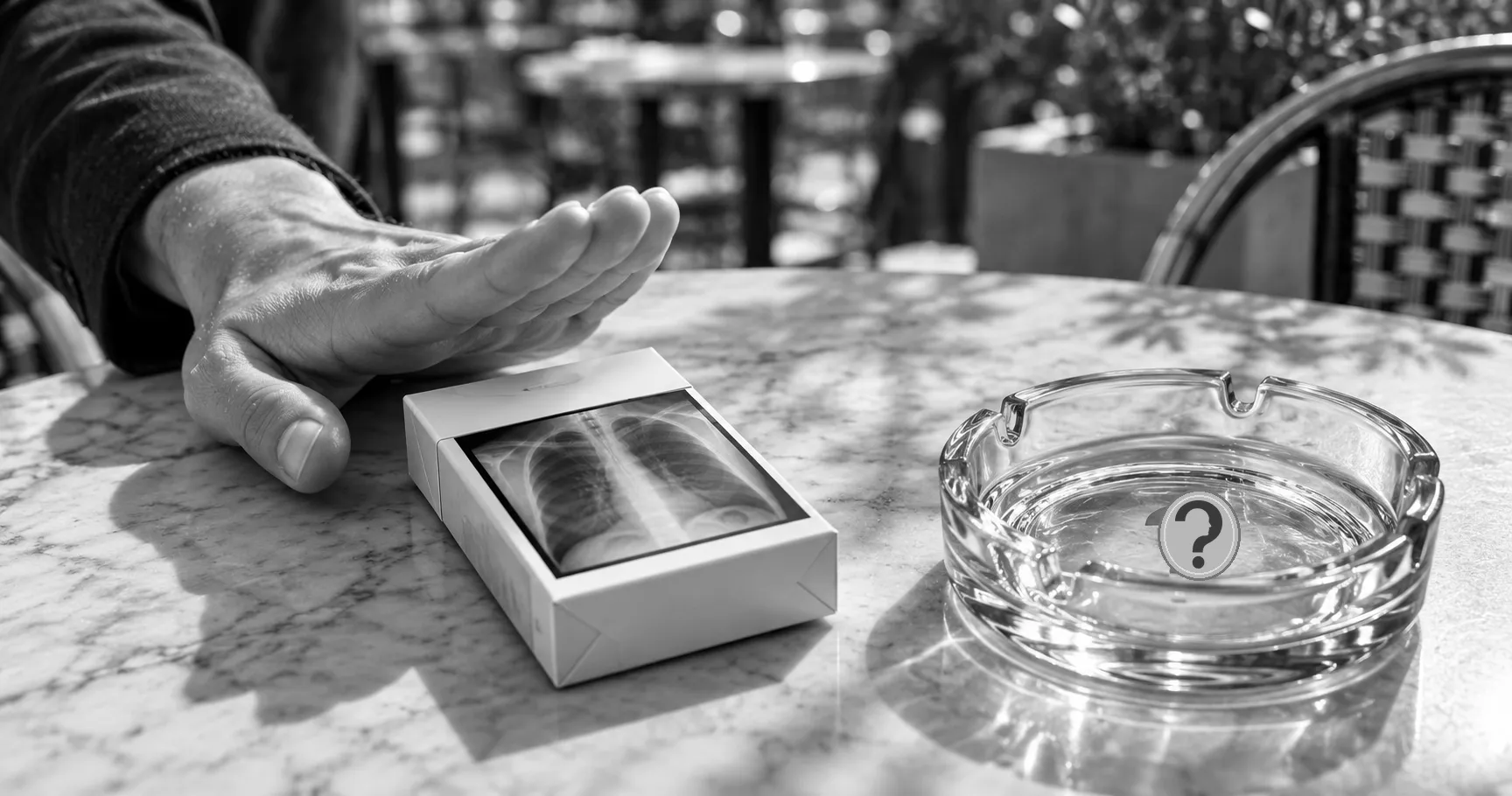
A bestselling book said warnings make smokers crave. Published brain studies that measured craving found it went down, and a trial found more quit attempts.
By The Why We Project · Medical review: [REVIEWER: name to be added]
Key takeaways
- Martin Lindstrom's Buyology reports that warnings stimulated craving in 32 smokers; we could not find the study in a peer-reviewed journal.
- Published brain-imaging studies in 2015 found graphic warnings were associated with reduced urges to smoke.
- A 2016 meta-analysis of 37 studies found pictorial warnings beat text-only warnings on 12 of 17 measures.
- In a 2016 randomised trial of 2,149 smokers, 40 per cent with pictorial warnings tried to quit over four weeks, against 34 per cent with text warnings.
- This is general information, not medical advice: speak to a GP, pharmacist or stop-smoking service.
This article is general information about research on cigarette warnings and craving. It is not medical advice, and it does not recommend any particular way of stopping. If you want help to stop smoking, speak to your GP, a pharmacist or a local stop-smoking service, who can explain the support and treatments available and help you choose between them. Anyone already using a stop-smoking medicine should keep to the advice of whoever prescribed it. Medical review: [REVIEWER: name to be added].
A smoker picks up a packet and sees a photograph of a diseased lung. Does the picture make the next cigarette less likely, or more? One bestselling marketing book answered that cigarette warnings make smokers want to smoke. The published research points the other way. Both accounts deserve a fair hearing, because each says something about how warnings work.
What did the Buyology scan claim?
Martin Lindstrom's Buyology, published in 2008, describes a brain-imaging study of smokers commissioned for the book. According to the book, 32 smokers in London were scanned while they looked at cigarette warnings. At page 14 Lindstrom writes that the labels had no effect on craving, "Zero", and that the money spent on them by governments around the world had been wasted. At page 15 he goes further: by activating the nucleus accumbens, a region he calls the craving spot, the warnings "appeared to encourage smokers to light up".
It is a striking claim, and it travelled widely. It also has a weakness that a reader of the book cannot see from the text. We could not find the study in any peer-reviewed journal. The book gives no superscript note for it, and our own review of the book found that none of the findings from its own studies carry a citation. A reader has only the author's account.
There is a second issue, about how brain images are read. A region such as the nucleus accumbens is involved in many things, including reward, motivation and attention. Seeing it become more active does not tell you which of those is happening. Reading "craving" off a scan runs the inference backwards, from activity to a single mental meaning, and imaging researchers treat that step with caution.
It is easy to see why the claim spread. It was counter-intuitive, it came with a brain scan, and it told readers that something governments had spent heavily on had backfired. Our impression is that stories with that shape travel further than stories in which a policy works modestly as intended, which is roughly what the later research found about cigarette warnings.
A dramatic finding from an unpublished study reached a very large readership. The published studies that measured craving point the other way.
The claim may yet turn out to be right, but it rests on an unpublished study, interpreted in a way that would need more than one region's activity to support. The sensible next step is to look at the studies that were published.
What did published scans find?
Several research teams have since scanned smokers looking at graphic warnings, and published the results with their methods.
In 2015 Wang and colleagues reported a study of 24 smokers in Tobacco Control. Warning labels that people rated as producing a strong emotional reaction were better remembered and were associated with a reduction in the urge to smoke. They also produced greater responses in regions including the amygdala, hippocampus, inferior frontal gyrus and insula.
The same year K. T. Do and Adriana Galván reported a study in Social Cognitive and Affective Neuroscience comparing adolescents aged 13 to 18 with adults aged 25 to 30, smokers and non-smokers. Adolescent smokers showed a greater reduction in craving after viewing the warnings than adult smokers, and greater activation in the insula and the dorsolateral prefrontal cortex went with greater reductions in craving.
A 2014 study in BMJ Open, scanning 50 adult smokers, found that warnings activated visual and emotional networks, and that smokers who found the labels more arousing showed stronger responses. It did not measure craving, so it neither supports nor contradicts the book on that point.
Set side by side, the published brain studies do not show cigarette warnings encouraging smoking. Where craving was measured, it went down, at least for the warnings that provoked strong reactions. These are small studies, each with a few dozen people, so they suggest a direction rather than establishing the size of an effect. But they are published, they describe their methods, and they reach the opposite conclusion from the one the book made famous.
Do warnings change smoking itself?
Brain activity and reported urges are one step removed from behaviour, so the stronger evidence is about what smokers do.
A 2016 meta-analysis led by Seth Noar, in Tobacco Control, pooled 37 experimental studies covering 48 samples and 33,613 people. Pictorial warnings outperformed text-only warnings on 12 of 17 measures of effectiveness. They drew and held attention better, produced stronger thoughts and feelings about the risks, made attitudes to smoking more negative, and strengthened intentions not to start and to quit. The authors noted a gap: the studies mostly lacked measures of actual smoking.
The same year a randomised trial filled part of that gap. Noel Brewer and colleagues, in JAMA Internal Medicine, gave 2,149 adult smokers in California and North Carolina either pictorial or text-only warnings on their own packs for four weeks. Forty per cent of those with pictorial warnings tried to quit during the trial, against 34 per cent with text warnings. By the end, 5.7 per cent had stopped smoking for at least a week, against 3.8 per cent.
Those are modest numbers, and four weeks is a short time. But they come from smokers' own packs in their own lives, and they point the same way as the meta-analysis.
What the trial could not show is how long the effect lasts. A week without cigarettes at the end of a month is not the same as stopping for good, and the study was not designed to follow people for years. Nor does it say how cigarette warnings perform once smokers have seen the same images hundreds of times. Those are open questions, and the fair summary is that pictorial warnings nudge behaviour in the right direction, compared with text alone, by a small amount over the period that has been tested.
A 2011 review by David Hammond of 94 articles reached a similar conclusion from a wider body of work: larger warnings with pictures were more effective than smaller, text-only ones, and pictorial warnings that provoked strong emotional reactions were more effective still.
Why might both feel true?
A smoker reading Buyology might recognise the claim. Seeing cigarettes, even on a warning, can remind you of smoking, and reminders can bring an urge. That experience is real, and a book that names it will feel accurate.
A single moment of wanting a cigarette and a measurable shift in behaviour over weeks are different things.
The research suggests the reminder is only part of what a warning does. Graphic warnings also produce fear, disgust and thoughts about harm, and in the published studies those reactions were linked to less craving and more quitting, not more smoking. A single moment of wanting a cigarette and a measurable shift in behaviour over weeks are different things, and the second is what matters for health. A smoker can feel a pull towards the packet in the moment and still be slightly more likely to try quitting over the following month.
There is also a difference in what each source can show. A book can describe a striking scan and tell a story about it. A trial can count quit attempts. When the two disagree, the trial is the better guide. We think the book was right that warnings act through emotion rather than through information alone, and wrong about the direction in which that emotion pushes smokers.
What should smokers take away?
For someone who smokes, the practical message is not to read warnings as the reason they keep smoking. On the best available evidence, pictorial warnings make quit attempts slightly more likely than text warnings do, not less likely.
That does not make a warning label a treatment. The effects in the trials were modest. Stop-smoking services, nicotine replacement and prescribed medicines have their own evidence, and a GP or pharmacist is the right person to discuss them with. This article is about how warnings work, not about which treatment suits any individual.
For readers interested in how marketing claims are built, the episode is a useful case. A dramatic finding from an unpublished study reached a very large readership. The published studies that measured craving point the other way.
Common questions
Do cigarette warnings make people want to smoke?
Not on the published evidence. A brain-scan study described in Buyology claimed they did, but it was not published in a peer-reviewed journal. Published imaging studies in 2015 found graphic warnings were associated with reduced craving.
Do graphic cigarette warnings help people quit?
Modestly. In a 2016 randomised trial of 2,149 smokers, 40 per cent with pictorial warnings tried to quit over four weeks against 34 per cent with text warnings, and 5.7 per cent against 3.8 per cent had stopped for at least a week.
Are pictorial warnings better than text warnings?
A 2016 meta-analysis of 37 studies found pictorial warnings outperformed text on 12 of 17 measures, including attention, emotional reactions and intentions to quit.
Where can I get help to stop smoking?
This article is not medical advice. A GP, a pharmacist or a local stop-smoking service can explain the options, including nicotine replacement and prescribed treatments.
Sources
Lindstrom, M. (2008). Buyology: Truth and Lies About Why We Buy. Doubleday. Read in full by this publication, with a reliability audit. pp. 14-15. The book's own study carries no citation; no peer-reviewed publication of it was located.
Wang, A.-L., Lowen, S. B., Romer, D., Giorno, M., & Langleben, D. D. (2015). 'Emotional reaction facilitates the brain and behavioural impact of graphic cigarette warning labels in smokers.' Tobacco Control, 24(3), 225-232. doi:10.1136/tobaccocontrol-2014-051993. 24 smokers.
Do, K. T., & Galván, A. (2015). 'FDA cigarette warning labels lower craving and elicit frontoinsular activation in adolescent smokers.' Social Cognitive and Affective Neuroscience, 10(11), 1484-1496. doi:10.1093/scan/nsv038.
Newman-Norlund, R. D., and colleagues (2014). 'Neural biomarkers for assessing different types of imagery in pictorial health warning labels for cigarette packaging: a cross-sectional study.' BMJ Open, 4(12), e006411. doi:10.1136/bmjopen-2014-006411. 50 adult smokers; craving not measured.
Noar, S. M., Hall, M. G., Francis, D. B., Ribisl, K. M., Pepper, J. K., & Brewer, N. T. (2016). 'Pictorial cigarette pack warnings: a meta-analysis of experimental studies.' Tobacco Control, 25(3), 341-354. doi:10.1136/tobaccocontrol-2014-051978. 37 studies, 48 samples, 33,613 participants.
Brewer, N. T., Hall, M. G., Noar, S. M., Parada, H., Stein-Seroussi, A., Bach, L. E., Hanley, S., & Ribisl, K. M. (2016). 'Effect of pictorial cigarette pack warnings on changes in smoking behavior: a randomized clinical trial.' JAMA Internal Medicine, 176(7), 905-912. doi:10.1001/jamainternmed.2016.2621. 2,149 smokers; quit attempts 40 per cent against 34; quit at least seven days 5.7 against 3.8.
Hammond, D. (2011). 'Health warning messages on tobacco products: a review.' Tobacco Control, 20(5), 327-337. doi:10.1136/tc.2010.037630. 94 articles.
A note on scope: general information, not medical advice. The trial ran for four weeks; long-term quitting was not measured.