Why There Is Always Room for Dessert
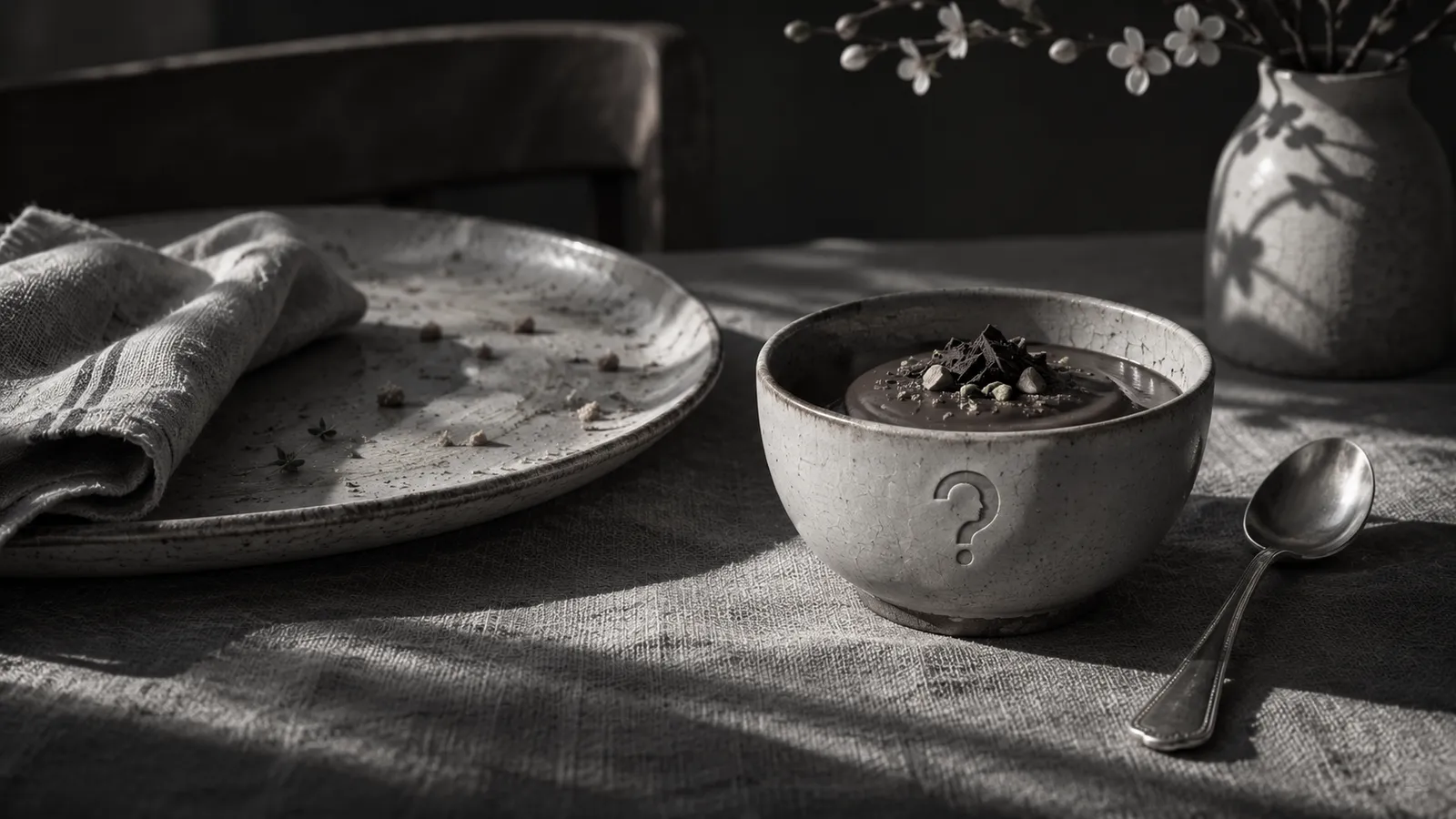
Fullness is not one gauge. Part of it belongs to the food just eaten, which is why a different course still finds room, and why people plan for that before they sit down.
Why can you eat dessert when you are full?
Fullness is partly specific to the food just eaten. As a meal goes on, its taste, smell and texture become less pleasant, while a dessert with different qualities keeps more of its appeal. Barbara Rolls and colleagues named this sensory-specific satiety in 1981, and in one study a four-course meal of different foods led to about 60 per cent more energy eaten than four identical courses.
Key takeaways
- A four-course lunch with a different food in each course led to about 60 per cent more energy eaten than four identical courses, nearly all of it in the later courses (Rolls and colleagues, 1984).
- In 1981, 32 people rated eight foods before and after eating one of them; the eaten food dropped most in pleasantness.
- Variety raised intake most when the foods differed clearly: four sandwich fillings led to about a third more eaten than one.
- Leonard Epstein and colleagues read the same decline as habituation, a drop in response to a repeated stimulus that recovers when something new arrives.
- People planning an imagined two-course meal chose more food when the courses differed, so the variety effect is anticipated as well as felt (Wilkinson and colleagues, 2013).
Stephan Guyenet, in The Hungry Brain, uses the pudding eaten after a heavy main course to show how appetite works within a single meal. His explanation rests on sensory-specific satiety, the finding that fullness attaches partly to the food just eaten. Roast meat loses its pull as the meal goes on, and a cold sweet dessert arrives with its appeal intact. Guyenet carries the same idea over to variety: a meal of many dishes keeps people eating, because no single food stays on the plate long enough to lose its charm.
The research behind that argument began in a laboratory in the early 1980s, with ratings of how pleasant ordinary foods tasted before and after lunch, and it has been extended many times since.
What exactly wears off during a meal
The experiment behind the term was simple. Volunteers rated how pleasant eight foods tasted, ate one of them for lunch, and rated all eight again two and twenty minutes later. The food they had eaten fell in pleasantness more than the seven they had not touched. The drop was already present two minutes after the meal ended and had not grown further by twenty minutes, so it is a fast change within the meal itself. In a second experiment reported in the same paper, that relative drop was linked to what people went on to eat when more food was offered. Barbara Rolls and her colleagues called the pattern sensory-specific satiety in 1981.
The decline reaches past the tongue. In a later study from the same research group, the look of a food eaten to satiety became less pleasant than the look of foods not yet eaten. Ratings of sight and taste moved together, which suggests the fading appeal is tied to several qualities of one food at once.
Sensory-specific satiety therefore separates two things that everyday speech runs together. Feeling full in the stomach is one, and finding the next mouthful of the same thing less pleasant is another. The second can be well advanced while the first still leaves room, which is the gap a dessert menu fills. That account explains the wanting; the mixed feelings that can follow a sweet course are a separate matter, taken up in Why We Feel Guilty About Treats.
How different the next food has to be
| Kind of difference between the foods | What happened to intake |
|---|---|
| Colour only, in chocolates | Pleasantness of the eaten colour fell; intake did not rise |
| Taste only, in yogurts | Intake did not rise |
| Flavour only, in sandwiches | Intake rose by 15 per cent |
| Shape only, in pasta | Intake rose by 14 per cent |
| Taste, texture and colour together, in yogurts | Intake rose, even against a favourite flavour |
| Four sandwich fillings against one | About a third more eaten |
| A different food in each of four courses | About 60 per cent more energy eaten |
A dessert works on appetite only if it feels different enough from what came before, and the early experiments on sensory-specific satiety give a rough sense of how much difference is enough. When chocolates differed only in colour, the colour that had been eaten became less pleasant, yet offering several colours did not raise the amount eaten. Yogurts that differed only in taste did not raise intake either, whereas sandwiches that differed only in flavour did, by 15 per cent, and pasta served in three shapes raised it by 14 per cent. Single differences, then, worked for some foods and not for others.
Larger contrasts give clearer ones. Three yogurts that differed in taste, texture and colour raised intake compared with a single flavour, even when that flavour was each person's favourite, and four sandwich fillings led to about a third more being eaten than one. The authors concluded that variety in a meal raises consumption and that the effect is likely to grow with how distinct the foods are.
The largest contrast tested in this early run of sensory-specific satiety studies was a whole meal: 48 people ate a four-course lunch with either a different food in each course or the same food throughout, and the varied version led to about 60 per cent more energy eaten, mostly in the third and fourth courses. A savoury main followed by a sweet pudding would be a contrast of that kind, across taste, texture and temperature at once, the kind of all-round difference that the colour-only chocolates lacked.
A second account built on habituation
Leonard Epstein and colleagues offer a different explanation for the same decline. In their review of habituation and food intake, the response to a food falls with repeated exposure, bite by bite, much as people stop noticing a sound that never changes. When a new food appears, responding recovers, and the recovery can extend to the food that had been habituated before.
The two accounts agree that the fading appeal belongs to the particular food. Where they part is on the process. Habituation places it among learning and attention, so on that account memory and distraction should change how quickly a meal stops being interesting, and Epstein and colleagues argue the framework helps explain why people differ in how fast that happens.
For a diner the practical difference between habituation and sensory-specific satiety is small, since both accounts predict that a new course revives interest. For research, habituation brings a wider set of tools, borrowed from studies of attention and learning. It also links the dessert question to the slower signals of hunger and fullness that play out over hours, which Why You Are Hungry an Hour After a Big Lunch follows from the moment a meal ends. Sensory-specific satiety, by contrast, describes the fast change inside a single meal.
Room planned before the first bite
Much of the size of a meal is settled before anyone eats, when a plate is filled or an order placed. Laura Wilkinson and colleagues tested whether variety plays a part at that stage. Participants saw pairs of food pictures standing for the first and second course of an imagined meal and planned how much they would eat. The variety effect appeared in the energy content of the meals they chose for themselves, and the authors concluded that the effects of variety are learned and anticipated. A related pattern, a table of diners ordering a more varied set of dishes than each would alone, is the subject of Group Decisions at the Checkout.
Read alongside the laboratory meals, the planning study suggests that sensory-specific satiety is part of what people expect from a meal as well as something that happens to them while they eat it. In the planning task, a second course that differed from the first was allowed for in the amount people chose, which is the closest the evidence comes to showing that room for dessert is expected before the meal starts. The task used pictures of imagined meals, so it shows the expectation and leaves open how closely real orders follow it.
Common questions
Why can you eat dessert when you are full?
Fullness is partly specific to the food just eaten. As a meal goes on, its taste, look and texture become less pleasant, while a dessert with different qualities keeps more of its appeal. Researchers call this sensory-specific satiety, a term introduced by Barbara Rolls and colleagues in 1981.
Does variety at a meal change how much people eat?
In laboratory studies it did when the foods differed clearly. Four sandwich fillings led to about a third more eaten than one, and a meal of four different courses led to about 60 per cent more energy eaten than four identical courses. Differences of colour alone did not raise intake.
Is sensory-specific satiety the same as habituation?
They describe the same drop in a food's appeal but explain it differently. Sensory-specific satiety is framed around the sensory qualities of food, while habituation treats the drop as a general learning process in which response to a repeated stimulus falls and recovers when something new appears.
Sources
Guyenet, S. J. The Hungry Brain. Seed book.
Rolls, B. J., Rolls, E. T., Rowe, E. A., & Sweeney, K. (1981). Sensory specific satiety in man. Physiology & Behavior, 27(1), 137-142. doi:10.1016/0031-9384(81)90310-3 https://doi.org/10.1016/0031-9384(81)90310-3
Rolls, B. J., Rowe, E. A., Rolls, E. T., Kingston, B., Megson, A., & Gunary, R. (1981). Variety in a meal enhances food intake in man. Physiology & Behavior, 26(2), 215-221. doi:10.1016/0031-9384(81)90014-7 https://doi.org/10.1016/0031-9384(81)90014-7
Rolls, B. J., Rowe, E. A., & Rolls, E. T. (1982). How sensory properties of foods affect human feeding behavior. Physiology & Behavior, 29(3), 409-417. doi:10.1016/0031-9384(82)90259-1 https://doi.org/10.1016/0031-9384(82)90259-1
Rolls, E. T., Rolls, B. J., & Rowe, E. A. (1983). Sensory-specific and motivation-specific satiety for the sight and taste of food and water in man. Physiology & Behavior, 30(2), 185-192. doi:10.1016/0031-9384(83)90003-3 https://doi.org/10.1016/0031-9384(83)90003-3
Rolls, B. J., Van Duijvenvoorde, P. M., & Rolls, E. T. (1984). Pleasantness changes and food intake in a varied four-course meal. Appetite, 5(4), 337-348. doi:10.1016/S0195-6663(84)80006-9 https://doi.org/10.1016/S0195-6663(84)80006-9
Epstein, L. H., Temple, J. L., Roemmich, J. N., & Bouton, M. E. (2009). Habituation as a determinant of human food intake. Psychological Review, 116(2), 384-407. doi:10.1037/a0015074 https://doi.org/10.1037/a0015074
Wilkinson, L. L., Hinton, E. C., Fay, S. H., Rogers, P. J., & Brunstrom, J. M. (2013). The variety effect is anticipated in meal planning. Appetite, 60, 175-179. doi:10.1016/j.appet.2012.10.001 https://doi.org/10.1016/j.appet.2012.10.001
Related concepts
People
More articles
- The Font Is Talking
Letters carry traits of their own before anyone reads the word they spell. Whether those traits help a brand depends on what the brand sells.
- Why a Price Per Day Feels Smaller
A yearly fee restated as a daily one can feel smaller, because the daily figure is set beside coffees and fares. Make the daily sum large, or the time unit odd, and the same move works against the…
- Why Music Makes a Workout Feel Shorter
The body does much the same work with a song playing. What changes is how hard that work feels, and in one study the change appeared at light and moderate loads but not at the heaviest.
- Why Second-Hand Feels Different
A used coat can feel tainted to one shopper and full of promise to the next. Both reactions come from the same intuition, that objects keep something of the people who handled them.