Why do lab-grown diamonds feel less special?
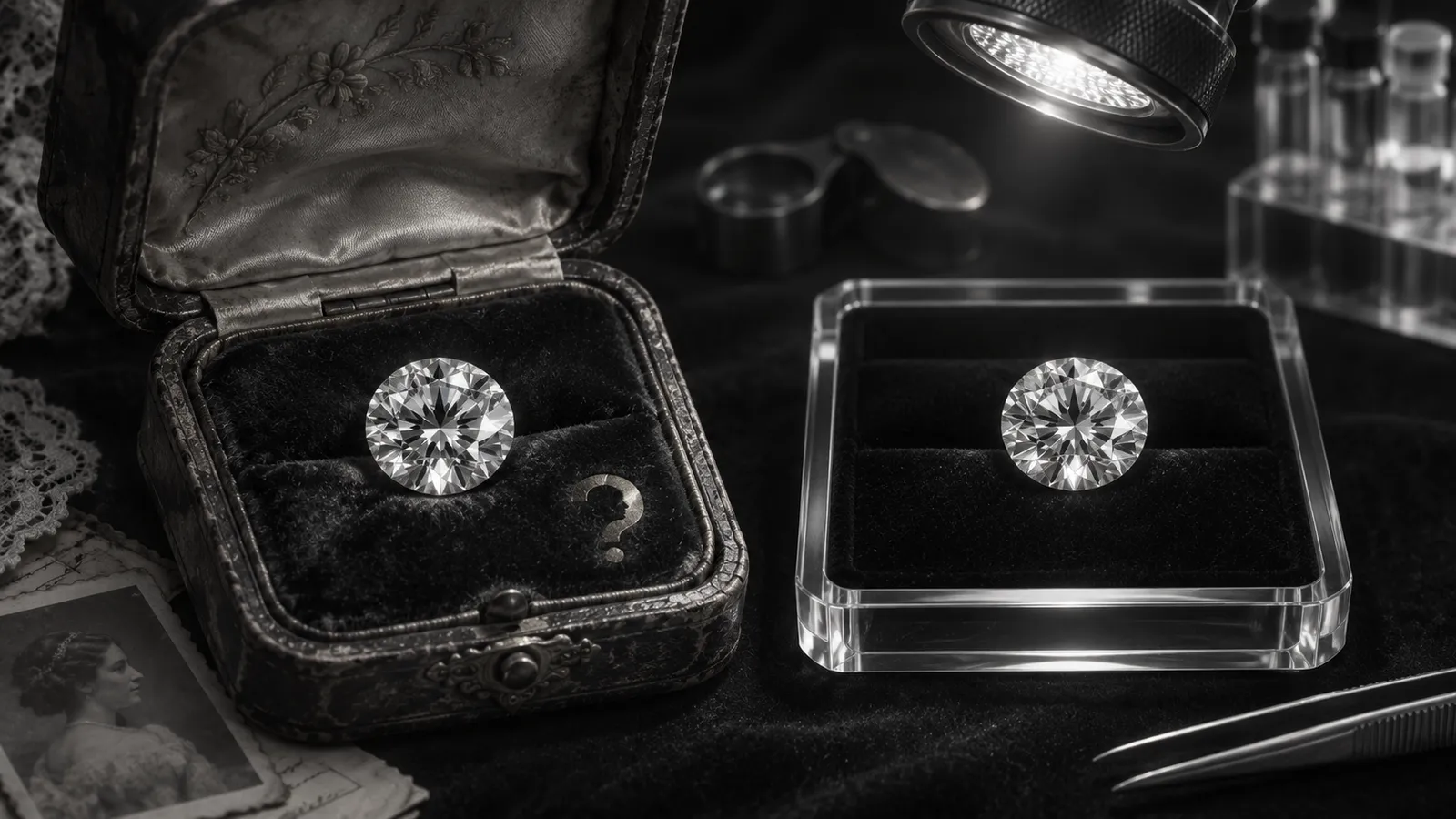
How beliefs about origin, making time and custom shape the sense that a lab-grown stone is worth less, and why the feeling varies from person to person.
Answer to the question
Why do lab-grown diamonds feel less special?
Lab-grown diamonds can feel less special because value follows an object's history as well as its looks. Experiments on originals and duplicates show people prize a unique making and a physical link to its source, and a long process reads as worth. A stone grown in weeks tells a different story from one formed deep underground.
Key takeaways
- A major gem-grading laboratory describes natural and lab-grown diamonds as having essentially the same chemical, physical and optical properties, while natural stones formed over very long spans and lab-grown stones typically grow in under a month.
- In five experiments, Newman and Bloom found support for two beliefs behind the premium on originals over perfect duplicates: that an original is a unique act of creation, and that an object keeps a physical link to its maker.
- Two preregistered replications of the effort heuristic, with 1,405 participants, supported the effect on liking and perceived quality in one attempt and found no effect on monetary value (Ziano and colleagues, 2023).
- Michael Morris's Tribal places the diamond engagement ring among customs that came to feel ancient well after they began.
- Newman and Dhar found that people more sensitive to contagion rated products from an original factory as more authentic and valuable, so the pull of origin varies from person to person.
A gem carries two things, its looks and its history. Lab-grown diamonds feel less special to many people because value follows the second as well as the first. A stone grown in a lab over days or weeks tells a different story from one formed deep underground over as long as 3 billion years, a span too long to picture. Experiments on paintings and products show how that works when two objects look the same: people assign worth to where an object came from, how it was made and the customs around it, even when nothing visible separates the copy from the original.
Why lab-grown diamonds can feel less special
A major gem-grading laboratory describes natural and lab-grown diamonds as having essentially the same chemical, physical and optical properties. Both are carbon in a cubic crystal structure, and the differences between them can be found only by trained gemologists using specialised equipment. Where the two part ways is in how they came to exist, and that is what the experiments below concern: beliefs about origin, not measured properties. The same source places the formation of natural stones deep in the earth, in some cases up to three billion years ago, while lab-grown stones typically take less than a month to grow at most sizes.
That gap is the opening for an effect that has been tested on art. George Newman and Paul Bloom asked why an original painting is worth more than a perfect duplicate. In five experiments, participants read scenarios in which an original object was copied, with the kind of object and the circumstances of the copy varied.
The results supported two beliefs. One is that an original is a unique act of creation. The other is that an object keeps a physical link to the person who made it, which the authors call contagion. They conclude that the gap between originals and duplicates comes from everyday beliefs about what art is, and not from attachment to particular kinds of art or to famous forgery cases.
Paintings and furniture were the objects tested. Carried over to gems, the pattern gives a mined stone a one-of-a-kind formation and a physical link to the ground, and gives lab-grown diamonds, however alike to the eye, a different origin. A buyer weighing lab-grown diamonds against mined ones may therefore be comparing two stories more than two stones. The same logic runs through Why Do Celebrity Objects Sell for More, where the premium attaches to contact with a person, and through Why We Pay More for Handmade, where the machine copy sits on the other side of the contrast.
Why a long making counts
People also read effort and time into value, and that bears on how lab-grown diamonds are judged. In 2004 Justin Kruger and colleagues proposed an effort heuristic: the more effort a producer is believed to have invested, the higher the judgments of a product's quality and money value. In 2023 a team led by Ignazio Ziano ran two preregistered replications of the first two experiments with 1,405 participants from the United States: one supported the original's second experiment but not its first, and the other gave mixed results, with liking and perceived quality holding and monetary value not.
Geological time is not a producer's effort, so the fit with diamonds is loose. What may carry over is the habit of treating a long, hard-to-repeat process as a sign of worth. The replications suggest that habit shapes how much people like and rate an object more reliably than how much they say they would pay. A stone with a story measured in ages and one of the lab-grown diamonds with a story measured in weeks can therefore be rated differently, and the rating can move apart from the price, which is shaped by many other things.
This is why the way a stone's making is described is not a trivial detail. A story about slow formation underground and a story about controlled growth in a laboratory are both accurate, and each invites a different reading of what went into the object.
Customs that age an object
Culture adds another layer. In Tribal, Michael Morris places the diamond engagement ring among customs that came to feel ancient well after they began, using the historian Eric Hobsbawm's term invented traditions. His wider point is that a sense of long standing can be built within a generation and then bind people as firmly as a custom that really is old. The feeling that a mined stone belongs to a very old ritual is, on this account, partly a cultural layer. Cultural layers can form around new things too.
None of this says that one kind of stone is better or worse than the other. It says that part of what a buyer feels comes from layers of meaning that culture has laid down, and that those layers differ in age.
Whether a stone also tells onlookers something about its wearer is a separate question, taken up in What the Luxury Label Actually Buys. The belief described here concerns the object's own history, which matters even when nobody else sees it. Three beliefs can sit behind the same feeling, and each can be separated with a simple question:
- Origin: does the formation of the stone matter beyond how it looks?
- Time: would a longer making story change how highly it is rated?
- Custom: is the appeal the object itself or the ritual it belongs to?
Why buyers feel it differently
The strongest evidence that the feeling is a belief, and not a fact about the stone, comes from work on products. George Newman and Ravi Dhar found that consumers who believe in contagion treat a company's original factory as the place where a brand's essence sits. Products made there were rated as more authentic and more valuable than identical products made elsewhere. Because the products were identical, the only difference was where they were made, which makes the result a test of belief and not of quality. People more sensitive to contagion showed the effect more strongly, and bringing the idea of contagion to mind raised preference for products from the original factory.
In the factory studies the effect grew with a person's sensitivity to contagion and rose when the idea was brought to mind.
Common questions
Why do lab-grown diamonds feel less special?
Lab-grown diamonds can feel less special because value follows an object's history as well as its looks. Experiments on originals and duplicates show people prize a unique making and a physical link to its source, and a long process reads as worth. A stone grown in weeks tells a different story from one formed deep underground.
Are lab-grown and natural diamonds the same material?
A major gem-grading laboratory describes them as having essentially the same chemical, physical and optical properties, with differences detectable only by trained gemologists using specialised equipment. The research in this article concerns beliefs about origin, not measured properties of the stone.
Does everyone feel this way?
No. In work on products, people more sensitive to contagion showed the effect more strongly, so the strength of the feeling varies from person to person.
Is this buying or valuation advice?
No. It describes research on perception. Prices depend on many factors beyond the ones covered here, and a buyer's own priorities decide what matters.
Sources
Morris, M. Tribal. Seed book; vault hub Books/Tribal.
Newman, G. E., & Bloom, P. (2012). Art and authenticity: The importance of originals in judgments of value. Journal of Experimental Psychology: General, 141(3), 558-569. doi:10.1037/a0026035 https://doi.org/10.1037/a0026035
Newman, G. E., & Dhar, R. (2014). Authenticity is contagious: Brand essence and the original source of production. Journal of Marketing Research, 51(3), 371-386. doi:10.1509/jmr.11.0022 https://doi.org/10.1509/jmr.11.0022
Ziano, I., Yeung, S. K., Lee, C. S., Shi, J., & Feldman, G. (2023). The effort heuristic revisited: Mixed results for replications of Kruger et al. (2004) Experiments 1 and 2. Collabra: Psychology, 9(1). doi:10.1525/collabra.87489 https://doi.org/10.1525/collabra.87489
Gemological Institute of America (2019, May 31). Is there a difference between natural and laboratory-grown diamonds? https://www.gia.edu/gia-news-research/difference-between-natural-laboratory-grown-diamonds