Why Do We Buy to Fit In and Stand Out
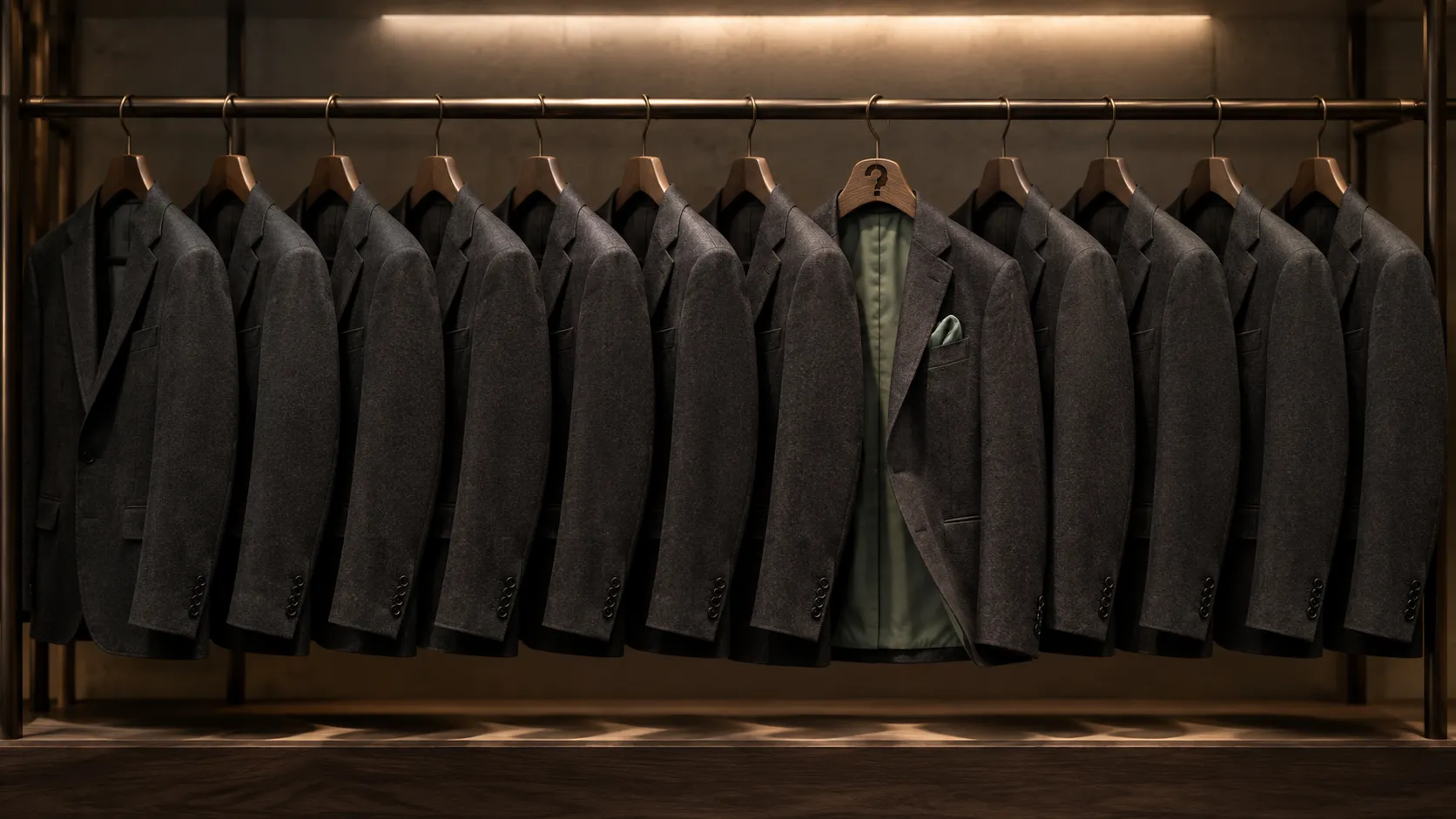
Jonah Berger's Invisible Influence says people want to belong and to be different at once. The studies behind it suggest shoppers do not split the difference. They copy the group on one attribute and depart on another.
Answer to the question
Why do we buy to fit in and stand out?
People hold two needs at once, to belong and to be distinct, and a single purchase can serve both. Chan, Berger and Van Boven (2012) report that shoppers match their group on attributes that signal identity, such as brand, and differ on others, such as colour.
Key takeaways
- Berger (2016) reports that observers placed blurred outfit photographs in the right one of two Princeton eating clubs 85 per cent of the time, while students who cared more about being different stood out further inside their club.
- Brewer (1991) proposed that social identity balances two opposing needs, to belong and to be distinct, and reported a laboratory experiment in which group size and depersonalisation together shaped identification.
- Chan, Berger and Van Boven (2012) report four studies in which shoppers matched their group on identity-signalling attributes such as brand and differed on others such as colour, and those with a stronger need for uniqueness chose less popular options within the group's range.
- Hornsey and Jetten (2004) set out eight strategies for reconciling the two needs, four by making the group distinctive and four by differentiating inside it.
- The book's car experiment has no citation of its own and the pages give no sample sizes for either study, so the account is the author's.
At each of two Princeton eating clubs, students dressed alike without dressing identically, and the ones who cared most about being different wanted to stand out further.
Most of us want to belong and want to be different, and a single purchase is expected to deliver both. The study is the chapter's evidence that people do fit in and stand out at the same time. How one choice can answer two pulls in opposite directions is the question the evidence has to settle.
What Blurred Princeton Photographs Showed
Jonah Berger describes the study in his book Invisible Influence. He and his co-authors picked two clubs that look different. Cottage is traditional and selective, and the book describes its members as preppy. Terrace admits members by lottery and leans alternative, with Chuck Taylors and vintage clothes.
Students were paid five dollars to complete a short survey and be photographed head to toe. The team then blurred everything except the clothes, so that even close friends would have struggled to recognise one another. A few days later, the students who had completed the survey saw other people's photographs one at a time and chose Cottage or Terrace. They chose correctly eighty-five times in a hundred, where guessing between two clubs would be right about half the time.
Inside each club, nobody dressed identically. Cottage members mostly dressed preppy, but some wore lighter khakis and others darker. Terrace members wore ripped jeans, some blue and some black. The book reports that students who said they cared more about being different wanted to stand out further, with examples such as a T-shirt in an unusual dragon pattern or lace fringe on a preppy skirt. They still looked enough like their club for observers to place them.
People copy the group on some features and set themselves apart on others.
Any result like this has two rival explanations, and Berger raises both, one of them in a full-page footnote. Preppy students might simply choose Cottage, so that matching dress reflects who joined rather than any influence between members. Or the clubs might carry norms about what to wear. The chapter answers with a follow-up on a different campus.
Respondents chose between a grey or blue Mercedes and a grey or blue BMW, and between backpacks. Some saw what looked like an earlier respondent's pick, which had in fact been filled in at random. Those who saw a grey Mercedes chosen tended to choose the blue Mercedes, and those who saw a blue BMW chosen tended to choose the grey one. The chapter sums this up as choosing the same brand in a different colour. Its notes cite the eating-club work to a 2012 journal paper and give the car experiment no citation of its own, and the pages give no sample sizes for either study.
Brewer's Theory Behind "Optimally Distinct"
The heading for this part of the chapter is "Optimally Distinct". That is the name of a theory Marilynn Brewer set out in 1991, in a paper titled The Social Self: On Being the Same and Different at the Same Time. It is not among the chapter's notes.
Brewer argued that social identity balances two opposing needs, to belong and to be distinct. People avoid self-definitions that are too personal or too inclusive, and they identify most strongly with categories that offer both [belonging and distinctiveness](https://thewhyweproject.com/articles/why-do-we-need-to-belong). Her paper reports a laboratory experiment in which group size and depersonalisation together shaped how strongly people [identified with a group](https://thewhyweproject.com/articles/what-is-group-identification). Someone who wants to stand out still needs a category to stand out from.
Berger reaches the same word by another road. The chapter's Goldilocks effect says liking tends to rise and then fall as something becomes more familiar, so that new things catch on when they are similar enough to feel familiar and novel enough to feel new. That is a claim about how alike an object is to what people already know. Brewer's concerns which group a person identifies with. Both are called optimal, and the middle of a scale is the main thing they share. Brewer and colleagues published a longer statement of the theory in 2010.
Is the Answer a Point on a Dial?
The word optimal suggests a dial with a best setting in the middle, neither too similar nor too different. The consumer study that the chapter's notes cite points somewhere else. Cindy Chan, Berger and Leaf Van Boven report four studies in which consumers pursued assimilation and differentiation goals at the same time, on different dimensions of a single choice. People matched their group on attributes that signal identity, such as brand, most of all in categories where identity is on show, such as clothing. They differed on attributes that signal uniqueness, such as colour.
A stronger need for uniqueness led people to pick less popular options among the ones their group typically chooses, so the shopper who wants to stand out stays inside the group's range.
The paper's press release adds that people concerned with signalling identity favoured the brand most in-group members preferred, and avoided a brand preferred by a group they did not want to be mistaken for. Its example is a snowboarder who wears a Burton jacket, which marks the wearer as a snowboarder rather than a skier, in an unusual pattern.
People can follow the crowd on one feature of a purchase and differ on another in the same choice.
On that reading, the eating-club photographs and the car choices show the same thing. In the photographs, the preppy or alternative look is the identity attribute and the shade of the khakis is free to vary. In the car choices the brand holds and the colour moves. The three accounts differ in what each one varies. Brewer's concerns the group, the Goldilocks effect concerns the object, and the 2012 studies concern one attribute of a choice while the others hold.
How Researchers Reconcile the Two Needs
The tension has a literature of its own.
Social identity theorists had traditionally treated differentiating oneself within a group as harmful to identification with it. Matthew Hornsey and Jolanda Jetten, in a 2004 review in Personality and Social Psychology Review, propose eight strategies that reconcile the two needs without breaking social identity principles. Four draw on optimal distinctiveness theory and resolve the tension by making the group itself distinctive. The other four let individuals set themselves apart inside the group while still identifying with it.
Brewer's 1991 test concerned group size, and the consumer studies concern the attributes of a choice. The consumer evidence therefore supports the two-needs claim directly and the middle-of-the-dial claim only by analogy. The eating-club result is also a field study of two clubs on one campus, where the book concedes that matching dress could reflect who joined.
The Princeton students fit both camps. Choosing Cottage or Terrace is a choice of a group whose look is distinctive on campus, and the khaki shades and dragon shirts are differentiation inside it. That is how one person can fit in and stand out within a single club, on my reading, since the study does not report this mapping.
The authors suggest, in the press release, that the same tension may appear outside shopping, in an employee who wants to belong to a team and hold a distinct role, or a politician who follows the party line while voicing a view of their own.
For consumer choices, the finding offers a way to read what people do. A group's identity usually lives in a few attributes, the brand, the cut, the look, and members keep those steady. The room to differ is in what the group does not use to identify itself. A seller who wants customers to fit in and stand out can keep the identity-bearing features recognisable and give buyers something free to vary, such as colour or pattern. The abstract describes choices and tests no product strategy, so treat this as a reading.
A shopper can read a basket the same way. Some items mark membership, and one lets the person stand out. The same shopper copies on one attribute and departs on another, and which is which depends on what the group leaves open for people to choose.
Common questions
Why do we buy to fit in and stand out?
Brewer's 1991 theory says people hold two opposing needs, to belong and to be distinct. Chan, Berger and Van Boven (2012) report that shoppers meet both in one choice, matching their group on identity-signalling attributes such as brand and differing on others such as colour.
Did the Princeton eating-club study prove it?
It shows a pattern. Students from two clubs dressed alike within each club but not identically, and observers placed them correctly 85 per cent of the time. The book itself notes that matching dress could reflect who joined each club, which is why it describes a follow-up with an apparent earlier respondent's pick.
Who first proposed optimal distinctiveness theory?
Marilynn Brewer, in a 1991 paper in Personality and Social Psychology Bulletin titled The Social Self: On Being the Same and Different at the Same Time. Invisible Influence uses the idea under the heading "Optimally Distinct" and cites Chan, Berger and Van Boven (2012) for the experiments.
Sources
Berger, J. (2016). Invisible Influence: The Hidden Forces That Shape Behavior. New York: Simon & Schuster. Seed book; vault hub Books/Invisible Influence.
Brewer, M. B. (1991). “The social self: On being the same and different at the same time.” Personality and Social Psychology Bulletin, 17(5), 475-482. doi:10.1177/0146167291175001 https://doi.org/10.1177/0146167291175001
Chan, C., Berger, J., & Van Boven, L. (2012). “Identifiable but not identical: Combining social identity and uniqueness motives in choice.” Journal of Consumer Research, 39(3), 561-573. doi:10.1086/664804 https://doi.org/10.1086/664804
Hornsey, M. J., & Jetten, J. (2004). “The individual within the group: Balancing the need to belong with the need to be different.” Personality and Social Psychology Review, 8(3), 248-264. doi:10.1207/s15327957pspr0803_2 https://doi.org/10.1207/s15327957pspr0803_2
Leonardelli, G. J., Pickett, C. L., & Brewer, M. B. (2010). “Optimal distinctiveness theory.” Advances in Experimental Social Psychology, 43, 63-113. doi:10.1016/S0065-2601(10)43002-6 https://doi.org/10.1016/S0065-2601(10)43002-6
University of Chicago Press Journals (2012). “Can consumers fit in yet remain unique?” Press release on Chan, Berger and Van Boven (2012), 16 May 2012, as carried by ScienceDaily. https://www.sciencedaily.com/releases/2012/05/120516140115.htm