Why do we overspend on Black Friday?
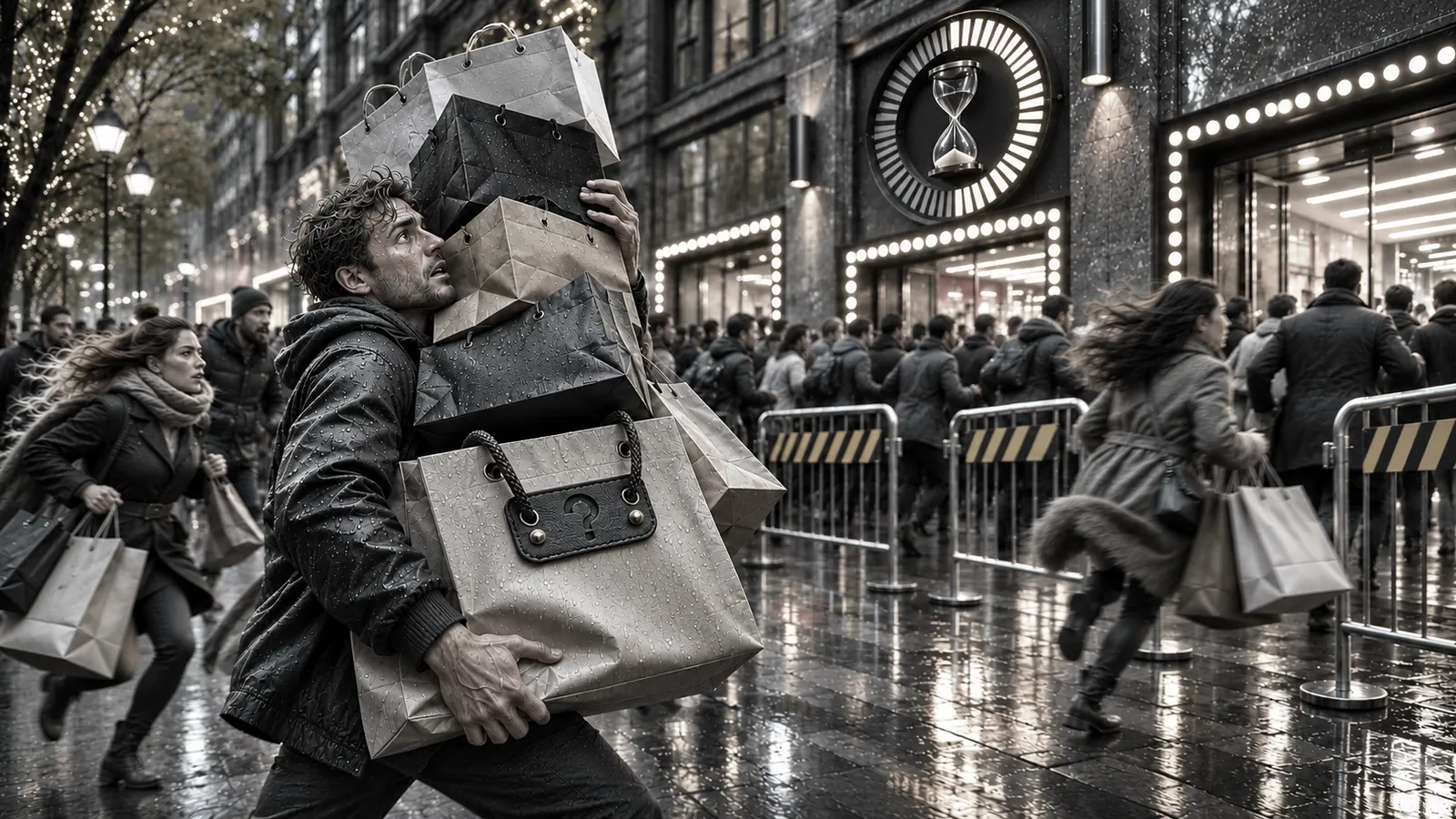
What auction experiments, a shopper survey and Robert Cialdini's work on scarcity say about why a sale day lifts spending, and what a shopper can settle in advance.
Answer to the question
Why do we overspend on Black Friday?
We overspend on Black Friday because excitement, rivals, scarce stock and the savings frame raise spending without being noticed. In auction experiments with real money, arousal from outside the auction raised bids, and bidders did not report that it had. A comparison made beforehand helps.
Key takeaways
- In three real-money experiments, bidders aroused by a competitive task, a writing task or images and music bid more than comparison groups (Adam, Ku and Lux, 2019).
- In the third experiment, bidders rated the earlier arousal task as having very little effect on their bids, and none mentioned their emotions.
- Robert Cialdini's Influence reports that scarce cookies were rated more desirable but not tastier, and suggests asking whether you want an item to use it or only to have it.
- In a survey of 225 US consumers, respondents liked the in-store experience of Black Friday and were more likely to shop on Cyber Monday for convenience (Swilley and Goldsmith).
- Online auction studies suggest buyers can overpay for widely available goods, so a price comparison made beforehand still matters (Ariely and Simonson, 2003).
A jar of one-penny coins worth 82 pence drew average bids of 90 pence from people who had just seen vivid images with energetic music, against 81 pence from people who had seen calm ones. None of the bidders named the images as a reason. Keep that in mind when asking why we overspend on Black Friday, a day built from a clock, rivals and constant stimulation.
Excitement that has nothing to do with the thing for sale still raises what people will pay for it. That is the finding of three experiments by Marc Adam, Gillian Ku and Ewa Lux, run with real money and published in 2019. In one, arousal came from a fast task with competition and time pressure, in another from a writing task that set people against their own views, and in the third from images and music. Bidders bid more each time. Those in the third experiment rated the earlier task as having very little effect on their bids.
Why do we overspend on Black Friday?
Shoppers who overspend are not usually weak at arithmetic, and there is no single cause. Robert Cialdini's Influence treats scarcity as a lever with two sources: a limited thing is read as a better thing, and a thing that others are chasing is wanted more. In the cookie experiments he reports, cookies made scarce were rated as more desirable and more costly, though not as tastier, and the pull was stronger when scarcity was newly created and when buyers competed for the item. A doorbuster shelf with a handful of units and a queue beside it supplies all of that at once, and the shopper who overspends there is responding to the setting as much as to the price.
Newly created scarcity is the form a sale day produces most often. An item sits on the shelf all week, then a stock count appears or a trolley empties, and the same item is suddenly one of few. In Cialdini's account that change carries more pull than a shortage that was always there, and watching others take the item adds to it. The shopper does not need to believe the item is better for the feeling to do its work. Seeing it go is enough to make it matter. A half-empty shelf, a visible stock count or a queue at the till all draw on the same lever, and each can start the feeling before any price is read.
Cialdini offers a test that fits the arousal finding. He suggests asking whether you want the item to use it or only to have it, and he concedes that knowing how scarcity works is not enough protection, because the surge of urgency suppresses careful thought. His answer is to treat the surge itself as the cue to stop before it turns into overspending. The bidders in the 2019 experiments show why that cue matters: they did not register the arousal that moved their bids.
What does the day itself add to the cart?
The first of the 2019 experiments shows what the arousal looked like in practice. Participants spent ten minutes on a symbol-matching task. In the high-arousal version they had seven seconds per decision, lost points for slow answers, competed for cash prizes and heard energetic music. In the calm version the music was soothing, decisions had twice the time and pay did not depend on performance. The high-arousal group bid more. A sale day offers a clock, rivals and sound in much the same combination.
Black Friday is an event people choose to attend, and the survey evidence is consistent with its being enjoyed. Esther Swilley and Ronald Goldsmith asked 225 consumers in the United States whether they would shop in stores or online on Black Friday and on Cyber Monday. Respondents liked the in-person experience of Black Friday, and they were more likely to shop on Cyber Monday because it was more convenient. A reasonable reading is that an outing enjoyed for its atmosphere has no natural stopping point, so people who came to take part can overspend without ever deciding to.
The savings frame travels with the day. A reduced price feels like money gained, the bookkeeping explained in What is mental accounting, and a gain in one pocket is easy to spend from another. The same saving also feels larger on a cheap item than on a dear one, a pattern of relative thinking taken up in Why We Drive Across Town to Save a Little. Neither pull needs a bad plan to make a household overspend. Both work on an ordinary plan met in an unusual setting.
| Pull on the day | What the research reports | A question to ask before paying |
|---|---|---|
| Rivals and a ticking clock | Arousal from competition and time pressure raised bids in real-money experiments | Would I want this at the same price on a quiet Tuesday? |
| Scarce stock | Items made scarce were rated more desirable, not better, in the experiments Cialdini reports | Do I want it to use or only to have? |
| Enjoyment of the event | Consumers said they liked the in-store experience of the day | Did I come for this item or for the atmosphere? |
| A price marked as a bargain | Buyers overpaid for widely available goods in online auctions | What does it cost elsewhere, found before today? |
Is a deal always a low price?
Dan Ariely and Itamar Simonson studied online auctions as a setting where buyers meet many signals of value at once. Their preliminary field studies suggested that buyers searched narrowly and overpaid for widely available goods such as CDs and DVDs, and that high starting prices raised winning bids mainly when comparable items were hard to find. The lesson for a sale is modest. A price marked as a bargain does not remove the need to compare, and a comparison is cheapest to make before the excitement starts.
Auction bidders show the pattern most clearly, as Why the Auction Winner Often Overpays sets out, and a crowded shop has rivals and a clock of its own. The weight of a countdown itself is less clear: in the one controlled test described in What a Countdown Timer Adds to a Sale, the markdown carried the effect and the timer added little. That points back to the price and the setting as the parts worth examining for anyone who wants to avoid overspending on the day.
What helps before the doors open?
Preparation works on the part of overspending that arousal leaves alone. A list narrows the spend without ending it, because the evidence in Why Impulse Buys Happen Without a List shows that lists cover only part of what shoppers go on to buy. Whether the fear of missing out lifts buying is still unsettled, as Fear of Missing Out at the Till shows, which is why the arousal findings carry more weight here than any single feeling.
The practical gain is in timing. Decisions about what the household wants, and what it already pays elsewhere, can be made at a table with no music and no queue. None of the experiments tested this step, but a want settled in advance, away from the tasks, images and sound that aroused their bidders, is the one least exposed to the same pull.
Common questions
Why do we overspend on Black Friday?
Excitement, rivalry, scarce stock and the savings frame all raise spending without being noticed. In auction experiments with real money, arousal from outside the auction raised bids, and bidders did not report that it had.
Does excitement really change what people pay?
In three experiments published in 2019, bidders who had been aroused by a fast competitive task, a writing task or images and music bid more than comparison groups.
Is a Black Friday price always a bargain?
Not by default. Online auction studies suggest buyers can overpay for widely available goods, so a comparison made beforehand still matters.
How can shoppers keep spending closer to plan?
Cialdini suggests asking whether the item is wanted to use or only to have, and treating a surge of urgency as the cue to stop. Deciding in advance, away from the crowd, keeps the choice out of the setting.
Sources
Cialdini, R. B. Influence: The Psychology of Persuasion (New and Expanded). Seed book; vault hub Books/Influence.
Adam, M. T. P., Ku, G., & Lux, E. (2019). Auction fever: The unrecognized effects of incidental arousal. Journal of Experimental Social Psychology, 80, 52-58. doi:10.1016/j.jesp.2018.07.009 https://doi.org/10.1016/j.jesp.2018.07.009
Swilley, E., & Goldsmith, R. E. (2013). Black Friday and Cyber Monday: Understanding consumer intentions on two major shopping days. Journal of Retailing and Consumer Services, 20(1), 43-50. doi:10.1016/j.jretconser.2012.10.003 https://doi.org/10.1016/j.jretconser.2012.10.003
Ariely, D., & Simonson, I. (2003). Buying, bidding, playing, or competing? Value assessment and decision dynamics in online auctions. Journal of Consumer Psychology, 13(1-2), 113-123. doi:10.1207/s15327663jcp13-1&2_10 https://doi.org/10.1207/s15327663jcp13-1&2_10