Why We Want the Food We Banned
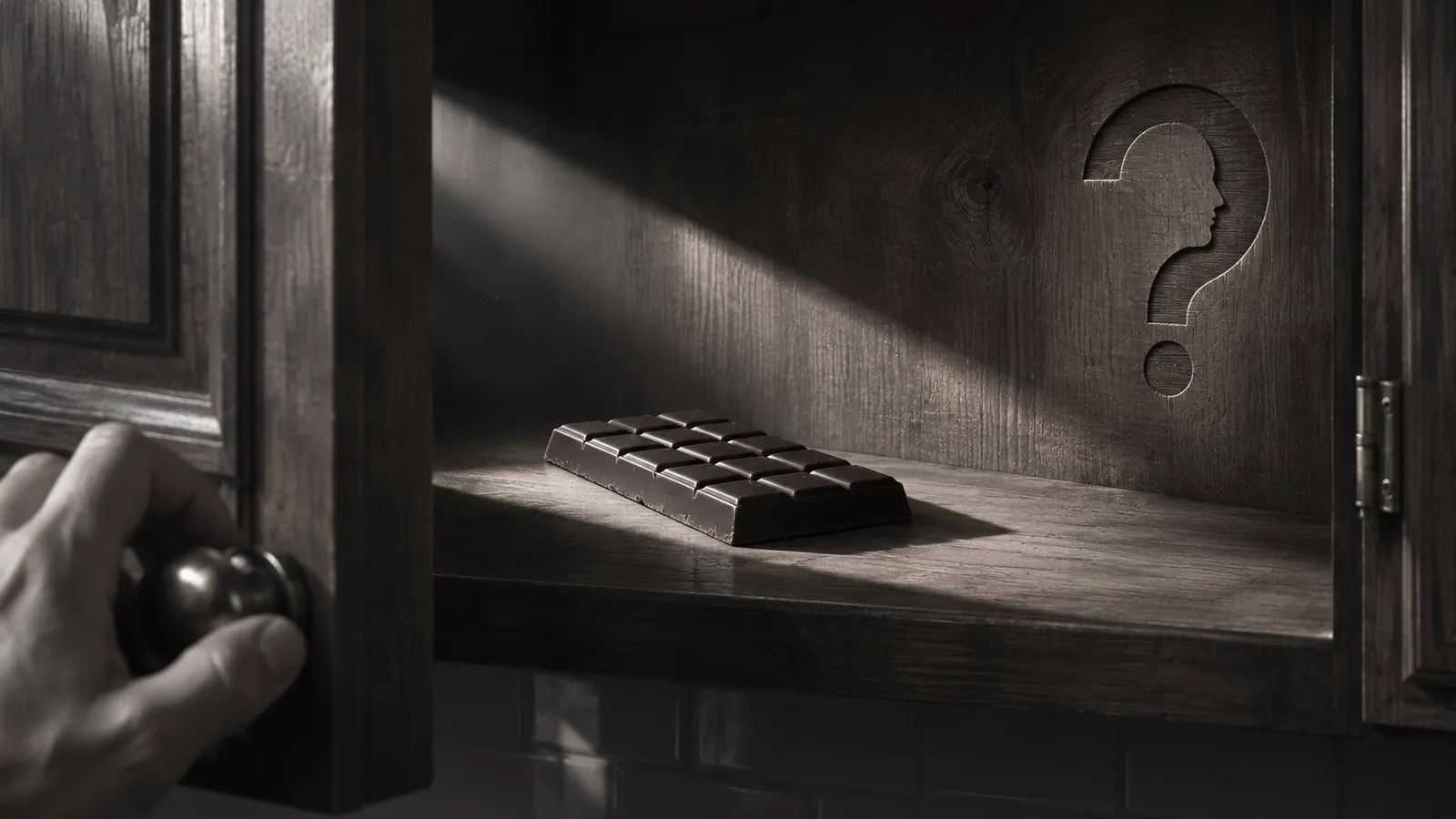
One body of research says a banned food grows louder. Another says it slowly goes quiet. The two are measuring different weeks of the same ban.
Why does cutting out a food make you crave it more?
Cutting out a food can raise food cravings in the short run, especially for people who habitually hold back: a week without chocolate led restrained eaters to eat more of it. Over months the pattern often reverses, and long diet trials found cravings fell most for the foods people stopped eating, which researchers explain as learned cue links weakening.
Key takeaways
- Women students who gave up chocolate for a week ate more of it in a later taste test, but only if they were restrained eaters (Polivy and colleagues, 2005).
- Limiting young children's access to a tasty snack increased their responses to it, and in one experiment raised how much of it they chose and ate (Fisher and Birch, 1999).
- Five minutes of trying not to think about chocolate was followed by more chocolate eaten, in adults who were not dieting (Erskine, 2008).
- Over a two-year trial, adults cutting carbohydrate reported larger falls in cravings for starchy and sugary foods, and adults cutting fat for fatty foods (Martin and colleagues, 2011).
- A pooled review of eight studies lasting twelve weeks or more found food cravings fell during calorie restriction, explained as de-conditioning (Kahathuduwa and colleagues, 2017).
Two groups of researchers give opposite answers to the same question about food cravings. One finds that a food put off limits looms larger: told to go without chocolate for a week, people who habitually hold back from food ate more of it once it returned, and children kept from a snack wanted it more. The other finds that a food no longer eaten slowly goes quiet, because the cues that used to summon it stop being followed by the food. Both groups have careful experiments behind them, and they are less at odds than they look. The gap between them is mostly a matter of how long the food has been gone.
Why a banned food grows louder in the first week
A week without chocolate did different things to different people. Janet Polivy and her colleagues at the University of Toronto asked about a hundred women students to give up chocolate, give up vanilla, or carry on as normal for seven days. Chocolate was chosen because little else stands in for it, vanilla because plenty does. At the end of the week everyone sat a taste test with chocolate on the table.
The women who had given up chocolate ate more of it, but only if they were restrained eaters, people who habitually hold back from food. Restrained eaters in the same study also reported more food cravings in general and were more likely to eat the foods they craved. The authors concluded that deprivation produces food cravings and overeating, chiefly in people already used to holding back.
Children show the same pull with no diet anywhere in the picture. Jennifer Orlet Fisher and Leann Birch ran two experiments in which young children's access to a tasty snack food was limited. Restriction increased the children's responses to the restricted food in both experiments, and in the second it also raised how much of that food they chose and ate in the setting where it had been limited. The authors read the result as restriction drawing attention to a food and heightening the wish for it.
That reading sits close to reactance, the push back people feel when a freedom is taken from them. Reactance: Why a No Makes You Want It shows how a rule can raise the value of the very option it removes, because the rule itself marks the option as worth wanting. A food ban is an unusually personal rule. It is renewed at every meal and every shop counter, so the reminder of the lost freedom arrives several times a day.
When food cravings fade over months of going without
Long diets studied over months tell a different story. In a trial lasting two years, Corby Martin and colleagues followed nearly three hundred adults in a weight-loss study, assigned either to a diet low in carbohydrate or to one low in fat, and tracked food cravings by type of food. The group cutting carbohydrate showed larger falls in cravings for starchy and sugary foods. The group cutting fat showed larger falls in cravings for fatty foods. Each group's larger fall was in cravings for the type of food it had been asked to avoid, and the authors concluded that diets restricting a type of food reduce cravings for that food.
A wider review pointed the same way. Chanaka Kahathuduwa and colleagues pooled eight studies in which adults with obesity ate fewer calories for at least twelve weeks and rated their food cravings before and after. Overall food cravings fell, and so did cravings for sweet, fatty, starchy and fast foods taken separately, with sweet cravings showing the largest fall in the pooled results.
The authors read this as support for de-conditioning. On this account, food cravings are partly learned: a place, a time of day or a feeling has been paired with a food again and again until the cue alone sets off the wanting. Take the food away for long enough and the pairing weakens, because the cue keeps arriving with nothing after it. Why do we crave sugar describes how those cue links form in the first place, through repetition in a familiar setting. The restriction trials supply the other half of the story, that links built by repetition can also loosen once the repetition stops, and that the loosening is specific to the food that went missing.
Set side by side, five studies split on time
The two camps rarely contradict each other on the same ground, so the real dispute is about conditions. Their studies differ in who took part, what was held back and how long the absence lasted, and those differences line up closely with which result appeared.
| Study | What was held back | Who took part | What happened to the wanting |
|---|---|---|---|
| Polivy and colleagues | Chocolate, or vanilla, for one week | Women students, restrained and unrestrained eaters | Chocolate eaten afterwards rose among restrained eaters only |
| Fisher and Birch | A tasty snack food | Young children | Responses to it rose; choice and intake rose in the second experiment |
| Erskine | Thoughts of chocolate, for five minutes | Adults not on a diet | Chocolate eaten afterwards rose |
| Martin and colleagues | Carbohydrate, or fat, over two years | Adults in a weight-loss trial | Cravings fell most for the restricted type of food |
| Kahathuduwa and colleagues | Calories, for twelve weeks or more | Adults with obesity, eight studies pooled | Food cravings fell overall and for each food type measured |
The short studies found the wanting or the eating going up; the long ones found cravings going down. The shortest is the most striking. James Erskine asked adults who were not dieting to spend five minutes speaking their thoughts aloud while trying not to think about eating chocolate, then gave them chocolate in what they believed was a taste test. Men and women alike ate more than a group who had simply spoken their thoughts. The ban existed only in the head, which ties the food result to ironic process theory, the finding that a thought pushed away tends to return more often. His paper names the eating version behavioural rebound.
Who restricts matters as much as how long. The rise in the chocolate study appeared only among restrained eaters, while the falls in the trials came from people who had enrolled in a long programme of change. A week of private refusal and two years of structured change are different experiences, even when both are described as cutting a food out.
Does a fortnight separate the two answers?
Anna Lembke, in Dopamine Nation, offers a timeline that lets both camps be right. Her book argues that giving up a habitual pleasure is followed by a stretch in which the wanting grows louder before it eases, and she puts that stretch at roughly two weeks. The book is not about food, and the timeline is her argument rather than a measured result, so we borrow its shape and nothing more.
Set against the restriction studies, it fits well. A week without chocolate sits inside her difficult first fortnight, and a twelve-week or two-year diet sits far beyond it. On that reading, the deprivation studies and the de-conditioning studies are measuring different stretches of one curve, the rise at the start and the slow fall after.
On our reading, the curve also hints at why a ban can falter early. Inside the Abstinence Violation Effect describes how one lapse can turn a broken rule into an abandoned one, and on this timeline the first, louder stretch would be the hardest one for a rule to survive. The de-conditioning account adds that a food eaten in that stretch would renew the pairing between cue and food, the very link that needs time without the food to weaken.
Over the first days, cutting out a food tended to raise the wish for it, most clearly for restrained eaters. Over months, the same absence went with a quieter appetite for that food, in trials where the change was broad and sustained. None of these studies measured how long the louder stretch lasts for food, so Lembke's fortnight is a borrowed estimate rather than a finding.
Common questions
Why does cutting out a food make you crave it more?
In short studies it often does. Women who gave up chocolate for a week ate more of it afterwards if they were restrained eaters, and children whose access to a snack was limited responded more to it. Researchers link this to attention: a banned food is noticed more, and pushing thoughts of it away can bring them back.
Do food cravings fade if a food is no longer eaten?
In longer studies they often did. In a two-year trial, adults who cut carbohydrate reported larger falls in cravings for starchy and sugary foods, and a review of eight studies lasting twelve weeks or more found that overall food cravings fell during calorie restriction. Researchers explain this as learned cue links weakening once the food stops following them.
Is wanting a banned food the same as reactance?
They overlap. Reactance is the push back against a lost freedom, and it can raise the value of whatever a rule removes. Food restriction studies point to added attention and desire for the restricted food, which fits that idea, though they measure eating and craving rather than reactance itself.
Sources
Lembke, A. Dopamine Nation. Seed book.
Polivy, J., Coleman, J., & Herman, C. P. (2005). The effect of deprivation on food cravings and eating behavior in restrained and unrestrained eaters. International Journal of Eating Disorders, 38(4), 301-309. doi:10.1002/eat.20195 https://doi.org/10.1002/eat.20195
Fisher, J. O., & Birch, L. L. (1999). Restricting access to palatable foods affects children's behavioral response, food selection, and intake. The American Journal of Clinical Nutrition, 69(6), 1264-1272. doi:10.1093/ajcn/69.6.1264 https://doi.org/10.1093/ajcn/69.6.1264
Erskine, J. A. K. (2008). Resistance can be futile: Investigating behavioural rebound. Appetite, 50(2-3), 415-421. doi:10.1016/j.appet.2007.09.006 https://doi.org/10.1016/j.appet.2007.09.006
Martin, C. K., Rosenbaum, D., Han, H., Geiselman, P. J., Wyatt, H. R., Hill, J. O., Brill, C., Bailer, B., Miller, B. V., Stein, R., Klein, S., & Foster, G. D. (2011). Change in food cravings, food preferences, and appetite during a low-carbohydrate and low-fat diet. Obesity, 19(10), 1963-1970. doi:10.1038/oby.2011.62 https://doi.org/10.1038/oby.2011.62
Kahathuduwa, C. N., Binks, M., Martin, C. K., & Dawson, J. A. (2017). Extended calorie restriction suppresses overall and specific food cravings: a systematic review and a meta-analysis. Obesity Reviews, 18(10), 1122-1135. doi:10.1111/obr.12566 https://doi.org/10.1111/obr.12566
Related concepts
People
More articles
- Why We Hear Freshness
A bite is a burst of tiny cracks, and the ear reads them. Change the noise and the same crisp seems fresher or staler, while the food itself stays exactly as it was.
- Why Ads Forget the Over-Fifties
Older people feel younger than their years and respond warmly to adverts that speak to what they value. Two accounts explain why they still appear less often on screen.
- Why a Pay Rise Can Feel Bigger Than It Is
Why people read a pay rise by the number on it, what the research on money illusion shows, and the two readings of the habit: a bias and a shortcut.
- Why One Portion Feels Like the Right Amount
How treating one unit as the right amount shapes what people take, what three bodies of research show about pieces, packs and totals, and where sellers and kitchens set the unit.