Why We Hear Freshness
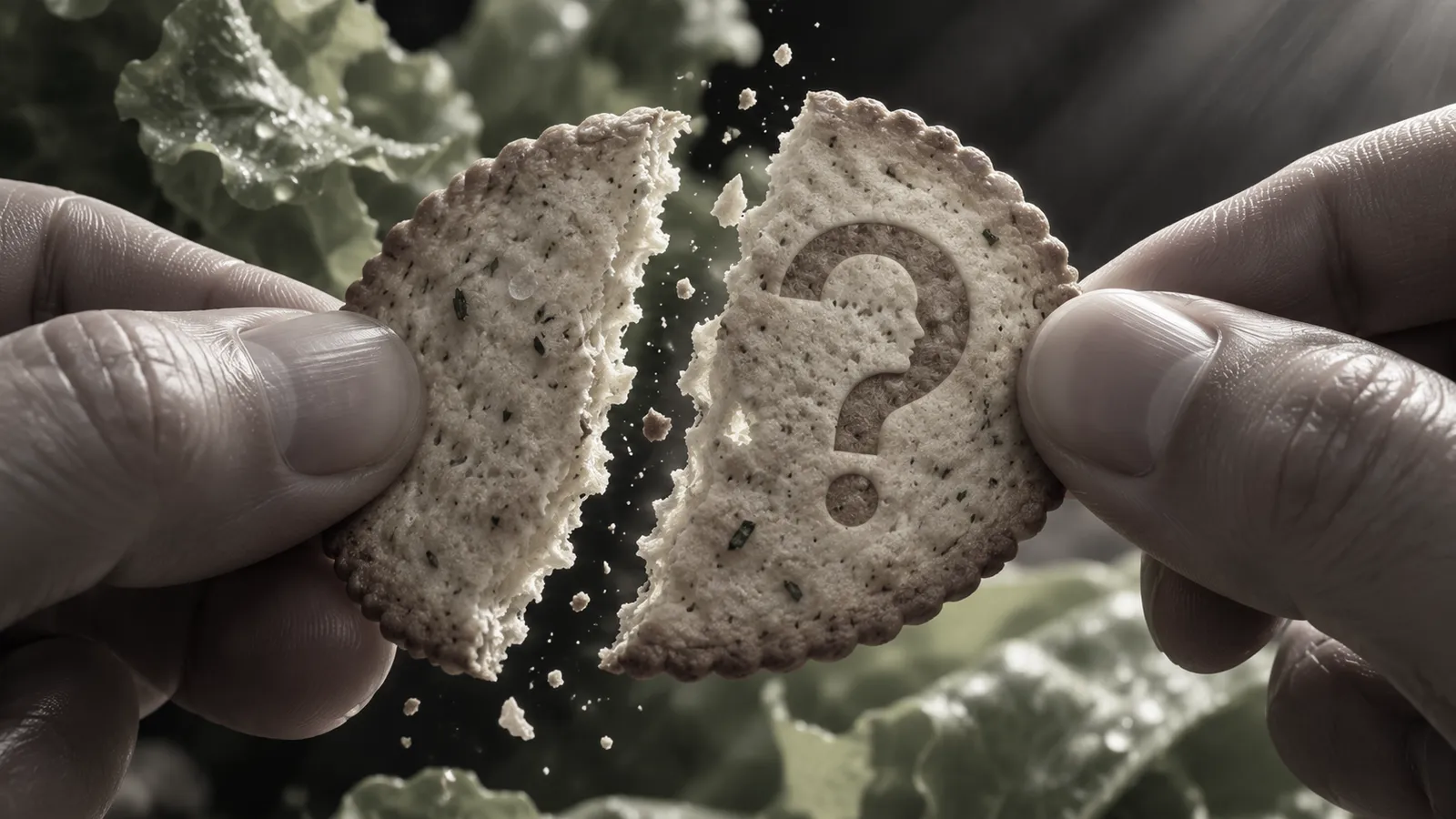
A bite is a burst of tiny cracks, and the ear reads them. Change the noise and the same crisp seems fresher or staler, while the food itself stays exactly as it was.
Does the sound of food change how it tastes?
Yes, most clearly for texture and freshness. In laboratory studies, the sound of food changed the verdict on the same snack: boosting the high-pitched part of a bite made crisps seem crisper and fresher, and turning the sound down made apples seem softer. Loud background noise also lowered ratings of sweetness and saltiness.
Key takeaways
- Crisp foods break into a rapid series of tiny cracks, and the noise they make is a large part of what people call crispness.
- Boosting the high-pitched part of a bite, between 2 and 20 kHz, made the same crisps seem crisper and fresher (Zampini and Spence, 2004).
- Turning the sound of a bite down made apples seem softer as well as less crisp, so hearing reaches hardness too (Dematté and colleagues, 2014).
- Sound changed how fizzy sparkling water seemed in the hand, but not with the water in the mouth (Zampini and Spence, 2005).
- Loud background noise lowered ratings of sweetness and saltiness while foods were rated crunchier (2011 study of background noise).
When teeth close on a dry biscuit, the tiny air cells inside it give way one after another, and each failure releases its own short burst of noise. That ragged string of cracks matters to the person eating. Across decades of laboratory work, the sound of food has shifted how crisp, how hard and how fresh a snack seems, often without the eater noticing that their ears were involved at all.
Crispness starts as a crack deep inside the food itself
Zata Vickers and Malcolm Bourne recorded people biting crisp foods such as vegetables, toast and biscuits. The sounds spread across a wide band of pitches, and their loudness rose and fell irregularly from moment to moment. To explain the pattern, the two researchers proposed a cellular model: as a brittle food is crushed, each cell or cell wall that ruptures adds one sound to a series. On their account, crispness is first of all something heard. Later work, gathered in a review by Charles Spence, separated the two words people use most: foods described as crispy give off strong high-pitched sound, while crunchy foods peak at lower pitches.
The noise travels to the inner ear by two paths, through the air and through the bones of the jaw and skull, and the ear reads loud, high-pitched bursts as crispness and lower, duller ones as crunch or softness. Every stage between the crack and that reading is a point where the sound of food can be altered, which is what made the idea testable.
Stuart Farrimond, in The Science of Flavour, describes flavour as something the brain builds from every sense at once, and in his account crunch is the cue that tells the eater a food is fresh. That places the heard crack inside flavour itself. If he is right, the sound of food is information about the food's condition, and changing the sound should change the verdict while the food stays exactly the same.
Brighter bites made the very same crisps seem fresher
Massimiliano Zampini and Charles Spence ran that test with crisps. Participants bit into them with their front teeth and rated either crispness or freshness, while the sound of each bite was fed back to them with its loudness or its pitch content changed. Raising the overall level made the crisps seem crisper and fresher. So did boosting only the high frequencies, between 2 and 20 kHz. Turning those frequencies down did the reverse, and the same crisps were judged staler and softer. The authors noted that people are often unaware that what they hear feeds into their verdict on a food.
The design kept everything else fixed: the same crisps, the same bite, the same rating scale. Only the sound reaching the ear changed, so any shift in judged freshness had to come through hearing. That is what lets these studies treat the sound of food as a cause of the verdict, where everyday eating could only show the two travelling together.
Fruit behaved the same way. A team led by Luisa Dematté had volunteers bite cylinders of apple while the sound of the bite was filtered. Reducing the sound, by filtering out the high frequencies or by turning it down overall, lowered rated crispness in both of their experiments. When the sound was turned down altogether, the apples were also judged softer, which the authors presented as the first evidence that hearing shapes hardness, a property usually treated as purely mechanical. Here the sound of food reached a quality that the teeth were already measuring directly, and still moved the result.
| Food | Change to the bite sound | What shifted |
|---|---|---|
| Crisps | Louder, or 2 to 20 kHz boosted | Seemed crisper and fresher |
| Crisps | 2 to 20 kHz turned down | Seemed staler and softer |
| Apple | Sound reduced | Seemed less crisp, and softer when turned down overall |
The crisp, sharp bursts these experiments raised and lowered are the same kind of sound that many viewers name among their favourite triggers, and Why does ASMR feel good follows that pleasure into recordings made with no food eaten at all. In the laboratory the effect ran in one direction: more high-pitched energy, more freshness. A bite heard as bright was a bite judged new.
Where does the sound of food stop steering the verdict?
Sound does not win every contest between the senses. In a later study, Zampini and Spence turned to sparkling water. When people held a cup and listened, louder fizz and amplified high frequencies made the water seem more carbonated, and sparkling samples held close to the ear were rated as fizzier than the same samples held further away. Once the water was in the mouth, the same changes to sound made no difference to perceived carbonation or to the prickle on the tongue. One reading, ours rather than the authors', is that touch and the sting of the bubbles had more to report there. The sound of food seems to carry most weight where other senses have less to report.
Background noise shows a second boundary. In a 2011 study, people ate foods without seeing them while hearing silence, quiet white noise or loud white noise. Under loud noise, sweetness and saltiness were rated lower than under quiet noise, yet foods were rated crunchier when noise was playing. The authors suggested that unrelated sound dulls taste and lifts the properties that travel by sound, such as crunch. They also found that people who liked the noise tended to like the food more.
Taste and texture answered the same noise in opposite directions. Two readings fit, and they are ours rather than the study's: a contrast between senses or a pull on attention. On either, outside noise competes with sweetness and saltiness for notice, while crunch is already a matter of hearing, so a louder room leaves the sound of food with a bigger share of the texture verdict.
Cues from one sense moving a verdict that belongs to another is a pattern with other members. Why Heavier Feels Better shows the weight of a spoon changing how dense and costly yoghurt seemed, and researchers group such effects under crossmodal correspondence. With crunch the link is unusually direct, since the noise is made by the very texture being judged.
Quiet bites read as stale, and the link is old
The link between crispness and freshness is old and practical. Spence points out that in fruit and vegetables such as lettuce, crispness goes with freshness, and he suggests this link is part of why crunchy foods appeal so widely. In food ratings, crispness and pleasantness rise and fall closely together. Carbonation sits differently in his account, since fizz may once have signalled food that had begun to spoil, while a clean crunch has long meant something good to eat.
Seen this way, the sound of food works much like the colour of a cup, which Why Your Coffee Tastes Different in a White Cup traces through expectation. A bright, loud bite fits the memory of produce picked that morning, and a muffled one fits the biscuit left out overnight. The ear makes the comparison quickly, and the verdict arrives as a feeling about the food.
In the crisp, apple and water studies, participants rated crispness, freshness, hardness or fizz rather than the sound, and their answers still tracked what reached their ears. Freshness, on this evidence, is partly heard, and the ear contributes to a judgement that people experience as taste or touch. The sound of food rarely announces itself, which is why the effect surprises the people who show it.
Spence also describes a chocolate-coated ice cream whose recipe was changed to answer a complaint from customers. The change removed the cracking sound of the coating, and the new version was liked less, though it had fixed the very thing people had asked about. The episode repeats what the experiments found under controlled conditions, that the sound of food works unnoticed and is missed by the very people who rely on it only once it falls quiet.
Common questions
Does the sound of food change how it tastes?
It changes how fresh and crisp food seems most clearly. In laboratory studies, crisps were judged crisper and fresher when the high-pitched part of each bite was boosted, and apples heard more quietly were judged softer. Loud background noise also lowered ratings of sweetness and saltiness, so sound reaches taste as well as texture.
Why do crisp foods seem fresher?
Crispness is largely heard. Brittle foods break into a quick series of cracks with strong high-pitched sound, and in fruit and vegetables that kind of bite goes with freshness. When researchers boosted those high frequencies, the same crisps were rated fresher; when they turned them down, the crisps seemed staler.
Does background noise change how food tastes?
In one study it did. People eating to loud white noise rated foods less sweet and less salty than people eating to quiet noise, while the same foods were rated crunchier when noise was playing. People who liked the noise also tended to like the food more.
Sources
Farrimond, S. The Science of Flavour. Seed book.
Vickers, Z. M., & Bourne, M. C. (1976). A psychoacoustical theory of crispness. Journal of Food Science, 41(5), 1158-1164. doi:10.1111/j.1365-2621.1976.tb14407.x https://doi.org/10.1111/j.1365-2621.1976.tb14407.x
Zampini, M., & Spence, C. (2004). The role of auditory cues in modulating the perceived crispness and staleness of potato chips. Journal of Sensory Studies, 19(5), 347-363. doi:10.1111/j.1745-459x.2004.080403.x https://doi.org/10.1111/j.1745-459x.2004.080403.x
Zampini, M., & Spence, C. (2005). Modifying the multisensory perception of a carbonated beverage using auditory cues. Food Quality and Preference, 16(7), 632-641. doi:10.1016/j.foodqual.2004.11.004 https://doi.org/10.1016/j.foodqual.2004.11.004
Woods, A. T., Poliakoff, E., Lloyd, D. M., Kuenzel, J., Hodson, R., Gonda, H., Batchelor, J., Dijksterhuis, G. B., & Thomas, A. (2011). Effect of background noise on food perception. Food Quality and Preference, 22(1), 42-47. doi:10.1016/j.foodqual.2010.07.003 https://doi.org/10.1016/j.foodqual.2010.07.003
Dematté, M. L., Pojer, N., Endrizzi, I., Corollaro, M. L., Betta, E., Aprea, E., Charles, M., Biasioli, F., Zampini, M., & Gasperi, F. (2014). Effects of the sound of the bite on apple perceived crispness and hardness. Food Quality and Preference, 38, 58-64. doi:10.1016/j.foodqual.2014.05.009 https://doi.org/10.1016/j.foodqual.2014.05.009
Spence, C. (2015). Eating with our ears: assessing the importance of the sounds of consumption on our perception and enjoyment of multisensory flavour experiences. Flavour, 4, 3. doi:10.1186/2044-7248-4-3 https://doi.org/10.1186/2044-7248-4-3
Related concepts
People
More articles
- Why Ads Forget the Over-Fifties
Older people feel younger than their years and respond warmly to adverts that speak to what they value. Two accounts explain why they still appear less often on screen.
- Why a Pay Rise Can Feel Bigger Than It Is
Why people read a pay rise by the number on it, what the research on money illusion shows, and the two readings of the habit: a bias and a shortcut.
- Why One Portion Feels Like the Right Amount
How treating one unit as the right amount shapes what people take, what three bodies of research show about pieces, packs and totals, and where sellers and kitchens set the unit.
- The Gap That Makes You Click
What the curiosity gap is, the three parts of a teaser that uses it, what the research shows about paying for answers and remembering them, and where the pull stops.