Why Flavour Lives in the Nose
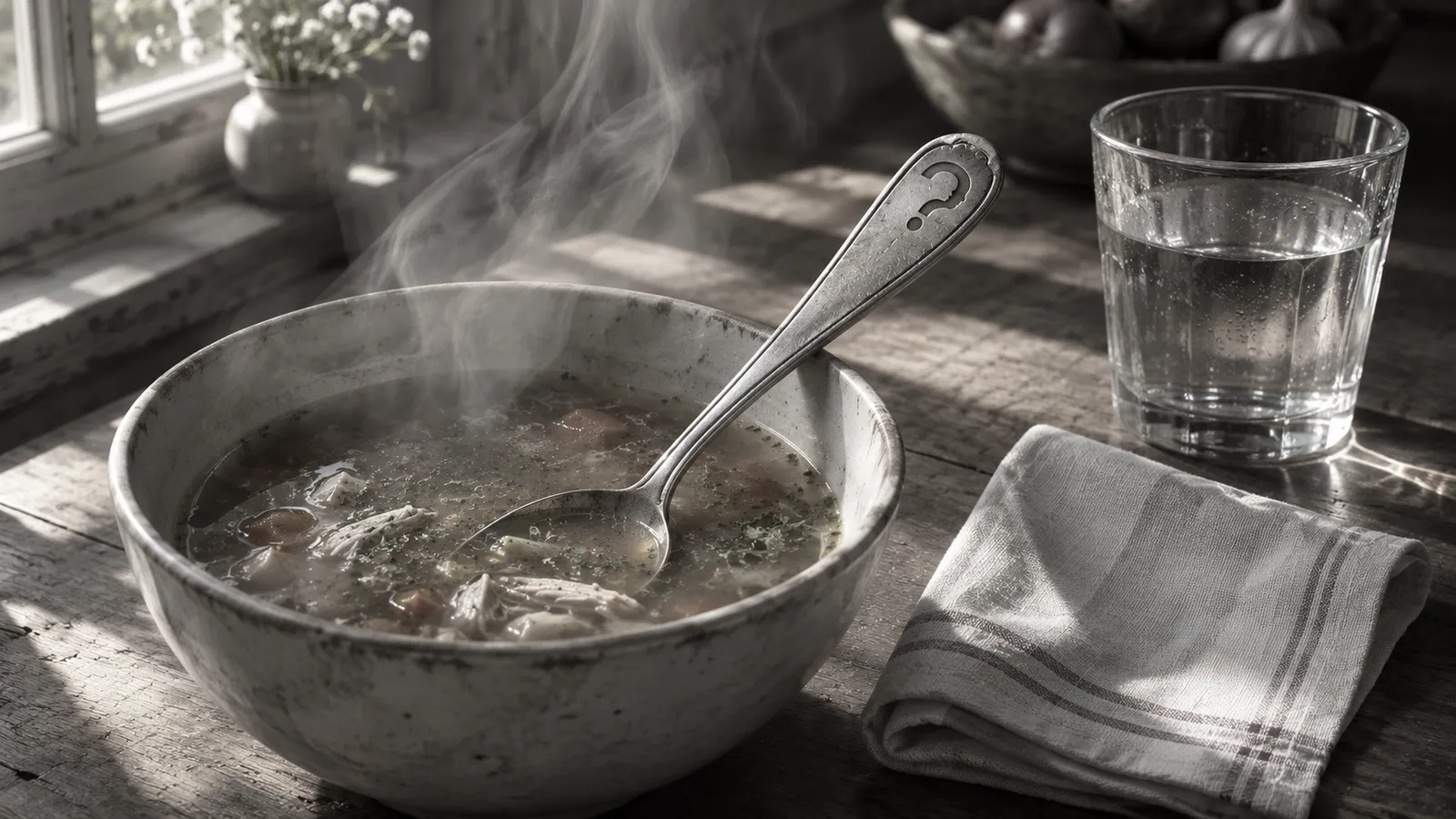
Smell reaches the nose two ways, and the one that runs up from the mouth carries most of what makes one food different from another. A cold blocks that route, and the tongue gets the blame.
Why does food taste bland when you have a cold?
Much of what people call taste is retronasal smell, aroma that rises from the mouth to the nose as food is chewed and swallowed. A cold narrows the nasal passage and dulls smell, so fruit, herb and roast notes fade while sweet, salty and sour from the tongue largely remain. The food loses its identity and keeps its outline.
Key takeaways
- In a preliminary test, volunteers who had learned four fruit juices by sniffing named them correctly about 56 per cent of the time when the juice went straight into the mouth, against 84 per cent by sniffing (Rozin, 1982).
- In 36 adults with a fresh cold, smell thresholds rose and odours were rated weaker, recovering as the cold passed (Hummel and colleagues, 1998).
- Brain imaging found that the same odour activated different regions depending on whether it was sniffed or arrived from the mouth, with the difference shown for a chocolate odour (Small and colleagues, 2005).
- Odours that smell sweet made sugar taste sweeter and citric acid less sour, an effect traced to learned links between smells and tastes (Stevenson and colleagues, 1999).
- The often-quoted 75 to 95 per cent figure for how much of taste is smell rests on thin evidence, though researchers agree smell plays the dominant part (Spence, 2015).
A cold narrows the passage that most of flavour depends on. Food goes flat with one because of retronasal smell, aroma that rises from the mouth to the nose while we chew and swallow, and which the brain files under taste. Gordon M. Shepherd builds Neurogastronomy around this route, arguing that food holds only molecules and that flavour is made in the brain.
For a 1982 paper on taste and smell confusions, Paul Rozin had volunteers learn four unfamiliar fruit juices by sniffing them. When each juice was delivered straight into the mouth through a tube, they named it correctly a little over half the time, against more than eight times in ten by sniffing. Rozin called the test preliminary, since odour leaking to the nose still needed better control, but it frames the question of why food goes flat with a cold.
Retronasal smell takes the back route
Smell reaches the nose in two directions. Sniffing draws air in through the nostrils, which is orthonasal smell, the kind that tells us what is on the plate. Chewing and swallowing push air the other way, from the back of the mouth up behind the palate, carrying the aroma released as food is broken down. That second route is retronasal smell, and it supplies the fruit in a strawberry, the roast in coffee and the herbs in a sauce. Rozin described smell as a dual sense for this reason: one set of receptors, two directions of travel, and two rather different experiences.
A cold works on the shared part of the system. In one study, adults with a fresh cold were tested on the second, fourth and sixth days of symptoms and again about a month later. The front of the nasal cavity narrowed and mucus increased, smell thresholds rose, odours were rated as weaker, and the brain's early response to an odour fell and then recovered as people got better. Thomas Hummel and colleagues judged the effect small and suggested part of it may arise independently of congestion.
An earlier experiment gave volunteers a common-cold coronavirus through the nose and measured their smell before and after. Smell declined, and the size of the decline tracked how blocked the nose had become rather than how much mucus it produced. The two studies agree that a cold dulls smell and differ on how much of the loss comes from blockage alone. Salt and sweetness surviving a cold while a meal loses its character fits a loss on the nasal side, since the tongue sits outside the blocked passage.
| Part of the eating experience | Main sense behind it | Expected with the nose blocked |
|---|---|---|
| Sweet, salty, sour, bitter, savoury | Taste buds on the tongue | Largely kept |
| Fruit, herb, roast, smoke and vanilla notes | Retronasal smell | Largely lost |
| Crunch, creaminess, temperature | Touch in the mouth | Kept |
| Chilli heat, mint coolness, fizz | Nerves of chemical irritation in the mouth | Kept |
| Sweetness lent by a sweet-smelling aroma | Smell bound to taste by learning | Reduced |
The table is our summary of how the senses divide, not a measured result. Closing the nostrils stops air moving through the nasal passage, so retronasal smell falls away while the tongue and the touch receptors of the mouth carry on. A blocked nose keeps the salt, the crunch and the heat of a meal, and takes the notes that tell one fruit, one herb and one roast from another, the part of flavour that arrived by retronasal smell all along.
The mouth takes the credit
Shepherd treats the unnoticed nose as the heart of the puzzle. In Neurogastronomy he describes retronasal smell as sensed in the nose yet felt in the mouth, because attention is on the food and touch places it on the tongue. The smell is folded into one flavour that seems to belong to the mouth. That referral is why a cold is experienced as a loss of taste, when the receptors that have gone quiet are in the nose.
Brain imaging gives the referral a trace. Dana Small and colleagues delivered the same odours either through the nostrils or through a tube to the back of the mouth, while scanning their brains. Odours delivered from the mouth activated the part of the sensory cortex that represents the mouth. Sniffed odours produced more activity in a set of regions that included the amygdala, the hippocampus and parts of the orbitofrontal cortex. For a chocolate odour, the mouth route produced more activity in the medial orbitofrontal cortex and a nearby part of the cingulate. Three non-food odours, lavender among them, showed no such difference, and the authors suggested the interaction depends partly on whether an odour belongs to food.
On this evidence, the brain may treat a food aroma arriving from the mouth as part of eating and place it where the eating happens. Expectation feeds into the same assembly: the colour of a mug can shift how sweet a coffee seems, the pattern followed in Why Your Coffee Tastes Different in a White Cup, and the flavour that results is still reported as coming from the tongue.
Smell lends sweetness to sugar
If smell is hidden inside taste, a smell should be able to change what the tongue seems to report. Richard Stevenson and colleagues tested this by asking people to rate 20 odours for sweetness and sourness, and then to taste sugar solutions with those odours added. Some odours raised the sweetness of the sugar and others lowered it, and the best predictor of the effect was how sweet the odour smelled on its own. In a second experiment, a caramel odour sweetened sugar and softened the sourness of citric acid.
Sugar itself cannot be smelled, so an odour that smells sweet carries a learned association with sweet foods. The authors read their results that way: experience binds certain smells to certain tastes, and the bound smell then lends its taste when it arrives in the mouth. On that account, flavour loses more than aroma when the nose is blocked. A vanilla dessert eaten with a cold would, on that account, lose the vanilla and, with it, part of the sweetness the vanilla was lending, leaving the sugar the tongue detects alone.
The route decides what kind of effect a smell can have. Scent in a shop reaches people through the nostrils, and the research pooled in What Scent Does in a Shop found it moving moods and evaluations far more reliably than spending. Inside the mouth, the same kind of molecule stops being background and becomes part of the thing being judged, which is the situation the sugar solutions recreated. Retronasal smell works on the object of attention rather than on the room around it.
That famous percentage, examined
Popular accounts often say that 75 to 95 per cent of taste is really smell. Charles Spence went looking for the evidence behind that range and found it rarely backed by any cited evidence. The one study sometimes offered for it, from 1977, asked six trained panellists to rate a mixture of a sweetener and a fruity odour. With the nose closed, their ratings of taste intensity fell by about 80 per cent. Spence notes that the odour smelled sweet, that the panellists probably sniffed as well, and that one mixture says little about a meal.
His conclusion is that no single percentage can be fixed, because the answer depends on how taste and flavour are defined, which senses count as part of flavour, and which food is being eaten. Researchers still broadly agree that smell plays the dominant part. Spence also separates the two routes. Retronasal smell belongs to flavour itself, and sniffing a dish shapes what people expect of it.
Common questions
Why does food taste bland when you have a cold?
Much of what people call taste is flavour, and much of flavour is retronasal smell, aroma that rises from the mouth to the nose during chewing and swallowing. A cold narrows the nasal passage and dulls smell, so fruit, herb and roast notes fade, while sweetness, saltiness and sourness from the tongue largely remain. The food seems bland because its identity arrived mainly through the nose.
What is the difference between retronasal and orthonasal smell?
Orthonasal smell is sniffing, with air drawn in through the nostrils from the world outside. Retronasal smell runs the other way, from the back of the mouth up to the nose as food is chewed and swallowed. The same receptors handle both, but brain imaging shows different patterns of activity for the two routes, and the retronasal one is felt as taste in the mouth.
Is it true that 80 per cent of taste is smell?
The figure is widely repeated but rests on thin evidence. A review found it rarely backed by cited evidence; the one study sometimes offered for it was a small 1977 study of a single sweet and fruity mixture rated by six panellists. The reviewer concluded that no fixed percentage holds, since it depends on how taste is defined and which food is eaten, while agreeing that smell plays the dominant part in flavour.
Sources
Shepherd, G. M. Neurogastronomy. Seed book.
Rozin, P. (1982). Taste-smell confusions and the duality of the olfactory sense. Perception & Psychophysics, 31(4), 397-401. doi:10.3758/BF03202667 https://doi.org/10.3758/BF03202667
Åkerlund, A., Bende, M., & Murphy, C. (1995). Olfactory threshold and nasal mucosal changes in experimentally induced common cold. Acta Oto-Laryngologica, 115(1), 88-92. doi:10.3109/00016489509133353 https://doi.org/10.3109/00016489509133353
Hummel, T., Rothbauer, C., Barz, S., Grosser, K., Pauli, E., & Kobal, G. (1998). Olfactory function in acute rhinitis. Annals of the New York Academy of Sciences, 855(1), 616-624. doi:10.1111/j.1749-6632.1998.tb10632.x https://doi.org/10.1111/j.1749-6632.1998.tb10632.x
Stevenson, R. J., Prescott, J., & Boakes, R. A. (1999). Confusing tastes and smells: How odours can influence the perception of sweet and sour tastes. Chemical Senses, 24(6), 627-635. doi:10.1093/chemse/24.6.627 https://doi.org/10.1093/chemse/24.6.627
Small, D. M., Gerber, J. C., Mak, Y. E., & Hummel, T. (2005). Differential neural responses evoked by orthonasal versus retronasal odorant perception in humans. Neuron, 47(4), 593-605. doi:10.1016/j.neuron.2005.07.022 https://doi.org/10.1016/j.neuron.2005.07.022
Spence, C. (2015). Just how much of what we taste derives from the sense of smell? Flavour, 4(1), 30. doi:10.1186/s13411-015-0040-2 https://doi.org/10.1186/s13411-015-0040-2
Related concepts
People
More articles
- Why the Menu Description Changes the Taste
The words on a menu decide what reaches the table, and they also set the frame in which the first mouthful is judged. Both effects are largest when the words and the food agree.
- Why Joyful Objects Lift Us
Bright colour, a soft curve and a generous quantity each lift an object through a different mechanism, and all three depend on what the object already means to the person holding it.
- Why We Buy the Brands Our Parents Bought
A parent's shopping habit is a brand's first market. Children learn brands at home before they learn prices, and for everyday goods the family choice travels well into adult life.
- The Flavour Added Back In
Processing takes flavour out and flavourings put it back. The harder question is what a flavour means to the body once it can be attached to almost any food.