Why Free Beats a Bargain
A price of nothing beats a price of one cent by more than a cent's worth of saving. The experiments say zero works as a category of its own, the best-supported account is affect, and the field evidence shows how steep demand is at the bottom of the scale.
Answer to the question
Why does the zero price effect make free win?
Because zero seems to work as a category of its own rather than as a very low price. In experiments, moving a price from 2 cents to 1 cent changed choices little, and moving it from 1 cent to nothing changed them a great deal. The 2007 paper behind the result named affect as the most likely account.
Key takeaways
- In the chocolate experiment Dan Ariely describes in Predictably Irrational (2008), 73 per cent chose the dearer truffle with the Kiss at 1 cent, and 69 per cent chose the Kiss once it was free.
- Moving the Kiss from 2 cents to 1 cent left the choice where it was, and moving it from 1 cent to nothing changed it, which separates zero from cheapness.
- Shampanier, Mazar and Ariely (2007) tested social norms, mapping difficulty and affect as the reason, and named affect the most likely.
- Palmeira and Srivastava (2013) found that people offered a product free would pay more for it later than people offered it at a low discounted price.
- Cohen and Dupas found uptake of bed nets fell by 75 per cent when the price rose from 0 to $0.75, which shows demand is steep near zero but not that zero beats one cent.
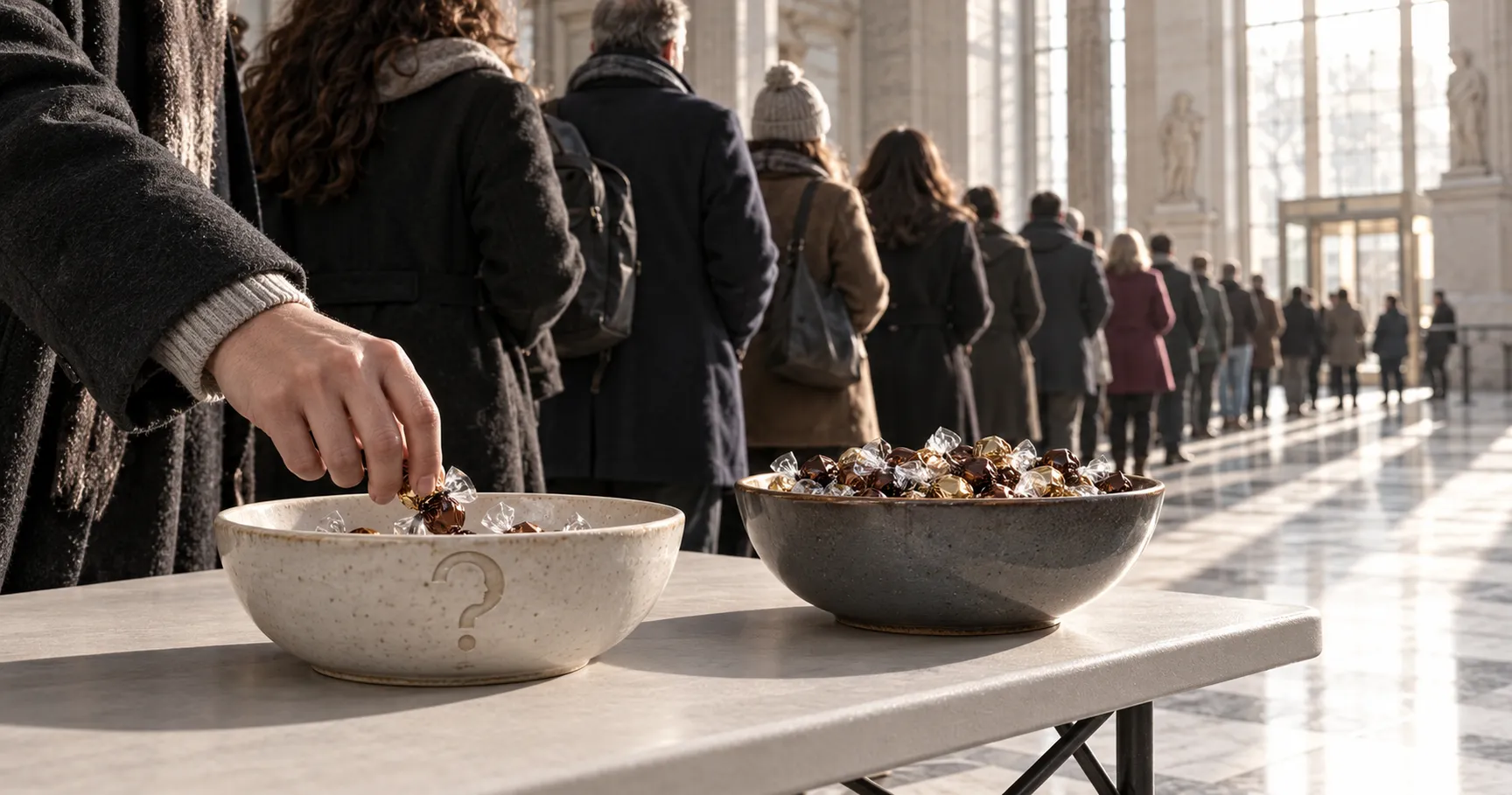
In an experiment Dan Ariely describes in Predictably Irrational (2008), people at a table could take one chocolate, a Lindt truffle or a Hershey's Kiss. With the truffle at 15 cents and the Kiss at 1 cent, 73 per cent took the truffle. Cut each price by a cent, which made the Kiss free, and 69 per cent took the Kiss.
The gap between the two prices had not changed. The zero price effect, the jump in demand when a price falls to nothing, is the name for what had. The usual explanation is that free is simply the biggest discount on offer. A discount predicts that each cent off counts alike, and in these experiments the last cent did not.
Zero is a category, not a very low price
The same design was run with the Kiss at 2 cents, then 1 cent, then nothing, the truffle moving with it. Two cents to one left the split where it was. One cent to nothing moved it. Cent-sized steps also drive charm pricing, the subject of The Price That Isn't Round, but the last cent is the one that behaves differently.
The zero price effect was not confined to chocolate. Offered a free $10 Amazon gift certificate or a $20 certificate for $7, most people took the free one, although the $20 certificate left them $13 ahead against $10.
Raise both prices by $1, so the free one costs $1 and the other $8, and the majority took the $20, with the gap in value unchanged and only the zero gone. In a Halloween version, about 70 per cent of children took a free small Snickers over a large one that cost a single Kiss, the worse trade.
Kristina Shampanier, Nina Mazar and Ariely published the work in Marketing Science in 2007 as "Zero as a Special Price". The paper's design held the price gap between two goods constant and moved both prices, once with the cheaper good at a low positive price and once at zero. In the zero condition dramatically more people chose the cheaper good and dramatically fewer chose the dearer one.
Their account of the zero price effect is that when a price is zero, people stop subtracting costs from benefits. They act, in the abstract's words, "as if zero pricing of a good not only decreases its cost, but also adds to its benefits." The book gives no sample sizes for these runs, and the paper was read for this article at the level of its abstract.
People appear to act as if zero pricing of a good not only decreases its cost, but also adds to its benefits.
Is free just easier than paying?
Perhaps the zero price effect is a convenience effect, with no coins to find and no payment to make. The book reports a run built to test it. At an MIT cafeteria the chocolates sat at the cashier, so a student could add one to lunch without a separate payment, and students still went overwhelmingly for the free one.
The paper tested three accounts of the zero price effect, social norms, mapping difficulty and affect, and says affect emerges as the most likely. Ariely's account in the book is loss aversion: a free item carries no risk of having chosen badly, so there is nothing to regret. He offers it with a hedge, and the abstract does not name it. The runs the book reports do not set the two against each other.
How free changes what a product is worth
In 2013 Mauricio Palmeira and Joydeep Srivastava asked what people would pay for a product after a promotion ended. Those who had been offered it free were willing to pay more than those offered it at a low discounted price. Their account is one of selective accessibility, and it runs through anchoring: a low price becomes the starting point for judging value, as in Why the First Price You See Decides What You Pay, while a free offer leaves people less likely to consider the product's value at all and open to other anchors, such as the price of the main purchase.
A free offer, they conclude, does not devalue the product, and at a minimum devalues it less than a low price would.
Free promotions are more salient than monetary discounts, so negative information about quality dented purchase intentions less, in three experiments by Sucharita Chandran and Vicki Morwitz in 2006. The effect reversed when people were drawn to other information. A 2011 study of a tourism product with two components carried the pattern into bundles: when the cheaper option included a free breakfast, demand rose for it and fell for the dearer option people leaned towards.
Free as a prize is a separate matter. Probabilistic promotions, which offer a chance of getting the whole purchase free, beat sure discounts of equal value across six experiments, in the field and the laboratory, in a 2017 paper led by Mazar. People were more likely to buy the product and bought more of it, and the paper found that the zero price effect was likely not behind the result, and nor were transaction costs or novelty. A 2025 study found that such promotions win mainly when the sure discount is or seems trivial, the subject of When Uncertain Discounts Work. These later studies, like the 2007 paper, were read at the level of their abstracts.
Does free hold up outside the lab?
In a field experiment at prenatal clinics in Kenya, Jessica Cohen and Pascaline Dupas randomised the price of anti-malarial bed nets sold to pregnant women, and uptake dropped by 75 per cent when the price rose from nothing to $0.75. Women who were given nets were no less likely to use them than women who paid, and charging a small price, known as cost-sharing, did not bring in women who were sicker.
On those results the authors judged free distribution both more effective and more cost-effective at reducing infant mortality, given the benefit that spreads to a whole community when nets are widely used. A 2007 evaluation of a Kenyan deworming programme found that cost recovery cut take-up by 80 per cent.
Both compare nothing with a positive price. They show how steeply demand falls at the bottom of the scale, which fits the zero price effect but does not isolate it, and they cannot say whether zero is special against one cent, which only the ladder can. A price of nothing can also hide costs that are not money, the subject of What You Actually Pay for Free Apps.
The seller chooses between the larger crowd that free attracts and the smaller one that would have chosen on value, because the zero price effect draws demand that one cent does not, and in the experiments where the free item was the worse deal, that demand went to the worse deal.
Common questions
Why does the zero price effect make free win?
Zero seems to be treated as a category of its own rather than a very low price. In the 2007 Marketing Science paper by Shampanier, Mazar and Ariely, people acted as if free added to a product's benefits as well as cutting its cost, and the authors named affect as the most likely account.
What is the zero price effect?
The jump in demand when a price falls to nothing, larger than the same fall between two positive prices. In Ariely's chocolate runs, moving the Kiss from 2 cents to 1 cent left the split where it was, and moving it from 1 cent to free changed it a great deal.
Does free work outside the lab?
In one Kenyan field experiment, uptake of bed nets fell by 75 per cent when the price rose from nothing to $0.75. That shows demand is very sensitive at the bottom of the price scale, not that zero is special against one cent.
Sources
Ariely, D. (2008). Predictably Irrational: The Hidden Forces That Shape Our Decisions. HarperCollins (revised and expanded edition, 2009). Chapter 3, pp. 49-65.
Shampanier, K., Mazar, N., & Ariely, D. (2007). 'Zero as a Special Price: The True Value of Free Products.' Marketing Science, 26(6), 742-757. doi:10.1287/mksc.1060.0254
Palmeira, M. M., & Srivastava, J. (2013). 'Free Offer ≠ Cheap Product: A Selective Accessibility Account on the Valuation of Free Offers.' Journal of Consumer Research, 40(4), 644-656. doi:10.1086/671565
Chandran, S., & Morwitz, V. G. (2006). 'The Price of "Free"-dom: Consumer Sensitivity to Promotions with Negative Contextual Influences.' Journal of Consumer Research, 33(3), 384-392. doi:10.1086/508439
Nicolau, J. L., & Sellers, R. (2012). 'The Free Breakfast Effect: An Experimental Approach to the Zero Price Model in Tourism.' Journal of Travel Research, 51(3), 243-249. doi:10.1177/0047287511418370
Mazar, N., Shampanier, K., & Ariely, D. (2017). 'When Retailing and Las Vegas Meet: Probabilistic Free Price Promotions.' Management Science, 63(1), 250-266. doi:10.1287/mnsc.2015.2328
Gaertig, C., & Simmons, J. P. (2025). 'Why (and When) Are Uncertain Price Promotions More Effective Than Equivalent Sure Discounts?' Journal of Consumer Research, 52(5), 1022-1042. doi:10.1093/jcr/ucaf036
Cohen, J., & Dupas, P. (2010). 'Free Distribution or Cost-Sharing? Evidence from a Randomized Malaria Prevention Experiment.' Quarterly Journal of Economics, 125(1), 1-45. doi:10.1162/qjec.2010.125.1.1
Kremer, M., & Miguel, E. (2007). 'The Illusion of Sustainability.' Quarterly Journal of Economics, 122(3), 1007-1065. doi:10.1162/qjec.122.3.1007