Adam Grant
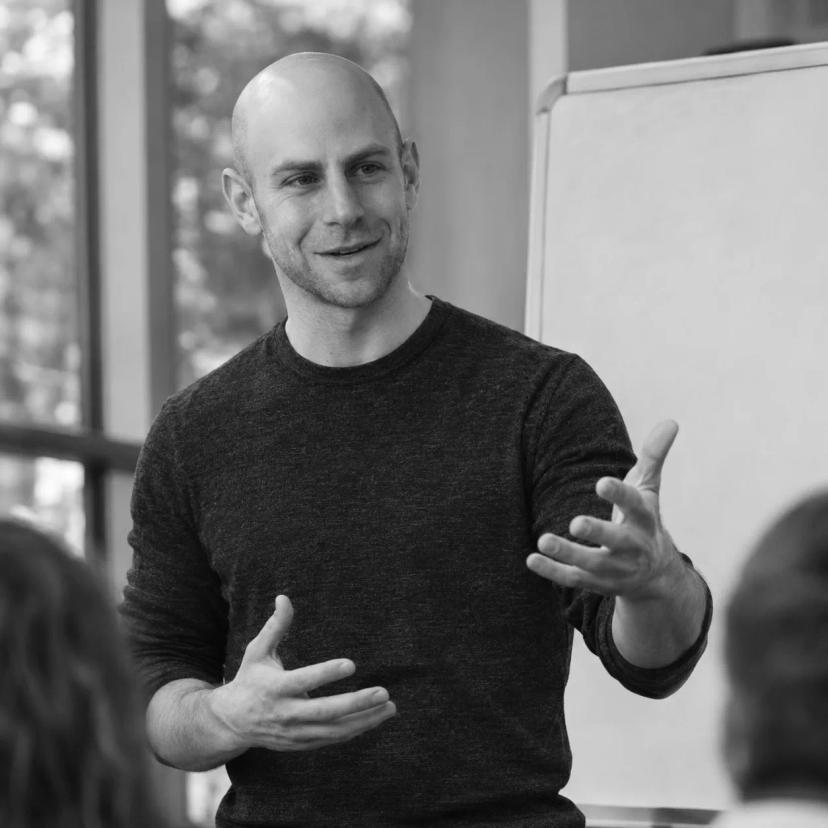
Adam Grant is an organisational psychologist at the Wharton School of the University of Pennsylvania. His 2008 paper in the Journal of Applied Psychology studied firefighters and telephone fundraisers and proposed that the wish to help others predicts most when it is paired with intrinsic motivation.
Who they are
Grant works in organisational psychology at the Wharton School, University of Pennsylvania. He is also the author of widely read books on work and behaviour, including Give and Take, Originals and Think Again.
Key papers
- Grant (2008), Does intrinsic motivation fuel the prosocial fire? Motivational synergy in predicting persistence, performance, and productivity, Journal of Applied Psychology, 93(1), 48-58. It reports two studies, one of 58 firefighters and one of 140 fundraising callers.
Key ideas
The 2008 paper draws on self-determination theory and proposes that prosocial motivation, the wish to help others, predicts persistence, performance and productivity best when it is paired with intrinsic motivation, enjoyment of the activity for its own sake. In the firefighter sample, enjoyment strengthened the link between the wish to help and overtime hours. In the fundraiser sample, callers high in both motives made more calls and raised more money a month later.
Sources
- Grant, A. M. (2008), Does intrinsic motivation fuel the prosocial fire? Motivational synergy in predicting persistence, performance, and productivity, Journal of Applied Psychology, 93(1), 48-58. https://doi.org/10.1037/0021-9010.93.1.48
Studies on this site by Grant
- Does intrinsic motivation fuel the prosocial fire? Motivational synergy in predicting persistence, performance, and productivity
Grant (2008) · Journal of Applied Psychology
- Introduction to behavioral addictions
Grant (2010) · The American Journal of Drug and Alcohol Abuse
- Reversing the extraverted leadership advantage: The role of employee proactivity
Grant (2011) · Academy of Management Journal
Articles that cite Adam Grant
- What is the difference between introverts and extroverts?
What a 39-nation test found holds extraversion together, why talkativeness is only the visible part, and how leader style fits a team.
- What are examples of intrinsic motivation?
Curiosity, a job that gives its own satisfaction and a task that absorbs the person doing it are the clearest examples. Each has a study behind it, and a 183-study analysis shows what intrinsic…
Concepts on this site
- Attention Residue
Attention residue is Sophie Leroy's term for the part of your attention that stays with a task you have just left, so the next task runs degraded. Her 2009 experiments found something most summaries…
- Prosocial Motivation
Prosocial motivation is the wish to help others through what one does at work. In Adam Grant's 2008 study of 58 firefighters and 140 fundraising callers, the wish to help predicted more overtime…
- Self-Signalling
Self-signalling is choosing an action partly for what it will tell you about yourself. The idea has two roots. Daryl Bem's self-perception theory says people work out their own attitudes by watching…
- The Five-Factor Model
The five-factor model is the mainstream structural model of personality. It describes people on five continuous dimensions rather than sorting them into kinds: openness, conscientiousness…
- The Four Psychometric Standards
The four psychometric standards are Benjamin Hardy's framing of what a proposed personality theory has to satisfy before anyone uses its results: are the categories reliable, are they valid, are…
- The Intensity Formula
The intensity formula is Cal Newport's stated law of productivity in Deep Work in 2016, set at page 40: high-quality work produced equals time spent multiplied by intensity of focus. It is presented…