Albert Ellis
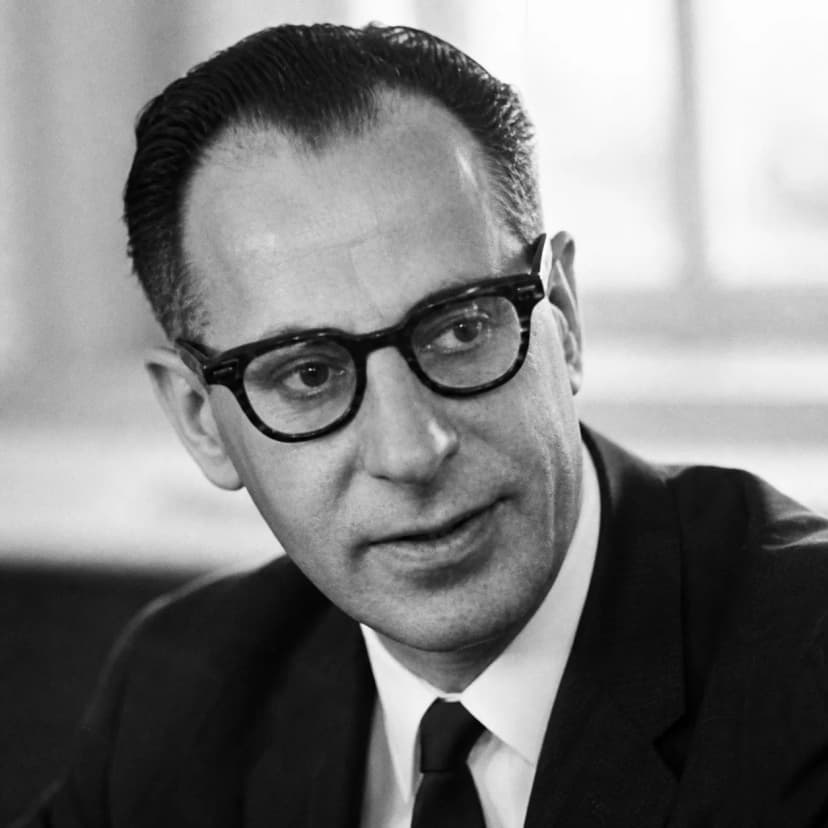
Albert Ellis, 1913 to 2007, was an American clinical psychologist who founded the first of the cognitive therapies in the mid-1950s, a decade before Aaron Beck's better-known version. He presented the approach to the American Psychological Association in 1956 and set it out in full in Reason and Emotion in Psychotherapy in 1962. He was unusually open about where it came from. The book names Zeno of Citium, Chrysippus, Panaetius of Rhodes, Cicero, Seneca, Epictetus and Marcus Aurelius as the originators of the principle, and quotes Epictetus directly at page 54. The cognitive turn in psychotherapy was a Stoic inheritance, and its founder said so in print.
Who they are
Ellis was born in Pittsburgh on 27 September 1913 and raised in New York. He took his MA and PhD in clinical psychology at Columbia, trained in psychoanalysis, and concluded that it was slow, passive and largely ineffective. His alternative was to stop excavating a patient's history and start examining the beliefs they were currently holding.
He delivered the paper "Rational Psychotherapy" at the annual convention of the American Psychological Association on 31 August 1956, and published it in the Journal of General Psychology in 1958. Reason and Emotion in Psychotherapy followed in 1962. He founded the Institute for Rational Living in New York, incorporated on 2 April 1959 and now the Albert Ellis Institute. The method itself was renamed twice, from rational therapy to rational emotive therapy and then, in 1993, to rational emotive behaviour therapy. Its core is the ABC sequence: an activating event, a belief about that event, and an emotional consequence that follows from the belief rather than from the event. Disputing the belief is the intervention.
His standing in the field was not marginal. A 1982 survey of American Psychological Association members published in American Psychologist ranked him the second most influential psychotherapist of the twentieth century, behind Carl Rogers and ahead of Freud. He nonetheless lost the naming rights. Cognitive behavioural therapy is routinely attributed to Beck alone, and the version of the history in which the cognitive model begins in the 1960s at the University of Pennsylvania is both extremely common and wrong by about ten years. This site credits the first author.
The other thing Ellis did honestly, and that the field has since been careless about, was to name his sources. He did not present the cognitive model as a discovery. He presented it as a very old proposition that had never been operationalised, and then operationalised it. That framing is what makes him the hinge between Epictetus and modern clinical practice, and it is also the reason his page belongs on a site interested in where ideas actually come from.
Books
Ellis was prolific to an unusual degree, with dozens of books and hundreds of papers across a fifty-year career. The three entries below are the ones this site relies on, verified individually. The full bibliography is far larger and is not reproduced here.
Key paper: Ellis, A. (1958), "Rational psychotherapy," Journal of General Psychology, 59(1), 35-49. First delivered at the APA annual convention on 31 August 1956, which is the earliest fixed date for the cognitive turn in psychotherapy.
Key papers
Ellis, A. (1958), "Rational psychotherapy," Journal of General Psychology, 59(1), 35-49. Delivered at the APA annual convention, 31 August 1956.
Ellis, A. (1962), Reason and Emotion in Psychotherapy, Lyle Stuart. Quotes Epictetus at p. 54; names the Stoic sources of the approach.
Ellis, A., & Harper, R. A. (1961), A Guide to Rational Living, Prentice-Hall.
Key ideas
The belief sits between the event and the feeling. The ABC sequence, and the operational core of the cognitive model.
Beliefs can be disputed in the room. The therapeutic move is argument with a proposition, not archaeology of a childhood. This is what separated him from the psychoanalysis he trained in.
He credited the Stoics openly. Zeno of Citium, Chrysippus, Panaetius of Rhodes, Cicero, Seneca, Epictetus and Marcus Aurelius, named in Reason and Emotion in Psychotherapy. See ataraxia.
Priority matters and is usually got wrong. Ellis's approach dates from the mid-1950s. Beck's arrived roughly a decade later and is far better known. The famous name collects the credit, which is the standard failure mode this site is built to correct.
Concepts on this site
Find them elsewhere
Lifespan: 1913 to 2007. No social accounts, and none are claimed on their behalf.
Deceased, so no social accounts. Reference is the Albert Ellis Institute biography, the organisation he founded
Checked 2026-09-10. Handles and affiliations go out of date, so treat this block as a snapshot rather than a standing fact.
Sources
- Ellis, A. (1958), "Rational psychotherapy," Journal of General Psychology, 59(1), 35-49. Delivered at the APA annual convention, 31 August 1956.
- Ellis, A. (1962), Reason and Emotion in Psychotherapy, Lyle Stuart. Quotes Epictetus at p. 54; names the Stoic sources of the approach.
- Ellis, A., & Harper, R. A. (1961), A Guide to Rational Living, Prentice-Hall.
- Epictetus, Enchiridion 5, the line Ellis quotes.
- The 1982 American Psychologist survey of APA members, which ranked Ellis second among twentieth-century psychotherapists behind Carl Rogers. Reported consistently across sources; the survey itself was not read in full.
- Founding date of the Institute for Rational Living (incorporated 2 April 1959) and the 1993 renaming to rational emotive behaviour therapy, per the Albert Ellis Institute.