Alvaro Pascual-Leone
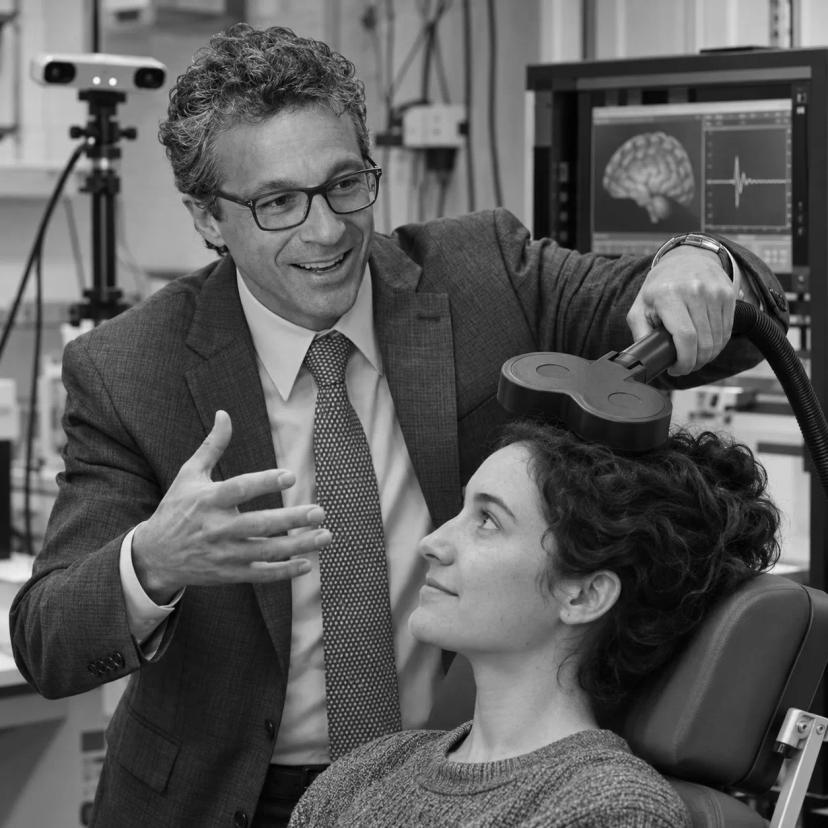
Alvaro Pascual-Leone is the first author of the 1995 paper Modulation of muscle responses evoked by transcranial magnetic stimulation during the acquisition of new fine motor skills, published in the Journal of Neurophysiology. One experiment in the paper compared mental practice with physical practice of a piano exercise.
Who they are
Alvaro Pascual-Leone appears in this site's sources as the first author of a 1995 paper with D. Nguyet, L. G. Cohen, J. P. Brasil-Neto, A. Cammarota and M. Hallett. The paper was published in volume 74, issue 3, of the Journal of Neurophysiology. This page records what that paper reports and does not attribute to him an affiliation or other work.
Key papers
The 1995 paper used transcranial magnetic stimulation, a method of stimulating the motor cortex from outside the head, to follow the muscle responses of people learning a new fine motor skill. In one part of the work, adults learned a one-handed five-finger piano exercise over five days, and the areas of motor cortex that drove the finger muscles were mapped across the week.
A further experiment compared kinds of practice. Fifteen right-handed adults were divided at random into three groups of five. One group practised the exercise at the piano, one sat at the piano and imagined playing it without moving their fingers, and one group did not practise. Muscle recordings were used to confirm that the group that imagined playing stayed still. Over the five days, both practising groups made fewer sequence errors and played with steadier timing, while the group that did not practise did not improve. The physical practice group reduced its errors significantly more than the mental practice group.
Key ideas
The paper's central idea is that learning a motor skill changes the motor system in ways that can be measured, and that these changes are not confined to the days when the fingers move. In the mental practice experiment, the people who only imagined playing gained skill, though less than people who practised physically.
For the question of whether mental rehearsal improves performance, the paper is an early controlled comparison in which the rehearsed task was a defined piano exercise and the measure was the accuracy and timing of that same exercise. It is cited in James Doty's book Mind Magic alongside the 2004 strength study led by Vinoth Ranganathan. The finding it supports is specific: imagined practice of a particular trained movement produced gains on that movement.
Sources
- Pascual-Leone, A., Nguyet, D., Cohen, L. G., Brasil-Neto, J. P., Cammarota, A., & Hallett, M. (1995), Modulation of muscle responses evoked by transcranial magnetic stimulation during the acquisition of new fine motor skills, Journal of Neurophysiology, 74(3), 1037-1045. https://doi.org/10.1152/jn.1995.74.3.1037
- Ranganathan, V. K., Siemionow, V., Liu, J. Z., Sahgal, V., & Yue, G. H. (2004), From mental power to muscle power: gaining strength by using the mind, Neuropsychologia, 42(7), 944-956. https://doi.org/10.1016/j.neuropsychologia.2003.11.018
Studies on this site by Pascual-leone
- Modulation of muscle responses evoked by transcranial magnetic stimulation during the acquisition of new fine motor skills
Pascual-Leone (1995) · Journal of Neurophysiology
Articles that cite Alvaro Pascual-Leone
- Does mental rehearsal improve performance?
Imagining a task before doing it has been tested on piano exercises, finger strength and sport. The studies agree on the direction of the effect and on its size, and they show where it works best.
Concepts on this site
- Mental Rehearsal
Mental rehearsal is practising a skill in the head, running through the movements or steps without carrying them out. The research on it finds a reliable but modest benefit for the task rehearsed…
- Motor Imagery
Motor imagery is imagining a movement from the inside, with its effort and its timing, without carrying it out. It is the form of imagery that most of the mental rehearsal studies on this site used…