Daniel Siegel
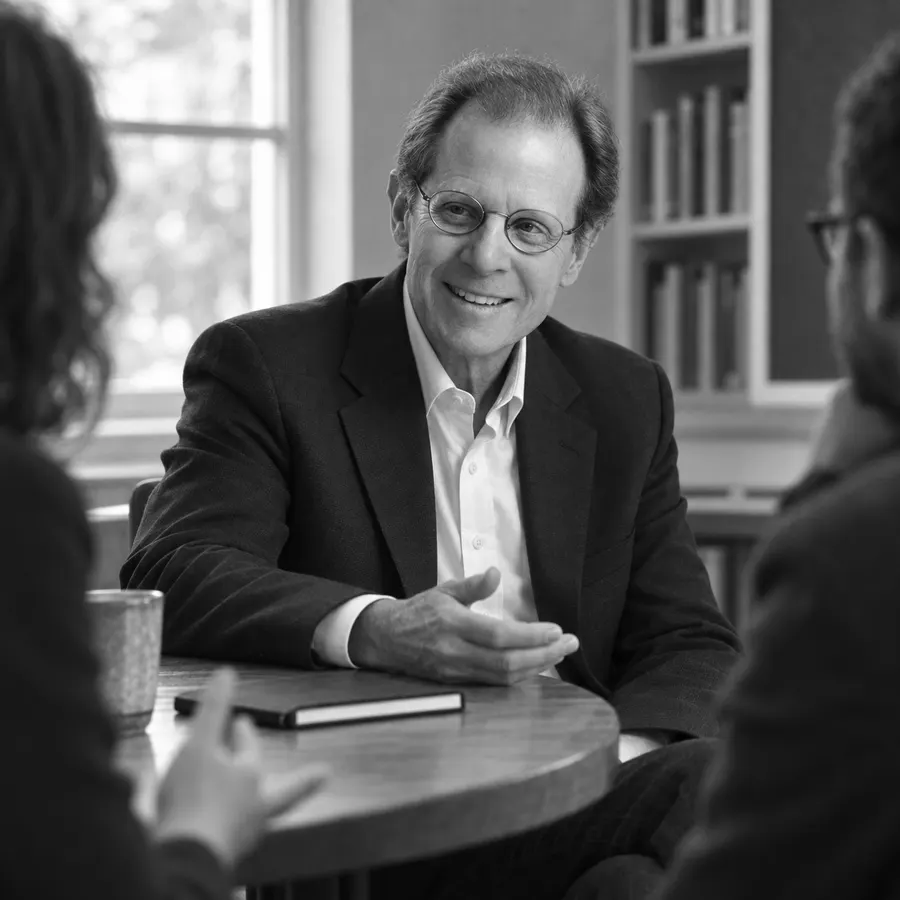
Daniel Siegel is an American psychiatrist, clinical professor of psychiatry at the UCLA School of Medicine, and executive director of the Mindsight Institute. He took his medical degree at Harvard and trained at UCLA in paediatrics and in child, adolescent and adult psychiatry. He coined the term mindsight for the capacity to perceive one's own mind and the minds of others. "Name it to tame it" is his phrase, and it appears in The Whole-Brain Child, written with Tina Payne Bryson, as one of twelve strategies.
Who they are
The phrase is his. The research is not, and this site keeps the two apart.
The underlying research programme on affect labelling, meaning what happens when a person puts a feeling into words, belongs to Matthew Lieberman and colleagues at UCLA, beginning with a 2007 paper in Psychological Science. Siegel's phrase is a popularisation of that literature, and popularisation is what it is. When this site needs the finding it goes to Lieberman. When it needs the phrase it goes to Siegel.
The co-author gets her name. The Whole-Brain Child is by Siegel and Tina Payne Bryson, and credit for the phrase is almost always given to him alone. Restoring her name costs one clause, and this publication does it every time.
The framing does not match the data, and this is the substantive point. His frame is left brain taming right brain, calming right-brain distress through left-brain storytelling. Lieberman's finding concerns a region at the front of the brain and the amygdala beneath it, which is a story about an upper region regulating a lower one, not about one hemisphere regulating the other. Popular retellings swap the two constantly, and no article on this site carries his hemispheres into a report of the research.
Neither book has been read here. Nothing is asserted about what he does or does not cite in them.
Key papers
He is a clinician and an author rather than the researcher behind this finding, and this site records no primary research paper of his.
Siegel, D. J., & Bryson, T. P. (2011). The Whole-Brain Child. Where "name it to tame it" appears, framed as a summary of existing studies rather than as his own finding. Not read here.
Mindsight.** Not read here.
Key ideas
Two sides on the phrase itself. In its favour: it is memorable, it is broadly faithful to the direction of the underlying result, and it has done real work in getting an emotion-regulation practice to parents and teachers who would never have read the papers. Against it: the rhyme flattens a modest and conditional effect into a promise, and in general circulation it has become detached from any sense of how large that effect is. Where this site lands: the phrase is a fair popularisation and it is not a citation, and it is never allowed to stand in for one.
The effect it names is conditional in ways the rhyme cannot hold. Naming reduces distress for intense unpleasant material and increases it for mild material, in work by Einat Levy-Gigi and colleagues. Naming before reframing or accepting makes those strategies work worse, in work by Erik Nook and colleagues. The slogan has room for neither.
Crediting an idea and citing evidence are different habits. Popular books that credit him for the phrase and then attach an uncited claim about what neuroscience shows are doing the first without the second. He did not write those sentences, and nothing here is a criticism of him for them.
Concepts on this site
Affect Labelling, the practice his slogan names
Name It to Tame It, the page that keeps his phrase apart from Lieberman's research
Personified Emotion, The Four Attachment Styles and Inviting Mara to Tea are related and have no page on this site yet
Sources
- Siegel, D. J., & Bryson, T. P. (2011). The Whole-Brain Child. Not read here; the endnotes were not obtained in the 2026-09-11 pass.
- Lieberman, M. D., and colleagues (2007). Psychological Science. The research programme the phrase popularises, held on this site under Lieberman's name.
- Vault record, 2026-09-11. The phrase is credited to Siegel and Bryson; the evidence is credited to Lieberman; the two are never merged.