Epictetus
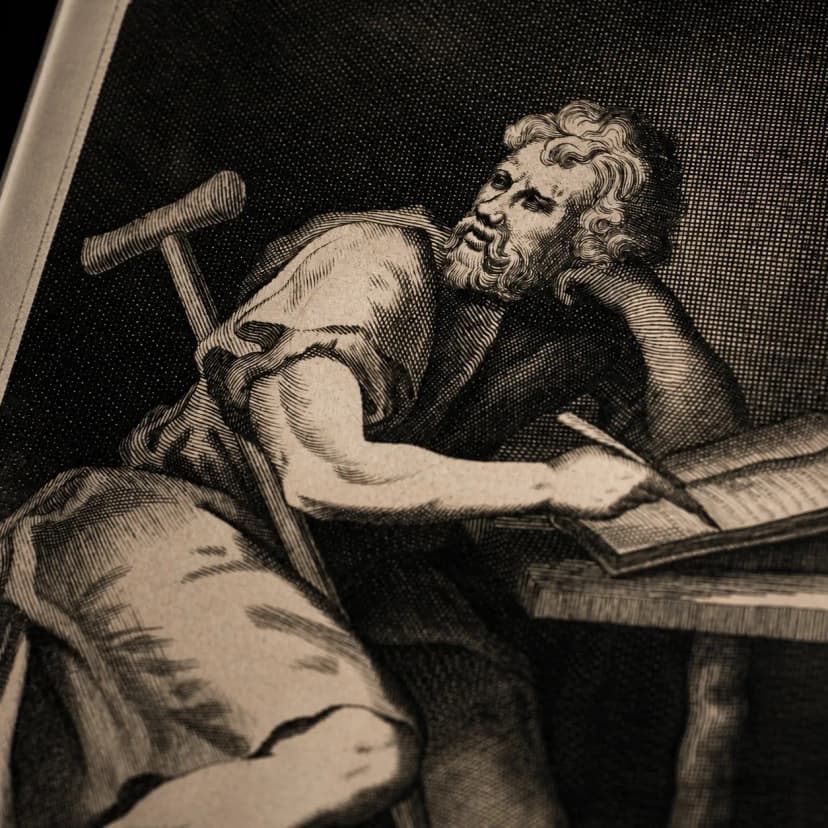
Epictetus, born into slavery in about 50 CE and dead in about 135, taught Stoicism at a school in Nicopolis in western Greece. He wrote nothing at all. Everything attributed to him was recorded by his student Arrian. One sentence from those records, that people are disturbed not by things but by the views they take of things, is the founding proposition of cognitive therapy: Albert Ellis quotes it in Reason and Emotion in Psychotherapy in 1962 and treats it as a clinical instruction rather than a consolation. That is the moment a philosophy becomes a therapy.
Who they are
Epictetus was born in Hierapolis in Phrygia, in Asia Minor, some time in the 50s CE, and spent part of his life enslaved in Rome to Epaphroditus, an administrator in Nero's court. He studied under the Stoic Musonius Rufus, and was freed at some point after Nero's death in 68. When Domitian expelled philosophers from Italy, an event usually dated to 89 CE, Epictetus left Rome and set up a school at Nicopolis in Epirus, on the west coast of Greece, where he taught until his death in about 135.
He wrote nothing, and this is not a technicality. What survives is a student's record. Arrian, later a Roman consul and the historian of Alexander's campaigns, attended the school and took down his teacher's lectures. Four books of the resulting Discourses survive out of an original eight. The Enchiridion, the Handbook, is Arrian's condensation of the same material into a short manual of practical instruction. So every sentence attributed to Epictetus arrives through a student's ear, a student's selection and a student's arrangement, then through translation. It reads as a body of aphorisms partly because it was compiled as one.
The line that matters here is the fifth entry in the Enchiridion, rendered in the English that reached twentieth-century psychology as: "Men are disturbed not by things, but by the views which they take of them." Ellis quotes it at page 54 of Reason and Emotion in Psychotherapy (1962), in a book that names Zeno of Citium, Chrysippus, Panaetius of Rhodes, Cicero, Seneca, Epictetus and Marcus Aurelius as the originators of the principle he was building a therapy on. The claim was never hidden. Ellis was explicit that his cognitive turn was a Stoic inheritance, and the profession has been much less careful about saying so since.
What descends is one proposition, in translation, detached from everything that held it up. In Stoicism the claim sat inside a determinist physics and an ethics in which virtue is the only good, and the practical instruction that follows it, sorting what is in your power from what is not, is a claim about the structure of the universe as much as about the structure of a mood. Cognitive therapy took the mechanism and left the metaphysics. That is a defensible move, and it also means the clinical evidence for CBT is not evidence for Stoicism. A thermostat can be adjusted without being the reason the room is cold.
Texts
Epictetus wrote nothing. Both works below are the records of his student Arrian, and neither was authored, edited or approved by Epictetus himself.
Key papers
He wrote nothing. Everything attributed to him reaches us through his student Arrian, which is worth holding in mind before treating any single sentence as definitive.
Discourses, recorded by Arrian. The fuller record of his teaching at Nicopolis.
Enchiridion, or Handbook, also Arrian's. The condensed version, and the source of the line that people are disturbed not by things but by their views of things.
Ellis, A. (1962), Reason and Emotion in Psychotherapy, page 54. Where the aphorism is quoted and treated as a clinical instruction. The cognitive approach itself dates from the mid-1950s, and the two dates are routinely fused.
Stanford Encyclopedia of Philosophy, entry on Epictetus. The reference used for his dates, placing his birth in the 50s CE and his death around 135.
Key ideas
Disturbance comes from judgements, not events. Enchiridion 5, and the proposition Albert Ellis turned into a clinical method. See the cognitive model.
The dichotomy of control. Some things are in our power and some are not, and confusing the two is the source of most distress. Enchiridion 1.
A tranquil state as the goal. The Stoic target, like the Epicurean one, is a condition of the person rather than a set of favourable circumstances, arrived at by a different route. See ataraxia.
He is a source that cannot be quoted directly. Every line is Arrian's record. Attributing an exact sentence to Epictetus is attributing a student's transcription, and popular Stoicism does this constantly without noting it.
The therapy inherited the mechanism, not the system. CBT's efficacy establishes that examining a thought helps. It does not establish the Stoic claim that judgement is where suffering originates.
Concepts on this site
Find them elsewhere
Lifespan: c. 50 to 135 CE. No social accounts, and none are claimed on their behalf.
Deceased, so no social accounts. Reference is the Stanford Encyclopedia of Philosophy entry, which places his birth in the 50s CE and his death around 135
Checked 2026-09-10. Handles and affiliations go out of date, so treat this block as a snapshot rather than a standing fact.
Sources
- Epictetus, Enchiridion 5, in the rendering Ellis quotes: "Men are disturbed not by things, but by the views which they take of them."
- Epictetus, Discourses, recorded by Arrian. Four of eight books extant.
- Ellis, A. (1962), Reason and Emotion in Psychotherapy, Lyle Stuart. Quotes Epictetus at p. 54 and credits the Stoics by name; the approach itself dates from the mid-1950s.
- Biographical outline (Hierapolis, enslavement to Epaphroditus, study under Musonius Rufus, Domitian's expulsion of philosophers from Italy, the school at Nicopolis) verified against standard reference scholarship on 2026-09-02. Birth and death years are approximate in every source consulted.