Epicurus
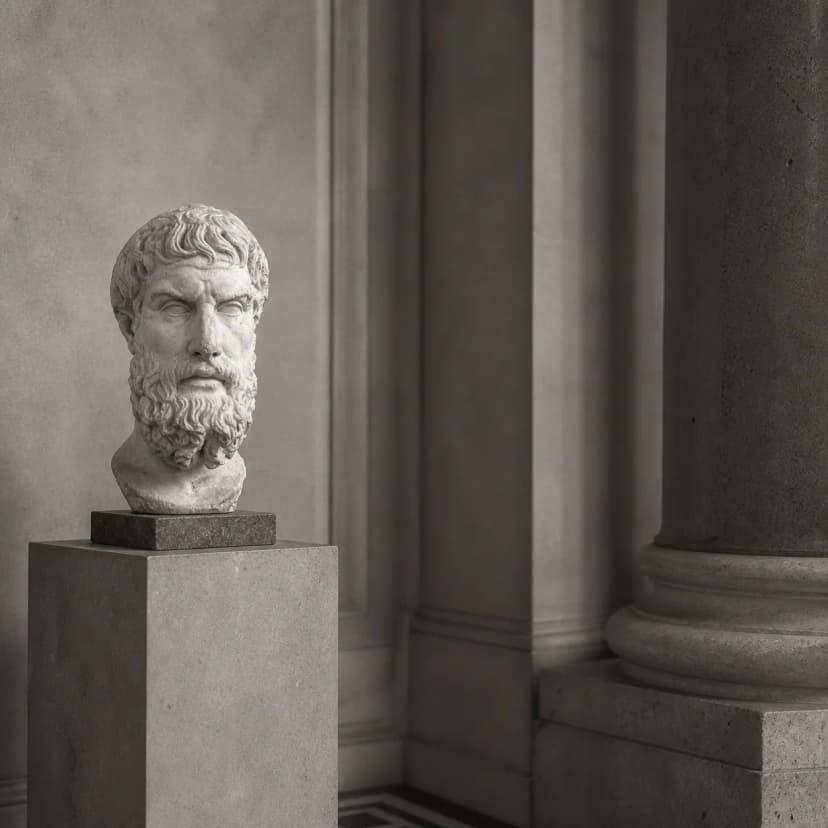
Epicurus, c. 341 to 270 BCE, was a Greek philosopher who founded the school known as the Garden in Athens and defined pleasure not as gratification but as the absence of pain. The move sounds like wordplay and is not. It makes the goal of a life a state of the person, ataraxia, freedom from disturbance, rather than a supply of good things from the world, and it makes all motivation a form of relief-seeking. That structure survives intact into modern behavioural writing, most visibly in Nir Eyal's Indistractable, which takes it from him by name.
Who they are
Epicurus was born in February 341 BCE on Samos, to Athenian parents who had settled there, and died in 270 BCE. He taught at Mytilene and Lampsacus before returning to Athens in about 306 BCE, where he bought a garden and founded a school in it. The Garden was unusual for its time in admitting women and enslaved people as members, and it functioned as a community as much as a curriculum.
Almost nothing he wrote survives. Diogenes Laertius, writing centuries later, describes him as extraordinarily prolific, crediting him with hundreds of treatises, and it is Diogenes who preserves what we have: three letters, to Herodotus on physics, to Pythocles on astronomy and meteorology, and to Menoeceus on ethics, together with the Kyriai Doxai or Principal Doctrines. A further collection, the Vatican Sayings, survives separately, and charred fragments of his major work On Nature were recovered from the library at Herculaneum. The ethics, in other words, reaches us through one late compiler and a set of aphorisms, which is worth holding in mind before treating any single sentence as definitive.
What survives is enough to fix the central claim. In the Letter to Menoeceus, pleasure is the beginning and end of the good life, but pleasure is defined negatively: the highest pleasure is the removal of everything that pains. Diogenes Laertius preserves the accompanying distinction between pleasure in motion and pleasure as a settled state, and it is the settled state, the condition of not being disturbed, that Epicurus treats as the target. Desire is then sorted rather than indulged: some desires are natural and necessary, some natural but unnecessary, and some neither, and the last category is where most human misery is manufactured. The famous caricature of Epicureanism as luxurious appetite gets the doctrine exactly backwards.
The reason he belongs on a psychology site is that this is a mechanistic claim about motivation, not only an ethical recommendation, and it is the same claim the Pali texts make about taṇhā, reached independently and about two centuries later. If wanting is by definition a discomfort, then every act of pursuit is an attempt to end a state rather than to acquire a thing, and distraction is relief-seeking rather than pleasure-seeking. That is precisely the proposition Kent Berridge's work puts under strain. Incentive salience, on his evidence, is a pull with nothing painful behind it. Epicurus and Berridge are describing the same behaviour and disagreeing about what is happening inside it, and the disagreement has never been properly joined.
Texts
Epicurus wrote a great deal and almost none of it survives. Everything below reaches us through a later compiler, a separate anthology or charred papyrus, not through a manuscript tradition of his own books.
Key papers
Letter to Menoeceus, preserved in Diogenes Laertius, Lives of the Eminent Philosophers, Book X. The ethics, and the passage where pleasure is defined as the removal of everything that pains.
Kyriai Doxai, the Principal Doctrines, also preserved in Diogenes Laertius, Book X. The aphorisms, including the sorting of desires into the natural and necessary, the natural but unnecessary, and the rest.
Letter to Herodotus and Letter to Pythocles, on physics and on astronomy and meteorology respectively. The other two surviving letters, both through Diogenes.
Vatican Sayings. A further collection surviving separately from the Diogenes material.
On Nature. His major work, surviving only as charred fragments recovered from the library at Herculaneum.
Diogenes Laertius, Lives of the Eminent Philosophers, Book X. The late compiler through whom nearly all of this reaches us, and the source of the distinction between pleasure in motion and pleasure as a settled state.
Key ideas
Pleasure is the absence of pain. Not gratification, not accumulation. See ataraxia.
The target is a state, not a supply. Ataraxia, freedom from disturbance, is a condition of the person rather than a property of their circumstances. That relocation is what makes the doctrine psychological rather than merely ethical.
Desires can be sorted. Natural and necessary, natural but unnecessary, and neither. Most suffering, on his account, comes from pursuing the third kind.
Motivation as relief-seeking. If wanting hurts, action is escape. Nir Eyal builds Indistractable on this reading explicitly, which makes a 2019 productivity book the carrier of a third-century BCE ethics. See time management is pain management and Nir Eyal.
The same conclusion as taṇhā, reached independently.* Two traditions with no contact arriving at the claim that wanting is itself the discomfort. Convergence is suggestive. It is not evidence. See tanha.
Concepts on this site
Time Management Is Pain Management
Find them elsewhere
Lifespan: c. 341 to 270 BCE. No social accounts, and none are claimed on their behalf.
Deceased, so no social accounts. Reference is the Stanford Encyclopedia of Philosophy entry, which gives the same dates
Checked 2026-09-10. Handles and affiliations go out of date, so treat this block as a snapshot rather than a standing fact.
Sources
- Epicurus, Letter to Menoeceus, preserved in Diogenes Laertius, Lives of the Eminent Philosophers, Book X. Pleasure defined as the absence of pain.
- Epicurus, Kyriai Doxai (Principal Doctrines), preserved in Diogenes Laertius, Book X.
- Diogenes Laertius, Lives of the Eminent Philosophers, Book X. The source for the surviving letters, the Principal Doctrines, and the account of his output.
- Eyal, N., & Li, J. (2019), Indistractable: How to Control Your Attention and Choose Your Life, BenBella Books. Takes its motivation theory from Epicurus explicitly.
- Robinson, T. E., & Berridge, K. C., incentive-sensitisation work on the wanting/liking dissociation. See wanting vs liking for the citation trail.