Harold Hotelling
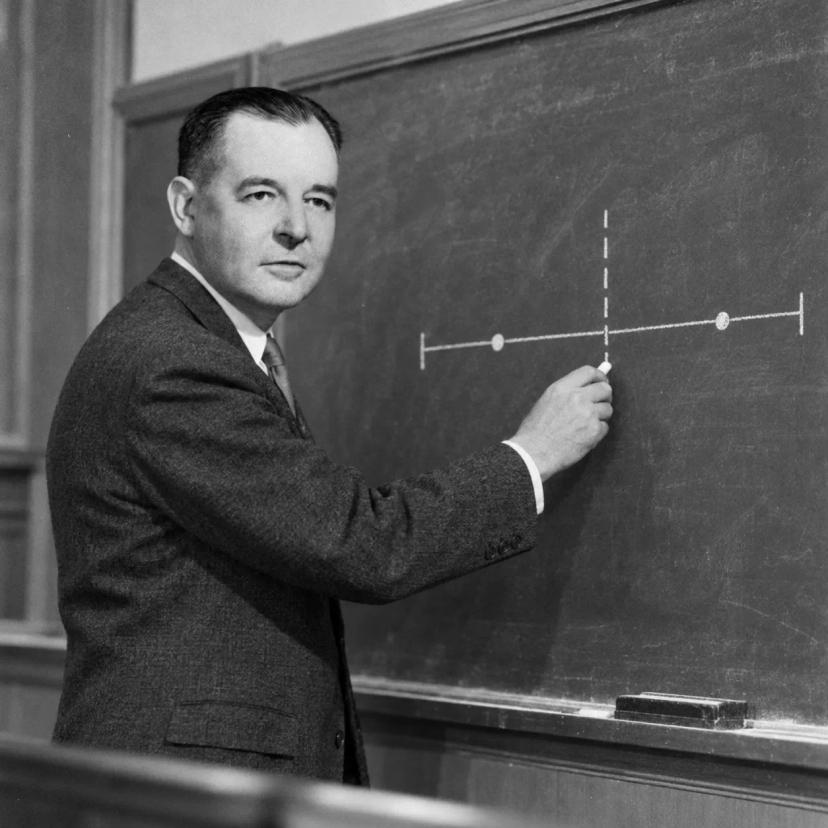
Harold Hotelling (1895 to 1973) was an American statistician and economist. This site cites him for a 1933 book review: his review of Horace Secrist's The Triumph of Mediocrity in Business argued that the convergence of firms toward the average, which Secrist read as competition, came from how the groups had been formed. The review is a standard early example of catching regression to the mean mistaken for a trend.
Who they are
Hotelling took a doctorate in mathematics at Princeton in 1924 and began at Stanford the same year. In 1931 he became professor of economics at Columbia, replacing Henry L. Moore, and he left in 1946. He then held a chair of economics and statistics at the University of North Carolina. He died in 1973. He trained Kenneth Arrow and Milton Friedman and helped appoint Abraham Wald.
His work covers a wide range. A 1929 paper on stability in competition introduced spatial competition in a duopoly. In 1929 he gave depreciation its modern definition as the decline in discounted future values. In 1931 he applied the calculus of variations to exhaustible resources, and in the same year his work on the Student's t distribution laid out what is now called confidence intervals. In 1932 he recast production theory as profit maximisation, in 1935 he derived demand at the same time as Hicks and Allen, and in 1938 his Econometric Society presidential address introduced marginal cost pricing as a general welfare proposition and proposed the two-part tariff for natural monopoly.
This site holds none of that work. The details above come from a single biographical profile, and the page uses them only to place the reviewer.
The Secrist review
Hotelling's review of The Triumph of Mediocrity in Business appeared in the Journal of the American Statistical Association (1933, volume 28, issue 184, at 463-465). Secrist had sorted firms across many industries by their performance in an early year, followed each group forward, and found the best groups sliding toward the average and the worst rising. He attributed this to competitive pressure from new entrants.
Hotelling's argument, as this site reports it, was that the pattern came from the grouping. A set of firms picked for an extreme year has that year's chance built into the selection, and chance does not repeat on schedule. Read the same record backwards, sorting on the later results, and the groups converge in that direction too. The finding therefore says little about competition.
Key papers
Hotelling, H. (1933). Review of The Triumph of Mediocrity in Business by Horace Secrist. Journal of the American Statistical Association, 28(184), 463-465.
Hotelling's other papers are named in his profile and are not cited or read here.
Key ideas
A group selected for an extreme result carries chance into the selection, and the drift of that group toward the average is expected before any cause is tested.
A convergence that appears in either direction of time is a property of the measurement, not of the world it measures.
Francis Galton named the effect in 1886 and Daniel Kahneman set it out for a general reader in Thinking, Fast and Slow. Hotelling's review is the business-statistics case between them.
Sources
- Hotelling, H. (1933). Review of The Triumph of Mediocrity in Business by Horace Secrist. Journal of the American Statistical Association, 28(184), 463-465. Citation confirmed in two secondary sources.
- Biographical profile of Harold Hotelling (1895 to 1973), History of Economic Thought website, for his positions, the dates of his appointments and the list of his contributions.
- Kahneman, D. (2011). Thinking, Fast and Slow.
Studies on this site by Hotelling
- The Triumph of Mediocrity in Business.
Hotelling (1933) · Journal of the American Statistical Association
Articles that cite Harold Hotelling
- Why Does a Great First Visit Disappoint
A great first visit is partly the place and partly the evening. The evening does not repeat, a business book once mistook the same arithmetic for competition, and expectation adds a second cost that…
Concepts on this site
- Regression to the Mean
Regression to the mean is the fact that on any measure less than perfectly correlated with whatever it is being compared to, an extreme score will on average be followed by a less extreme one. It is…