Icek Ajzen
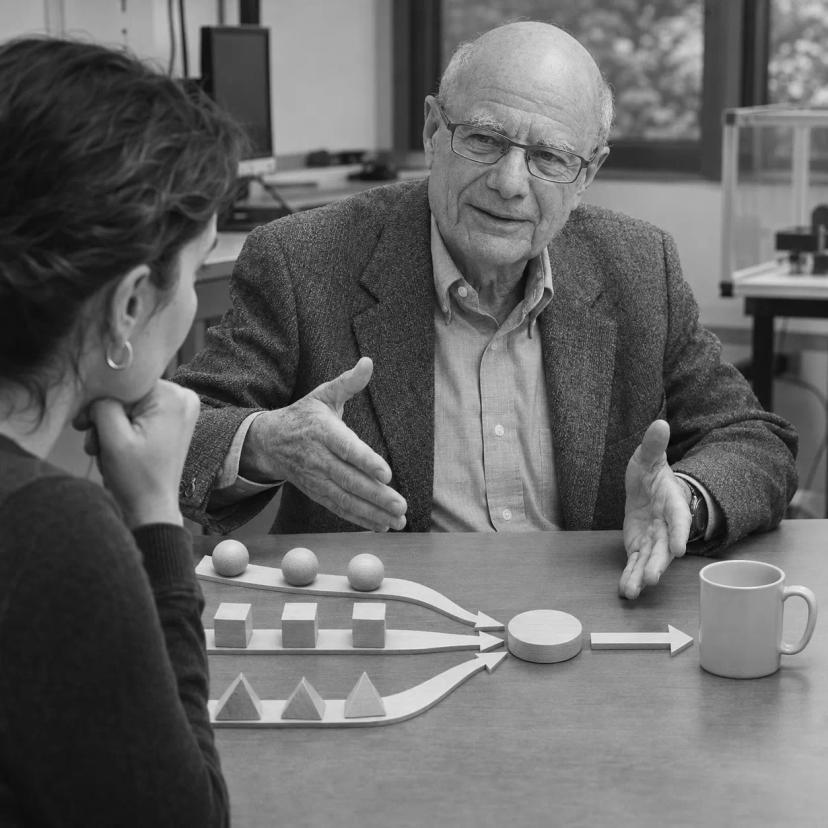
Icek Ajzen is a social psychologist and professor emeritus at the University of Massachusetts Amherst. He is best known for the theory of planned behavior, a model in which a person's intention to act is predicted from their attitude toward the act, the social pressure they feel and their sense of control over it. The model is one of the most widely applied frameworks in the study of why people do what they do, and it is one of the five models set out in the article on consumer behavior models on this site.
Who he is
Ajzen earned his doctorate in social psychology at the University of Illinois at Urbana-Champaign in 1969 and joined the University of Massachusetts Amherst as a professor in 1971. He spent most of his research career there, and he headed the university's Division of Personality and Social Psychology on three occasions: from 1980 to 1985, from 1997 to 1999 and from 2001 to 2012.
His work sits in attitude research, the study of how beliefs and evaluations shape what people choose to do. A long working relationship with Martin Fishbein, who developed the multi-attribute attitude model, produced the reasoned action approach, the line of theory from which planned behavior grew. In 2025 the BBVA Foundation named Ajzen a co-recipient of its Frontiers of Knowledge Award in the Social Sciences, shared with Dolores Albarracín, Mahzarin Banaji, Anthony Greenwald and Richard Petty, for work that changed how attitudes are understood and measured. The foundation's profile reports more than 530,000 citations to his work and applications of the theory in public health, environmental behavior and technology use.
Key papers
Ajzen, I. (1991). The theory of planned behavior. Organizational Behavior and Human Decision Processes, 50(2), 179-211. doi:10.1016/0749-5978(91)90020-T.
Ajzen first set out the theory in a 1985 book chapter and developed it in the 1991 review. His books include Attitudes, Personality, and Behavior (2005), Prediction and Change of Health Behavior (2007), written with Dolores Albarracín and Robert Hornik, and Predicting and Changing Behavior: The Reasoned Action Approach (2010), written with Martin Fishbein.
Key ideas
The theory of planned behavior starts from intention. Whether someone acts, the theory says, depends first on how strongly they intend to, and intention in turn rests on three things: the attitude toward the behavior, the subjective norm, which is the perceived social pressure to act or not to act, and perceived behavioral control, the person's belief about how able they are to carry the act out. Intention and perceived control then together predict the behavior itself.
The third element is what separates the planned behavior model from its predecessor. The earlier reasoned action model covered attitude and norm only. Adding perceived control allowed the model to account for acts that a person wants to perform but may not be able to, such as keeping a routine, saving money or using an unfamiliar tool. In the 1991 review, Ajzen drew together research from many fields showing that intentions based on these three components, together with perceived control, account for a considerable share of the variation in behavior.
The article on consumer behavior models uses the theory as the model that explains the gap between wanting and doing. It cites a pooled analysis by Christopher Armitage and Mark Conner of 185 independent studies, which found that planned behavior explained 39 per cent of the differences in intention and 27 per cent of the differences in behavior. Perceived control added to the prediction of both, and the share of behavior explained was higher when behavior was self-reported than when it was observed. The reading for a brand is practical: a campaign that changes attitudes alone leaves two of the three predictors untouched, and a product that is hard to use can fail even when people intend to buy it.
Where he appears on this site
Ajzen appears in 5 Consumer Behavior Models Every Brand Should Know. The related concepts are the theory of planned behaviour and perceived behavioural control. Connected people are Martin Fishbein, Christopher J. Armitage and Mark Conner.
Sources
- Ajzen, I. (1991). The theory of planned behavior. Organizational Behavior and Human Decision Processes, 50(2), 179-211. doi:10.1016/0749-5978(91)90020-T. Published abstract read at an institutional record.
- Armitage, C. J., & Conner, M. (2001). Efficacy of the theory of planned behaviour: a meta-analytic review. British Journal of Social Psychology, 40(4), 471-499. doi:10.1348/014466601164939. Published abstract read at an institutional record.
- BBVA Foundation Frontiers of Knowledge Awards, laureate profile of Icek Ajzen, consulted 4 November 2026.
Studies on this site by Ajzen
- The theory of planned behavior
Ajzen (1991) · Organizational Behavior and Human Decision Processes
Articles that cite Icek Ajzen
- 5 Consumer Behavior Models Every Brand Should Know
Five established models, each built to answer one question about buyers. What each predicts, one published finding behind it, and what a brand can ask of it.
Concepts on this site
- Perceived Behavioural Control
A person's belief about how able they are to carry out an act.
- Theory of Planned Behaviour
A theory in which a person's intention to act is predicted from their attitude toward the act, the social pressure they feel and their perceived control, with intention and perceived control then…