Irna Phillips
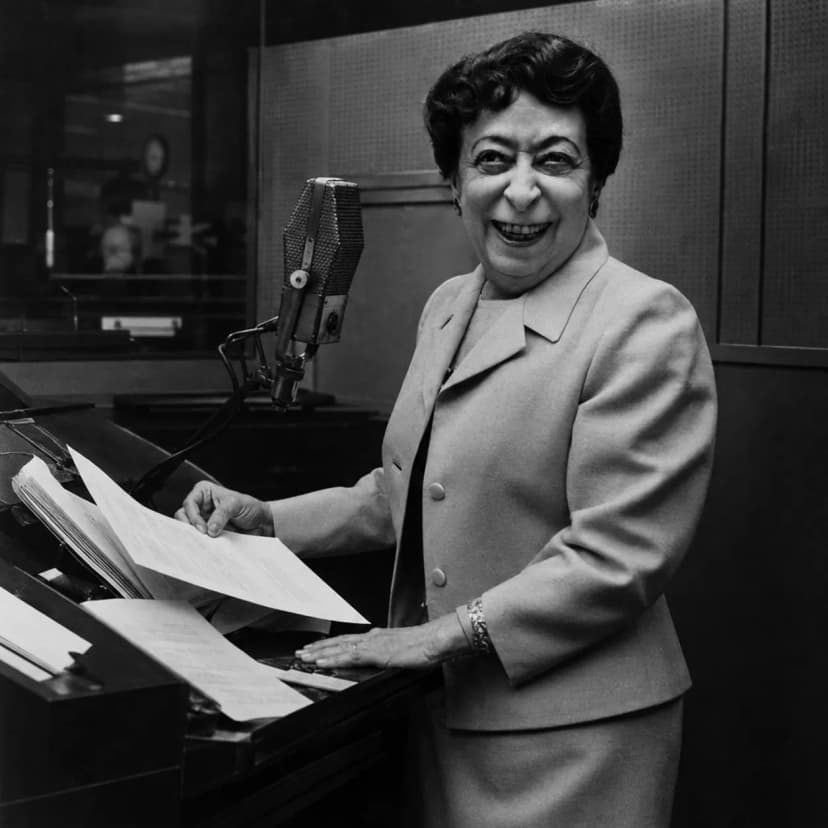
Irna Phillips invented the daytime serial, and with it the soap opera. Her contribution to the psychology of attention is a controlled experiment nobody called one: she took the serialisation technique that had built evening radio audiences and ran it in the middle of the day, for an audience of women at home, and it worked just as well. That result separates the mechanism from its setting. What brings an audience back is the unfinished story, not the hour, not the evening ritual, not the family gathered round the set. She is routinely left out of the histories that name Paley and Sarnoff, and she solved a harder scheduling problem than either of them.
Who they are
Irna Phillips, 1901 to 1973, was a Chicago writer who came to radio from teaching. Painted Dreams went out on WGN in Chicago from 20 October 1930 and is generally treated by historians of the genre as the first daytime serial, with Phillips herself among the small cast playing the parts. She went on to create Guiding Light, which became the first radio serial to make the move to television successfully, and later As the World Turns, which ran on CBS from 2 April 1956 until 2010. She wrote for or shaped several other serials, including Days of Our Lives, and the trade nickname that followed her, Queen of the Soaps, understates what she was doing.
The craft devices are the interesting part, because each one is a solution to a specific attention problem. The cliffhanger ending leaves a question open at the exact moment the listener would otherwise disengage, and the intuition behind it, that an unfinished story holds the mind better than a finished one, was being applied commercially decades before popular writing had a vocabulary for it. The organ bridge smooths the transition between scenes so that the listener is never handed a natural exit point. Neither device depends on the audience being an audience of the evening.
That is why she belongs in the prime-time argument rather than in a footnote to it. Tim Wu's history treats Amos 'n' Andy in 1929 as the invention of prime time, and identifies the real innovation as serialisation rather than comedy (pp. 85-94). Phillips is the proof that the identification is correct (p. 93). Move the technique to a completely different hour, a completely different audience and a completely different commercial model, and the audience still comes back tomorrow. If the mechanism had been about the evening, or about the whole household attending together, daytime would have failed. It did not.
Her audience is also the first one anybody built a schedule around who had been treated as commercially uninteresting. Women at home during the day were an attention market nobody had bothered to price. She priced it, and the sponsors who gave the form its name, the soap manufacturers, followed.
Key works
Phillips wrote and created for broadcast rather than publishing, so her body of work is a list of serials rather than of books or papers.
Painted Dreams, WGN Chicago, from 20 October 1930. Widely credited as the first daytime serial.
Guiding Light, created with Emmons Carlson, first broadcast on NBC radio on 25 January 1937. The first radio serial to transfer successfully to television.
As the World Turns, CBS, from 2 April 1956 to 2010. Created as a companion to Guiding Light.
Further serial work including Days of Our Lives.
Key papers
None. Phillips wrote and produced for broadcast rather than for publication, so there are no papers to list and no books either. Her body of work is the serials named above, and the scholarly and reference accounts of her career are by other people. They are listed under Sources.
What stands in place of a paper here is the scheduling result itself. Moving serialisation out of the evening and into the middle of the day, for a different audience and a different commercial model, and finding that the audience still came back, is the demonstration this site cites her for.
Key ideas
Serialisation is a mechanism, not a genre and not a time slot. Phillips is the demonstration that it survives being moved out of prime time entirely.
What returns an audience is an open question, not a satisfying ending. The cliffhanger is the commercial application of that.
Continuity devices, including the organ bridge between scenes, remove the natural exit points where attention would otherwise break.
An audience treated as commercially worthless is an unpriced attention market. Daytime was the first one anyone scheduled around.
Concepts on this site
Find them elsewhere
Lifespan: 1901 to 1973. No social accounts, and none are claimed on their behalf.
Deceased, so no social accounts. Reference is the catalogue record for her papers at the Wisconsin Historical Society, which names her as Irna Phillips with the dates 1901 to 1973
Checked 2026-09-10. Handles and affiliations go out of date, so treat this block as a snapshot rather than a standing fact.
Sources
- Wu, T. (2016), The Attention Merchants: The Epic Scramble to Get Inside Our Heads, Knopf. Serialisation and Amos 'n' Andy, pp. 85-94; Irna Phillips and daytime, p. 93.
- Britannica, biography of Irna Phillips. Dates, Painted Dreams, and the cliffhanger and organ-bridge devices.
- Jewish Women's Archive, encyclopedia entry on Irna Phillips.
- Painted Dreams, WGN Chicago, from 20 October 1930.
- Guiding Light, NBC radio, from 25 January 1937.
- As the World Turns, CBS, 2 April 1956 to 2010.