Melissa Bateson
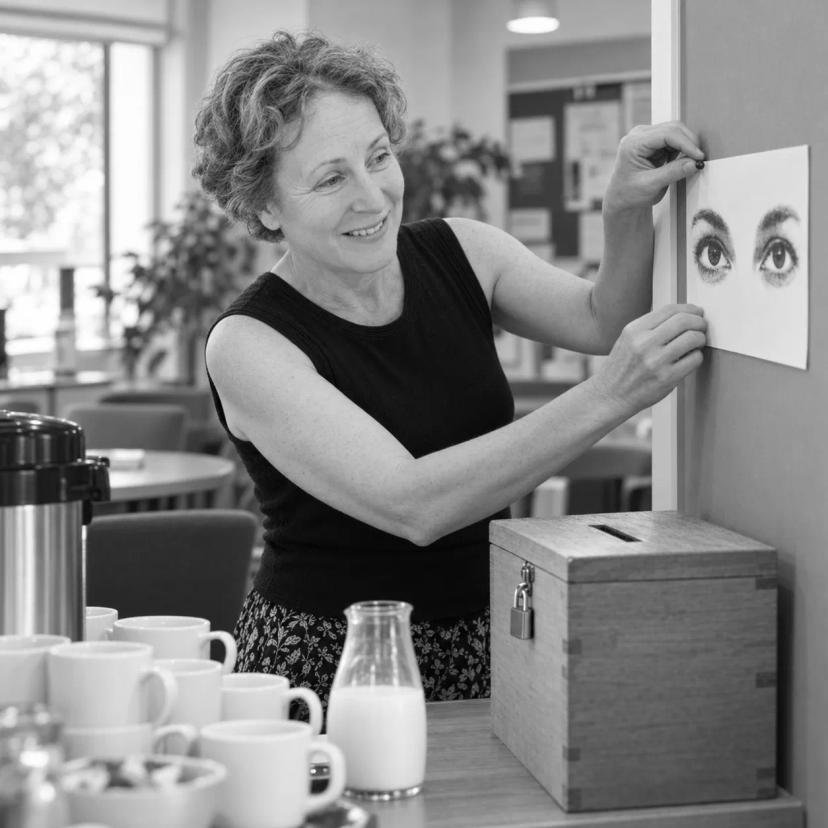
Melissa Bateson is first author of the 2006 coffee-room study in Biology Letters that started the modern watching eyes literature, and a co-author of the 2012 Newcastle bicycle-stealing study. Her work is the reason a pair of eyes above an honesty box became a standard example in books about hidden motives.
Who they are
Bateson is a researcher whose work on cues of being watched is hosted on Newcastle University's pages, which is where this library found the 2006 paper. Her role and department were not checked beyond that, and this page does not state them.
The 2006 paper, written with Daniel Nettle and G. Roberts, reports a field experiment in a university coffee room. A notice above an honesty box alternated weekly for ten weeks between a pair of eyes and a picture of flowers. The price list asked 30 pence for tea, 50 pence for coffee and 10 pence for milk. Per litre of milk consumed, people paid £0.417 in the eye weeks and £0.151 in the flower weeks, about 2.76 times as much. The eye images varied in sex and head orientation, and all looked directly at the viewer.
The study is a field experiment with real money and real drinkers, which is why it travelled. It also had features that later reviewers weigh. It took place in one room, over ten weekly swaps of the poster, with no observer present when people paid.
The 2012 paper, with Daniel Nettle and Kenneth Nott, moved the idea from a coffee room to a campus. Signs with watching eyes and a related verbal message were placed above bicycle racks at three high-theft sites, and reported thefts were followed for twelve months before and after. Thefts fell 62 per cent at the signed sites, while the rest of the campus saw a 65 per cent increase. The authors noted that the signs might have displaced offending to locations with no signs, and recommended them as an adjunct to other measures. Tom Stafford, writing in Mind Hacks in 2013, argued that the design could not separate the eyes from the message, among other concerns.
Key papers
Bateson, M., Nettle, D., & Roberts, G. (2006). Cues of being watched enhance cooperation in a real-world setting. Biology Letters, 2(3), 412-414. doi:10.1098/rsbl.2006.0509
Nettle, D., Nott, K., & Bateson, M. (2012). Cycle thieves, we are watching you: Impact of a simple signage intervention against bicycle theft. PLoS ONE, 7(12), e51738. doi:10.1371/journal.pone.0051738
Key ideas
The idea her work established is the claim at the centre of The Watching Eyes Effect: that a cue resembling a watcher can change behaviour when nobody is watching. Her coffee-room result is the founding evidence for it.
The later record is divided by what was measured. Two meta-analyses published in 2017 by Northover and colleagues found no evidence that artificial surveillance cues raise generosity. A 2019 review by Dear and colleagues linked eye images to a 35 per cent reduction in the risk of antisocial behaviour across 15 experiments. Read against that record, the coffee room is closer to rule-keeping than to generosity, since the money for the milk was owed.
Sources
- Bateson and colleagues (2006), as cited above, read from the Newcastle University copy for the figures quoted here.
- Nettle, Nott and Bateson (2012), read from the abstract on the Northumbria University research portal.
- Stafford, T. (2013). Did the eyes really stare down bicycle crime in Newcastle? Mind Hacks, 16 May 2013.
- Simler, K., & Hanson, R. (2018). The Elephant in the Brain. Oxford University Press.
Studies on this site by Bateson
Articles that cite Melissa Bateson
- Do Watching Eyes Make People Behave
A pair of eyes above an honesty box once made people pay 2.76 times as much for their milk. Pooled studies have not found the same lift in generosity, and the better case for watching eyes is a…
Concepts on this site
- The Watching Eyes Effect
The watching eyes effect is the claim that people behave better when something resembling a pair of eyes is present, even a crude drawing. The evidence is split by what is measured. Pooled studies…