Morton Deutsch
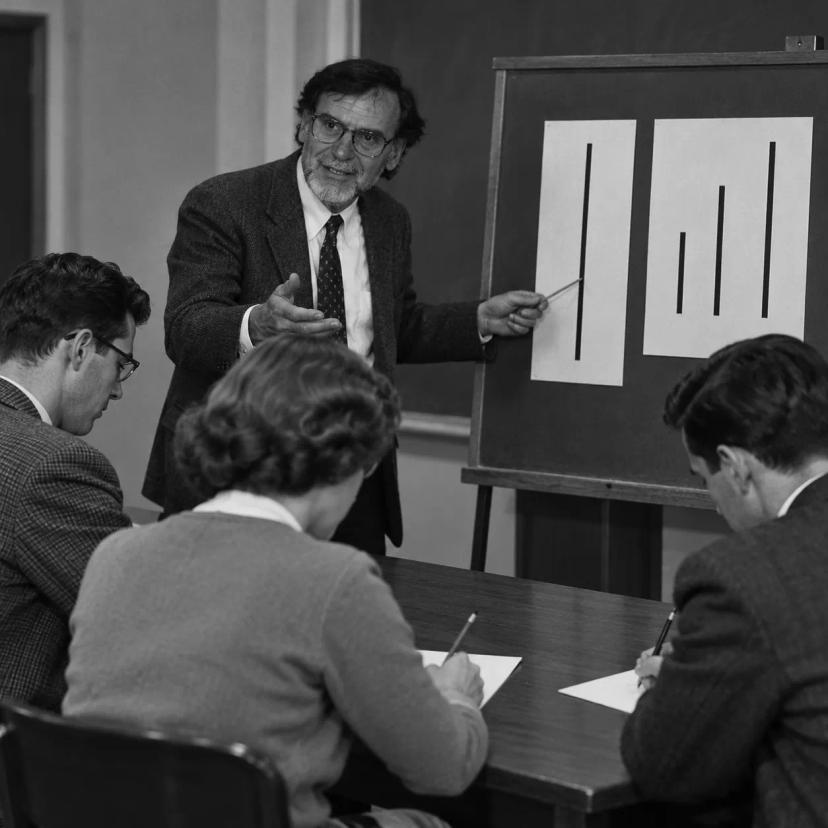
Morton Deutsch was a social psychologist who spent more than fifty years at Teachers College, Columbia University, and died in March 2017 at the age of 97. This site uses him for the 1955 paper, written with Harold Gerard, that separated two kinds of social influence: taking other people's judgements as evidence about what is true, and matching other people because their approval matters.
Who they are
Deutsch held the Edward Lee Thorndike professorship of psychology and education at Teachers College, Columbia University. He founded the college's International Center for Cooperation and Conflict Resolution and directed it until 1997. He retired from the faculty in 1990 and stayed active at the college until his death. His work is associated with conflict resolution, cooperative learning and social justice, and he supervised many doctoral students who went on to work in negotiation, peace studies and mediation. These details come from the Teachers College announcement of his death.
Key papers
Deutsch, M., & Gerard, H. B. (1955). A study of normative and informational social influences upon individual judgment. Journal of Abnormal and Social Psychology, 51(3), 629-636. doi:10.1037/h0046408. The paper that gives the two kinds of influence their names. It is used on this site at the level of that distinction.
Key ideas
Informational influence is accepting what others say or do as evidence about reality, which matters most when a situation is unclear. Normative influence is matching others because their approval or expectations matter. The two can produce the same outward agreement, which is why the distinction is useful: evidence stays evidence whether or not anyone is watching, while approval only matters when someone is present to give or withhold it. Why do people conform uses the pair to read Sherif's dark-room study, a brain-imaging study of conformity and a study of peer copying in two-year-olds.
Sources
- Deutsch, M., & Gerard, H. B. (1955). A study of normative and informational social influences upon individual judgment. Journal of Abnormal and Social Psychology, 51(3), 629-636. doi:10.1037/h0046408.
- Teachers College, Columbia University (2017). Sad news: the passing of Morton Deutsch. https://www.tc.columbia.edu/articles/2017/march/sad-news-the-passing-of-morton-deutsch. Used here for his posts, the centre he founded and the dates.
Studies on this site by Deutsch
- A study of normative and informational social influences upon individual judgment
Deutsch (1955) · Journal of Abnormal and Social Psychology
Articles that cite Morton Deutsch
- Why do people conform?
People match the judgements and choices of others for two reasons that experiments can tell apart: to get things right and to get along.
- When Copying Is the Rational Move
The popular account treats following the crowd as a failure of nerve, and two economists disproved that in 1992 by showing that people reasoning perfectly well end up copying anyway. What separates…
Concepts on this site
- Conformity
Conformity is changing what you say or do to match a group, including when you can see the group is wrong. Solomon Asch's line-judgment studies are the founding demonstration: 123 American male…
- Counterfactual
A counterfactual is the comparison case for a decision: what would have happened if the option had not been chosen. A figure that describes an outcome becomes an estimate of an effect only when it…
- Information Cascades
An information cascade is the point at which somebody who can see what others chose, but not why, correctly stops using what he knows himself and copies instead. His choice then carries no…
- Informational Influence
Informational influence is accepting what other people say or do as evidence about reality. Morton Deutsch and Harold Gerard set it beside normative influence in a 1955 paper whose title names the…
- Normative Social Influence
Normative social influence is influence that works through what a person believes others do or approve of, rather than through information about the world. Rod Bond's meta-analysis of a hundred and…
- Rational Herding
Rational herding is copying that is the correct inference given what the copier can observe, rather than a failure of nerve. Abhijit Banerjee's 1992 model shows optimising individuals abandoning…