Paul Slovic
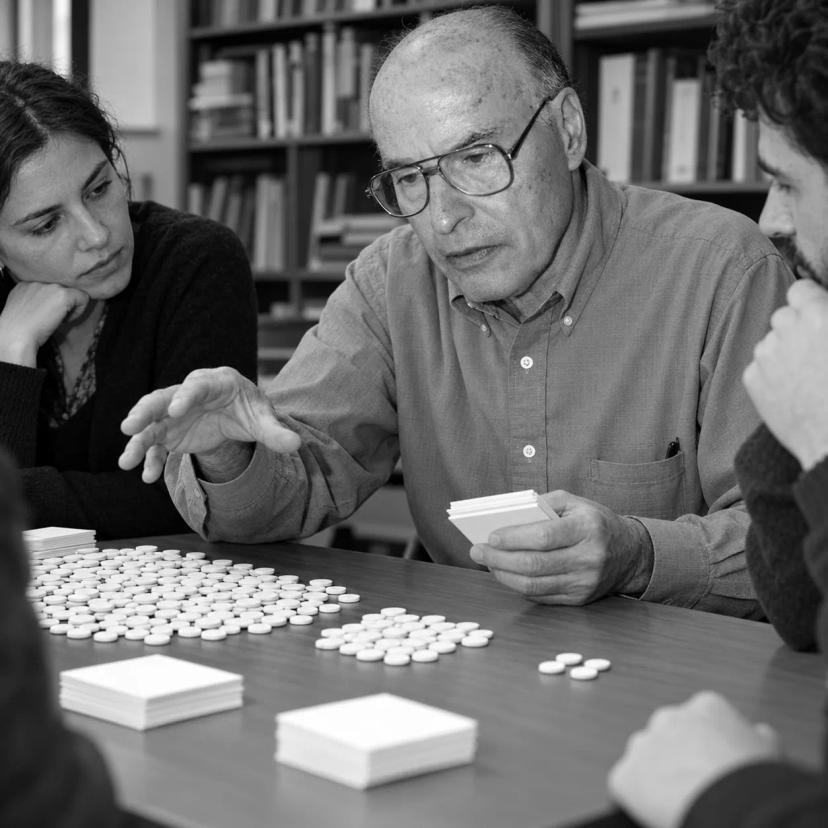
Paul Slovic is a psychologist at the Oregon Research Institute who moved the heuristics-and-biases programme out of the laboratory and into the study of risk. He is credited with the affect heuristic, and he is lead author of a 2000 study in which forensic psychologists and psychiatrists judged a patient more dangerous when a risk was stated as a frequency than as a probability. He is often credited with the label denominator neglect, which this publication does not do, because who first used the label has not been established.
Who they are
Slovic's larger position, as Kahneman prints it in Thinking, Fast and Slow, is that risk is not an objective quantity waiting to be measured. There are several defensible ways to define and measure it, they do not rank hazards in the same order, and the choice of measure settles the answer before any data are gathered. The point the vault's notes keep is that defining risk is itself an exercise in power.
Kahneman treats him as a friendly opponent. Kahneman leans towards the view that public risk judgments are distorted by availability and affect. Slovic argues that the public's richer conception of risk, which includes dread, controllability and the distribution of harm, is not a defective version of the expert's. Both positions stay in the vault, because they are not measuring the same object: one asks whether people estimate frequencies accurately, and the other whether frequency is the right thing to be estimating.
Key papers
Slovic, Monahan and MacGregor (2000), in Law and Human Behavior, gave forensic psychologists and psychiatrists case summaries of patients hospitalised with mental disorders. The clinicians estimated the likelihood that each would harm someone within six months of discharge and rated each as high, medium or low risk. Scales that distinguished better among small probabilities led clinicians to judge patients as less likely to be violent. Asking for relative frequencies, or training the clinicians, did not remove that effect. At the same likelihood a patient seemed more dangerous when it was framed as a frequency, ten out of a hundred, than as a probability, ten per cent, and two out of ten produced much higher perceived risk than twenty per cent. The authors attribute the gap to the more frightening images frequencies evoke.
Monahan, Heilbrun, Silver, Nabors, Bone and Slovic (2002), Communicating Violence Risk: Frequency Formats, Vivid Outcomes, and Forensic Settings, International Journal of Forensic Mental Health, followed the line.
Peters, Vastfjall, Slovic, Mertz, Mazzocco and Dickert (2006), "Numeracy and decision making", Psychological Science 17(5), 407-413, found that people with higher numeracy were more likely to recall and apply the right numerical rules and were less prone to framing effects, and that the numeracy effect did not stem from general intelligence.
Key ideas
The affect heuristic is the finding that a global feeling about a thing supplies the answers to separate questions about its risks and its benefits. No paper, year or journal is recorded in the vault for it, and none is reconstructed here.
Two attributions to hold carefully. The causes-of-death study, which showed the overweighting of vivid and publicised deaths, is credited in Kahneman's book to Slovic first, but on the published paper Sarah Lichtenstein is first author. And Slovic's dissent from the usual account of the Alar episode is recorded in the book as a personal communication dated 11 May 2011, which makes it an unpublished disagreement and not a paper.
Sources
- Slovic, P., Monahan, J., & MacGregor, D. G. (2000). "Violence Risk Assessment and Risk Communication: The Effects of Using Actual Cases, Providing Instruction, and Employing Probability Versus Frequency Formats." Law and Human Behavior, 24(3), 271-296. doi:10.1023/A:1005595519944.
- Monahan, J., Heilbrun, K., Silver, E., Nabors, E., Bone, J., & Slovic, P. (2002). "Communicating Violence Risk: Frequency Formats, Vivid Outcomes, and Forensic Settings." International Journal of Forensic Mental Health.
- Peters, E., Vastfjall, D., Slovic, P., Mertz, C. K., Mazzocco, K., & Dickert, S. (2006). "Numeracy and decision making." Psychological Science, 17(5), 407-413.
- Kahneman, D. (2011). Thinking, Fast and Slow. Farrar, Straus and Giroux. The risk chapters and endnotes, as recorded in the vault note for Slovic. The abstract of the 2000 paper was read on the publisher's page on 2026-10-23.
Studies on this site by Slovic
- Rating the risks
Slovic (1979) · Environment: Science and Policy for Sustainable Development
- Behavioral decision theory perspectives on protective behavior
Slovic (1985) · Taking Care
- Perception of risk
Slovic (1987) · Science
- Violence Risk Assessment and Risk Communication: The Effects of Using Actual Cases, Providing Instruction, and Employing Probability Versus Frequency Formats
Slovic (2000) · Law and Human Behavior
- Violence Risk Assessment and Risk Communication: The Effects of Using Actual Cases, Providing Instruction, and Employing Probability Versus Frequency Formats
Slovic (2000) · Law and Human Behavior
- Risk as analysis and risk as feelings: Some thoughts about affect, reason, risk, and rationality
Slovic (2004)
Articles that cite Paul Slovic
- Why We Fear Flying but Not Driving
Analysts rank hazards by annual fatalities. Everyone else ranks them by how they feel to live with, and control and choice do much of the work.
- What is the affect heuristic?
How a general feeling sets what people believe about a thing's risks and benefits, what time pressure and persuasion do to the pattern, and who shows it least.
- What is the availability heuristic?
The availability heuristic has two readings, one about how many examples come to mind and one about how easily they arrive. A 1991 experiment was designed to tell them apart.
- Does the Availability Heuristic Sell
Vivid news does shift what people buy, but the evidence is narrower than the heuristic's name suggests. Insurance, travel and meat show local effects that fade, and the one study that tested media…
- Denominator Neglect and the Bigger Bowl
Ten in a hundred and one in ten are the same probability, yet people reach for the larger count. Bowls of beans, a paid marble task, a disease rated riskier at half the death rate and a study of…
Concepts on this site
- Availability Heuristic
The availability heuristic is judging how common or how large a category is by how easily instances of it come to mind. Nothing is counted. The speed with which examples arrive becomes the answer…
- Denominator Neglect
Denominator neglect is attending to the number of cases and ignoring the base they sit on. One in a hundred thousand produces a mental image of a person, while the hundred thousand who are fine…
- Framing
Framing is the finding that identical information produces different judgements and different choices depending on how it is presented. Daniel Kahneman and Amos Tversky formalised the general…
- Just-Noticeable Difference
The smallest change in a product attribute that people will notice, which grows with the starting level.
- Psychometric Paradigm
An approach to risk perception in which people rate many hazards on many qualities and the ratings are reduced to a few underlying factors.
- Risk as Feelings
The hypothesis that emotions felt at the moment of a risky choice shape the decision and can differ from a cognitive judgement of the same risk.
- Substitution
Substitution is what the fast, automatic part of the mind does when a hard question has no ready answer: it answers an easier question instead, and translates the answer back onto the original scale…
- The Affect Heuristic
The affect heuristic is letting how you feel about something decide what you believe about it. You do not weigh a technology's risks against its benefits and arrive at an attitude; you arrive at the…
- The Availability Cascade
An availability cascade is a self-reinforcing chain that turns a minor event into a national emergency. A small incident gets reported, the reporting produces public alarm, the alarm is itself…