Peter Norton
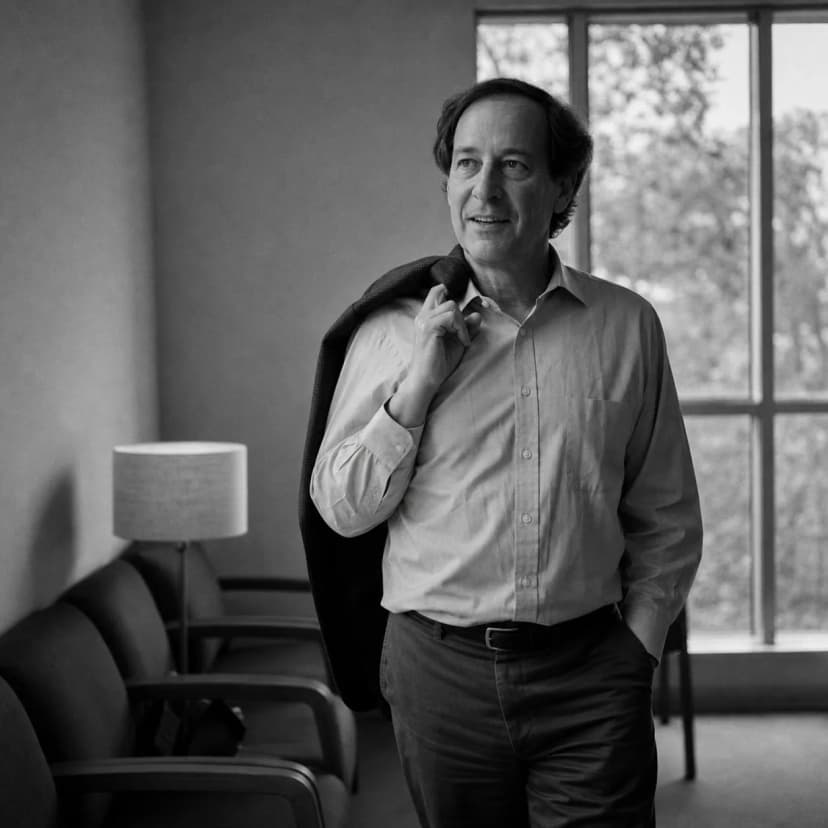
Peter J. Norton is a clinical psychologist whose main body of work is on transdiagnostic cognitive behavioural treatment for anxiety disorders. He is on this site for something smaller and stranger: with Brandon Weiss he ran the 2009 study that produced the Courage Measure and then tested it against behaviour. Thirty-two people with elevated spider fear filled in a self-report scale, then faced four taxidermied tarantulas and were asked to bring a hand as close as they were willing. Their courage scores predicted how close they got, even after controlling for how frightened of spiders they were. That is still, sixteen years later, the strongest behavioural evidence psychology has that self-reported courage predicts what a person does.
Who they are
Norton is a registered clinical psychologist and Professor of Psychology at the Cairnmillar Institute in Melbourne, where he is also Associate Head of School for Research. He was in the Department of Psychology at the University of Houston at the time of the 2009 study. His research career has been built on transdiagnostic group cognitive behavioural therapy for anxiety, including randomised trials comparing a single protocol across panic disorder, social anxiety disorder and generalised anxiety disorder against diagnosis-specific protocols, and he has published a treatment manual on the approach. He sits on the editorial boards of Cognitive Therapy and Research and the Journal of Anxiety Disorders.
The courage work grows out of that clinical territory rather than out of moral philosophy, and the definition reflects it. Norton and Weiss define courage as persistence in the face of fear: not the absence of fear but the continuation of effort despite the subjective experience of it. That is a definition a clinician can use, because it is what exposure therapy asks a patient to do.
The 2009 study is careful about its own weight, more careful than the literature that has since leaned on it. Its own title calls it a proof-of-concept pilot study. The sample was thirty-two people and the threat was a dead spider behind glass. There has since been one direct behavioural replication, by McKinlay and Norton, in which twenty-eight people who feared public speaking completed the same measure and then gave a timed speech. Their courage scores predicted how long they spoke.
The measure has also been criticised. Howard and Alipour argued in 2014 that the Courage Measure may not capture courage as the construct is usually understood, and may instead be indexing persistence, or the relative absence of fear, rather than action taken in spite of fear. Both positions have force. The scale does predict behaviour in two independent samples, which is more than most courage instruments can say, and the construct-validity objection is a fair one that the original authors did not answer. Our own view is that the argument about what the scale measures is downstream of a bigger problem: sixty people across two studies, facing a spider that cannot move and a lecture theatre, is not enough evidence to settle either question. The field's difficulty is not that Norton's instrument is bad. It is that nobody has done the harder study.
Key papers
Norton, P. J., & Weiss, B. J. (2009), "The role of courage on behavioral approach in a fear-eliciting situation: a proof-of-concept pilot study," Journal of Anxiety Disorders. N = 32 with elevated spider fear; the Courage Measure predicted approach distance to four taxidermied tarantulas after controlling for spider fear.
McKinlay, M. L., & Norton, P. J. (2023), "The role of courage in predicting behavior: replication in a public-speaking fearful sample," Motivation and Emotion. N = 28; the same measure predicted speech duration after controlling for public-speaking fear.
Norton, P. J. (2012), Group Cognitive-Behavioral Therapy of Anxiety: A Transdiagnostic Treatment Manual, Guilford Press. His main clinical contribution, unrelated to the courage work.
Key ideas
Courage as persistence despite fear: the continuation of effort while the fear is present, not its absence.
Self-reported courage predicts behavioural approach in a fear-eliciting situation, over and above how afraid of that specific thing the person is.
The authors' own framing is a proof of concept, and the field has treated a pilot as a foundation.
The critical case, made by Howard and Alipour in 2014, is that the scale may measure persistence or low fear rather than courage. It is a fair objection. It is also not the binding constraint, which is sample size and the triviality of the threat.
Concepts on this site
Find them elsewhere
He is now at Bond University, not Monash, and his staff page names the courage measurement work explicitly. The Scholar profile reads Peter J Norton with a Bond address and the anxiety corpus. No X, Bluesky or LinkedIn account could be confirmed, and the NortonPsych account is a publisher's feed, not his
Checked 2026-09-10. Handles and affiliations go out of date, so treat this block as a snapshot rather than a standing fact.
Sources
- Norton, P. J., & Weiss, B. J. (2009), "The role of courage on behavioral approach in a fear-eliciting situation: a proof-of-concept pilot study," Journal of Anxiety Disorders.
- McKinlay, M. L., & Norton, P. J. (2023), "The role of courage in predicting behavior: replication in a public-speaking fearful sample," Motivation and Emotion.
- Howard, M. C., & Alipour, K. K. (2014), "Does the courage measure really measure courage? A theoretical and empirical evaluation," The Journal of Positive Psychology, 9(5), 449-459.
- Norton, P. J. (2012), Group Cognitive-Behavioral Therapy of Anxiety: A Transdiagnostic Treatment Manual, Guilford Press.
- Cairnmillar Institute staff profile. (Current affiliation and role.)