Stephen Jay Gould
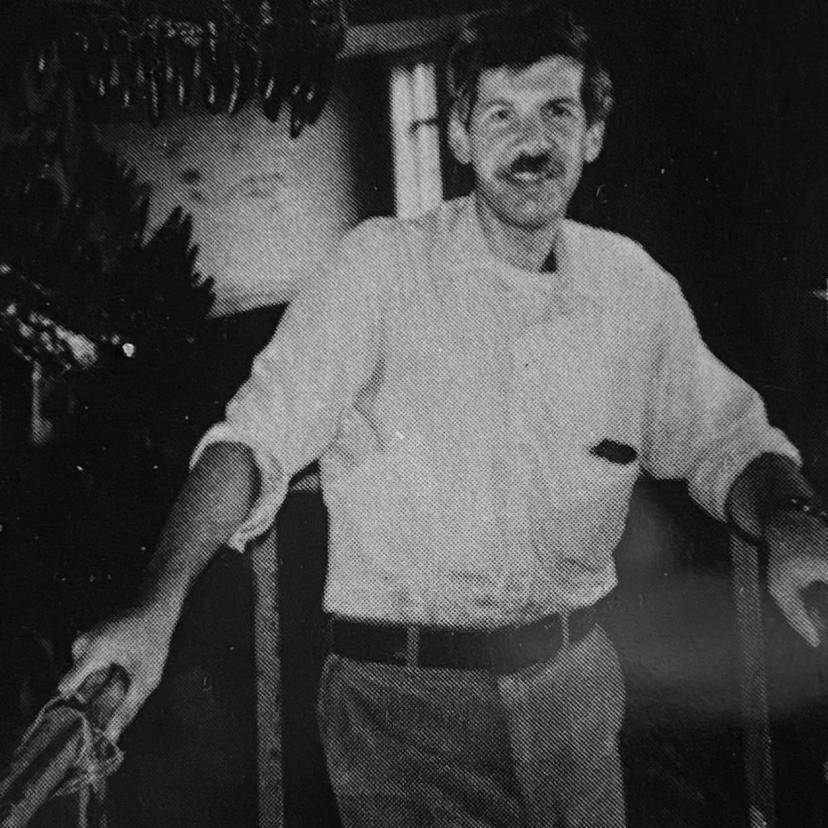
Stephen Jay Gould was an American palaeontologist and evolutionary biologist, 1941 to 2002. In this article he appears as first author, with Richard Lewontin, of the 1979 critique of the adaptationist programme.
Who they are
Gould taught at Harvard and wrote for a general readership for three decades. His 1979 paper with Richard Lewontin, published in the Proceedings of the Royal Society of London B, is the one used in this article.
Key papers
- Gould, S. J., & Lewontin, R. C. (1979). The spandrels of San Marco and the Panglossian paradigm: a critique of the adaptationist programme. Proceedings of the Royal Society of London. Series B. Biological Sciences, 205(1161), 581-598.
Key ideas
In this article Gould appears as first author, with Richard Lewontin, of the 1979 critique of the adaptationist programme. The paper criticised splitting organisms into separate traits, accepting plausible adaptive stories untested, confusing a trait's current use with the reason it arose, and neglecting by-products and developmental constraints. It proposed studying organisms as integrated wholes and endorsed a pluralist view of evolutionary causes.
Its spandrel image is used in the shopping debate to ask whether the pleasure of a bargain is a by-product. Evolutionary accounts of consumers answer by offering checkable predictions, and the article gives each side its case.
Sources
- Gould, S. J., & Lewontin, R. C. (1979). The spandrels of San Marco and the Panglossian paradigm: a critique of the adaptationist programme. Proceedings of the Royal Society of London. Series B. Biological Sciences, 205(1161), 581-598. https://doi.org/10.1098/rspb.1979.0086
Studies on this site by Gould
Articles that cite Stephen Jay Gould
- Is Shopping an Old Instinct
Shops are new and searching for good things to carry home is old. Evolutionary accounts and their critics read that gap differently, and the evidence gives each side something.
Concepts on this site
- Adaptationist Programme
The adaptationist programme is the name Stephen Jay Gould and Richard Lewontin gave in 1979 to the habit of explaining each trait of an organism by its own adaptive story. They argued that a…
- Borrowed Certainty
Borrowed certainty is the failure in which a book takes on the authority of research through register alone, while naming no researcher and supplying no apparatus that would let a reader find one…
- Construct Validity
Whether an instrument measures the thing its name says it measures. A test can be reliable, widely used, and predictive of something real, and still not be measuring what everyone assumes. It is the…
- Exaptation
An exaptation is a feature recruited for a use other than the one it evolved for. In the shopping debate it describes how a search capacity built for other purposes could be put to work in a shop.
- General Intelligence (g)
General intelligence, or g, is Charles Spearman's 1904 proposal that performance on any cognitive task reflects a general ability common to all such tasks plus a specific ability peculiar to that…
- Spandrel
A spandrel is a trait that arises as a by-product of other structures and may later be put to use. Gould and Lewontin took the word from architecture in 1979 to argue that a feature can be useful…
- The Intelligence Quotient
In 1912 the German psychologist William Stern proposed dividing mental age by chronological age rather than subtracting one from the other, which is what Alfred Binet had done. Lewis Terman, at…