Steven Fein
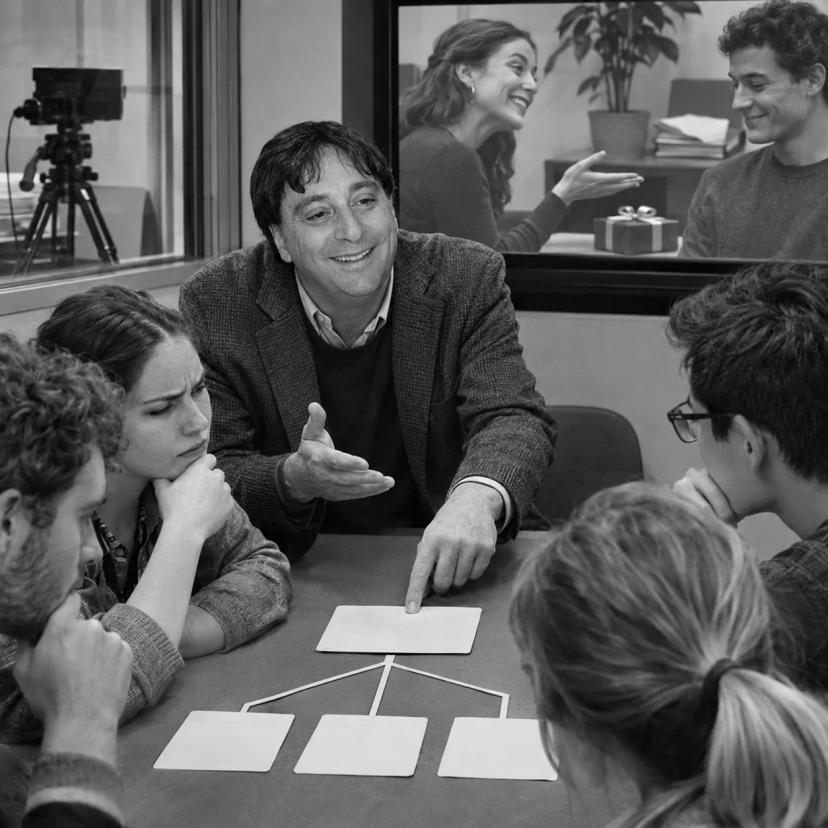
Social psychologist and first author, with James Hilton and Dale Miller, of the 1990 Journal of Personality and Social Psychology paper Suspicion of ulterior motivation and the correspondence bias.
Who they are
Steven Fein is a social psychologist. The work that connects him to this site is a 1990 paper written with James L. Hilton and Dale T. Miller, which sits in the research tradition on the correspondence bias, the research label for the fundamental attribution error. That tradition goes back to the 1967 essay study by Edward Jones and Victor Harris, in which readers inferred a writer's attitude from an essay even when told that the writer had been assigned the position.
The 1990 paper asks what protects a perceiver from drawing that kind of inference. Its answer concerns the contents of the perceiver's mind and not only the facts of the situation.
Key papers
Fein, S., Hilton, J. L., & Miller, D. T. (1990). Suspicion of ulterior motivation and the correspondence bias. Journal of Personality and Social Psychology, 58(5), 753-764. https://doi.org/10.1037/0022-3514.58.5.753
Key ideas
The paper reports three studies. It compares two kinds of information a perceiver can hold about an actor whose behaviour was prompted from outside. One kind is a situational constraint, such as knowing that the actor was instructed to behave in a certain way. The other is a set of plausible rival motives, such as a reason the actor might have to ingratiate or to avoid something unwelcome.
In the first two studies, participants told that an actor had been instructed to behave in a particular way still drew dispositional inferences that matched the behaviour. Participants who suspected that the actor was trying to ingratiate, in the first study, or trying to avoid an unwanted job, in the second, did not show the bias.
The third study addressed an obvious objection, that suspicious people might simply refuse to infer anything about a person. It found that the resistance did not reflect a general reluctance among suspicious perceivers to make dispositional inferences. The authors discussed what the findings mean for attribution theory.
The article What is the fundamental attribution error? uses the paper to show one of the conditions that moves the bias. Alongside the 1988 busyness experiments of Daniel Gilbert and colleagues and the 2018 individual-differences scale of Irene Scopelliti and colleagues, it is one of three studies the article uses to show that the error varies with the information a perceiver holds, the attention available and the person judging.
Sources
- Fein, S., Hilton, J. L., & Miller, D. T. (1990). Suspicion of ulterior motivation and the correspondence bias. Journal of Personality and Social Psychology, 58(5), 753-764. https://doi.org/10.1037/0022-3514.58.5.753
Studies on this site by Fein
- Suspicion of ulterior motivation and the correspondence bias
Fein (1990) · Journal of Personality and Social Psychology
Articles that cite Steven Fein
- What is the fundamental attribution error?
A ten-item scale, a busy-viewer experiment and a study of suspicion show that the fundamental attribution error is not one fixed habit but a judgement that moves with the person, the moment and the…
Concepts on this site
- The Fundamental Attribution Error
The fundamental attribution error is the tendency to explain what someone did by what they are like, and to underrate the situation that produced the behaviour. The finding behind the name comes…