Tanya Rosenblat
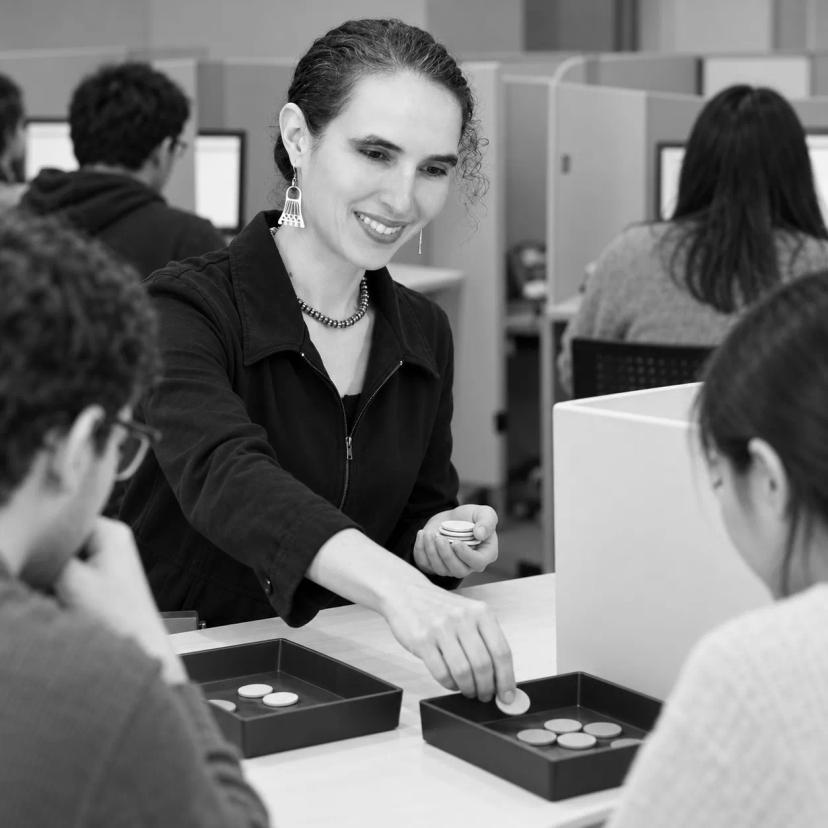
Tanya Rosenblat is an economist and the co-author, with Markus Mobius, of "Why beauty matters" (American Economic Review, 2006), an experimental wage market that split the beauty premium into confidence, employers' mistaken judgements of ability and communication skills.
Who they are
Rosenblat appears on this site as second author of one paper.
A recommendation to the University of Michigan Board of Regents in May 2019 describes her as associate professor of information with tenure in the School of Information and associate professor of economics in the College of Literature, Science, and the Arts, recommended for promotion to full professor in both. It gives her degrees as a B.A. and M.A. from Northwestern University (1994) and a Ph.D. from MIT (1999).
The same document summarises her work as behavioural economics, with two main areas: the economics of social networks, and the economics of belief formation, especially how beliefs affect labour market outcomes. It adds that she studies discrimination and persistent gender differences, using laboratory and large-scale field experiments. It calls "Why Beauty Matters" (American Economic Review, 2006) her best-known work alongside "Managing Self-Confidence", on male overconfidence and how people update beliefs. Other selected papers it lists include Ethnic Discrimination: Evidence from China (with Markus Mobius and Qiqi Wang, European Economic Review, 2016) and Social Norms Regarding Bribing in India: An Experimental Analysis (with Ritwik Banerjee and Tushi Baul, Schmollers Jahrbuch, 2016). The document counted 18 publications at the time, 12 of them peer-reviewed journal articles. This is a 2019 snapshot; her current position was not checked.
Key papers
The experiment ran 33 sessions with 330 participants at the Universidad Nacional de Tucumán in Argentina, 165 as workers and 165 as employers. Workers solved mazes on a computer. Fifty high-school students rated each worker's facial photograph from plain to above-average beautiful. Employers set wages after seeing a résumé alone, a photograph, a phone interview, a photograph with a phone interview, or a face-to-face interview. Beauty did not significantly predict how many mazes a worker solved.
The paper's abstract names three channels. Attractive workers were more confident, and confidence raised wages. At the same confidence level, employers wrongly judged attractive workers to be more able. And after controlling for confidence, attractive workers' communication and social skills raised their wages in the exchange with employers.
Key ideas
Three channels, not one. The decomposition is the paper's contribution. A premium for looks is not a single mechanism: confidence, employers' misjudgement of ability and communication skill each contribute.
Same method, other gaps. The authors suggest the design could be applied to other sources of discriminatory pay differences. Verified for this page is that suggestion and the single paper, nothing more.
The first author's page, Markus Mobius, gives the sizes of the premium under each way employers met the worker.
Sources
- Mobius, M. M., & Rosenblat, T. S. (2006). 'Why beauty matters.' American Economic Review, 96(1), 222-235.
- University of Michigan Board of Regents (May 2019). Recommendation for promotion, Tanya Rosenblat. regents.umich.edu
- Vault note: [[Tanya Rosenblat]].
Articles that cite Tanya Rosenblat
- Do Good-Looking People Earn More
The claim that good-looking people earn more is repeated without a source in a popular psychology book. Four studies, a survey, an experiment pool, a wage experiment and a CV field test, put figures…
Concepts on this site
- The Attractiveness Premium
The attractiveness premium is the systematically better treatment physically attractive people receive across situations that have nothing to do with appearance. It is the applied face of the…