Do People Buy Lipstick in a Recession
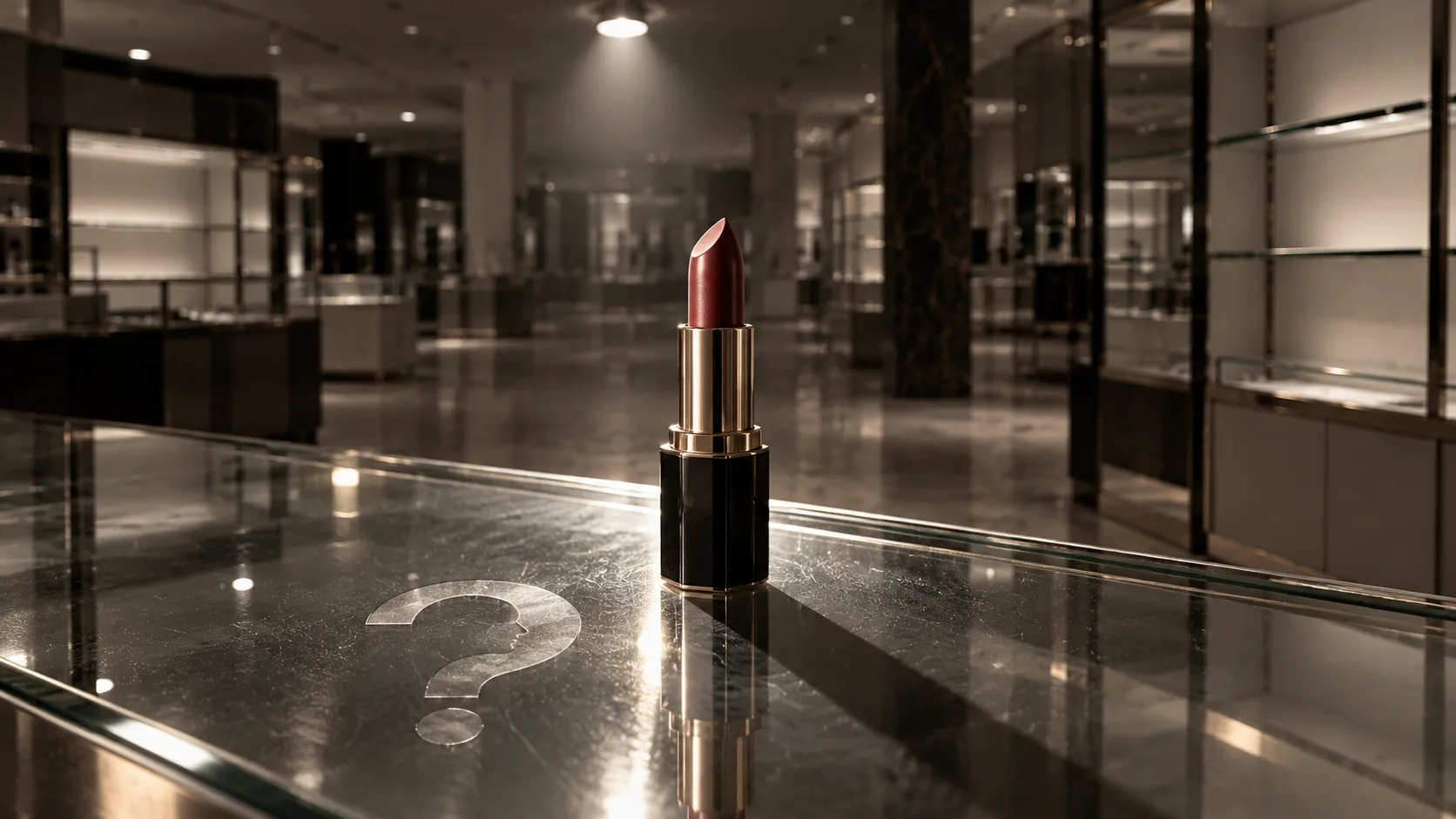
Adrian Furnham's The New Psychology says the lipstick effect has long been established, and gives no source. The published work splits it into three claims: what women want, what spending shows, and why.
Answer to the question
Do people buy lipstick in a recession?
Some do. Laboratory studies show women's desire for beauty products rising when recession cues are shown, and two spending studies found lipstick or cosmetics demand holding up in the 2007 to 2009 downturn. Press figures for 2009 and 2020 show lipstick sales falling, so the pattern is not general.
Key takeaways
- Furnham (2024) states the lipstick effect as long established, with no study, researcher or year. The claim is three separate ones: what women want, what spending shows, and why.
- Hill and colleagues (2012) found women, not men, rating beauty products higher after recession cues in a 154-student experiment (6.19 against 4.97). Their real-world data ran from 1992 to 2011.
- Li and colleagues (2020) report the income sensitivity of lipstick demand falling from 0.31 to 0.05 in the 2007 to 2009 recession, and recovering to 0.31 by mid-2014.
- MacDonald and Dildar (2020) found cosmetics spending rose among women aged 18 to 40 regardless of marital or employment status, which counts against the partner and job explanations.
- Quartz (2020), citing McKinsey, reports makeup sales down by up to 30 per cent globally in 2020; it also cites Fortune for lipstick sales down nearly 10 per cent in 2009.
Adrian Furnham's The New Psychology says the lipstick effect has long been established. It gives no study, researcher or year.
He states that the Lipstick Effect is long established: when the economy is down, spending on beauty products rises, lipstick above all. Behind it sit three separate claims, and each has been tested in a different way, on different people, with different measures and over different years.
The sentence sits in the book's entry on cosmetic surgery.
The first is psychological: when people feel economically threatened, they come to want certain products more. The second is economic: aggregate spending on cosmetics rises when the economy falls. The third concerns motive, and asks why either of the first two would be true. Popular retellings fuse the three, and the evidence differs for each.
A result about what people say they want in a laboratory is not a till receipt, and a till receipt says nothing about why anyone bought.
Furnham supplies his own motive, that beauty is "seen as Currency" which raises the chance of a job or a relationship, and calls the spending "Investment Therapy". Both phrases are his framing rather than terms from the research literature, and he cites nothing for either.
What women in the laboratory wanted
The experimental claim rests mainly on a paper in the Journal of Personality and Social Psychology by Sarah Hill and four colleagues. It opens with real-world data on American unemployment and retail spending, and goes on to experiments with university students.
The data run monthly from January 1992 to April 2011, 232 months in all. As unemployment rose, the share of spending going to personal care and cosmetics rose with it, while the shares going to furniture, electronics and leisure goods fell. Raw spending showed the same direction more weakly, and because these are correlations in time they cannot say what caused what.
The experiments came next. In one, 154 university students read either a news article about the recession or an article about architecture. Women who read about the recession rated beauty products higher than the control group did (6.19 against 4.97) and rated ordinary goods such as a stapler lower. Men who read it wanted both kinds of product less. A pretest showed the article lowered readers' estimates of how many people have good jobs and incomes, but not their estimates of how many people are attractive.
Two further experiments used unmarried female students and a slideshow of unemployment lines and foreclosure signs. The recession group wanted luxury beauty products more, and discount beauty products no more than the control group did. A woman's own social class made no difference, which the authors read as evidence against a purely social-roles account. These women also put more weight on a partner's financial stability, and that preference accounted for part of the rise in desire for beauty products.
A final experiment showed advertisements for jeans, perfume and boots with either mating slogans or neutral ones. Recession cues raised interest in the mating versions only, and the effect was strongest among women who had said, about two weeks earlier, that they were highly motivated to attract a long-term partner. The experimental samples were all university students, and the later experiments tested women only.
Spending records, and a dispute about motive
Two later studies went to spending data instead of volunteers. Wenying Li and colleagues used weekly American retail scanner data on lipstick from 2006 to 2016. By their estimate, the sensitivity of lipstick demand to income fell from 0.31 to 0.05 during the 2007 to 2009 recession and returned to 0.31 by the second quarter of 2014. Buyers, on this reading, stopped trimming their purchases as incomes fell.
Daniel MacDonald and Yasemin Dildar used the American household expenditure diary survey for 2005 to 2014, with the recession set at 2008 to 2010. Cosmetics spending rose significantly among women aged 18 to 40.
The table sets the three real-world tests side by side.
| Test | Data | What it reported |
|---|---|---|
| Hill and colleagues, 2012 | US unemployment and retail spending shares, 1992 to 2011 | Cosmetics share rose with unemployment |
| Li and colleagues, 2020 | US weekly lipstick scanner data, 2006 to 2016 | Income sensitivity of demand fell in the recession, then recovered |
| MacDonald and Dildar, 2020 | US household expenditure diary survey, 2005 to 2014 | Cosmetics spending rose among women aged 18 to 40 |
The measures differ: a share of retail spending, an income sensitivity for one product, and average spending by women in one age band.
The motive keeps moving. Hill and colleagues found partner preference carrying part of the effect. Ekaterina Netchaeva and McKenzie Rees, in Psychological Science in 2016, reported that women with high economic concern used appearance products both to attract partners and to make a good impression at work, and that the professional motive was the stronger one. MacDonald and Dildar tested a mating account, an employment account and a treat-yourself substitution account. The rise held regardless of marital or employment status, which counts against the first two, and the data fit women cutting back on clothing and spending part of the saving on cosmetics.
Where the name came from, and what 2020 added
Hill and colleagues say journalists coined the term in 2001 and that cosmetics sales were reported to have boomed in the Great Depression. Quartz, writing in 2020, credits Leonard Lauder of Estée Lauder with naming the lipstick index in 2001, after the company's lipstick sales reportedly spiked in the downturn.
The pandemic recession gave the idea another test. Quartz cited a McKinsey report that makeup sales fell by up to 30 per cent globally in 2020, with Amazon sales of lip care and colour down 15 per cent year on year in the four weeks to 11 April, the largest fall of any category. It also cited a Fortune report that lipstick sales fell nearly 10 per cent in 2009. These are press accounts of industry figures, not peer-reviewed studies. Quartz wanted the index replaced by overall consumer spending.
Common questions
Do people buy lipstick in a recession?
Some do. Laboratory work shows women's desire for beauty products rising when recession cues are shown, and two spending studies found lipstick or cosmetics demand holding up in the 2007 to 2009 downturn. Press figures for 2009 and 2020 show sales falling, so the pattern is not general.
Who coined the lipstick effect?
Hill and colleagues say journalists coined it in 2001. Quartz credits Leonard Lauder of Estée Lauder, who is reported to have named the lipstick index after the company's lipstick sales rose that year. Furnham gives no source for it.
Does the lipstick effect apply to men?
The main experiments tested women. In the 2012 paper, recession cues lowered men's desire for both beauty and ordinary products, and the authors did not follow men's responses further.
Sources
Furnham, A. (2024). The New Psychology: The 50 Newest Concepts That Are Shaping How We Live and Work. London: Bloomsbury Business. Seed book; vault hub Books/The New Psychology.
Hill, S. E., Rodeheffer, C. D., Griskevicius, V., Durante, K., & White, A. E. (2012). “Boosting beauty in an economic decline: Mating, spending, and the lipstick effect.” Journal of Personality and Social Psychology, 103(2), 275-291. doi:10.1037/a0028657 https://doi.org/10.1037/a0028657
Netchaeva, E., & Rees, M. R. (2016). “Strategically stunning: The professional motivations behind the lipstick effect.” Psychological Science, 27(8), 1157-1168. doi:10.1177/0956797616654677 https://doi.org/10.1177/0956797616654677
Li, W., Zhen, C., & Dorfman, J. H. (2020). “Modelling with flexibility through the business cycle: using a panel smooth transition model to test for the lipstick effect.” Applied Economics, 52(25), 2694-2704. doi:10.1080/00036846.2019.1693701 https://doi.org/10.1080/00036846.2019.1693701
MacDonald, D., & Dildar, Y. (2020). “Social and psychological determinants of consumption: Evidence for the lipstick effect during the Great Recession.” Journal of Behavioral and Experimental Economics, 86, 101527. doi:10.1016/j.socec.2020.101527 https://doi.org/10.1016/j.socec.2020.101527
Quartz (2020). “It is time for the lipstick index to go away for good.” News report, citing a McKinsey report and Fortune. https://qz.com/1887917/it-is-time-for-the-lipstick-index-to-go-away-for-good/