What the Pink Cell Never Proved
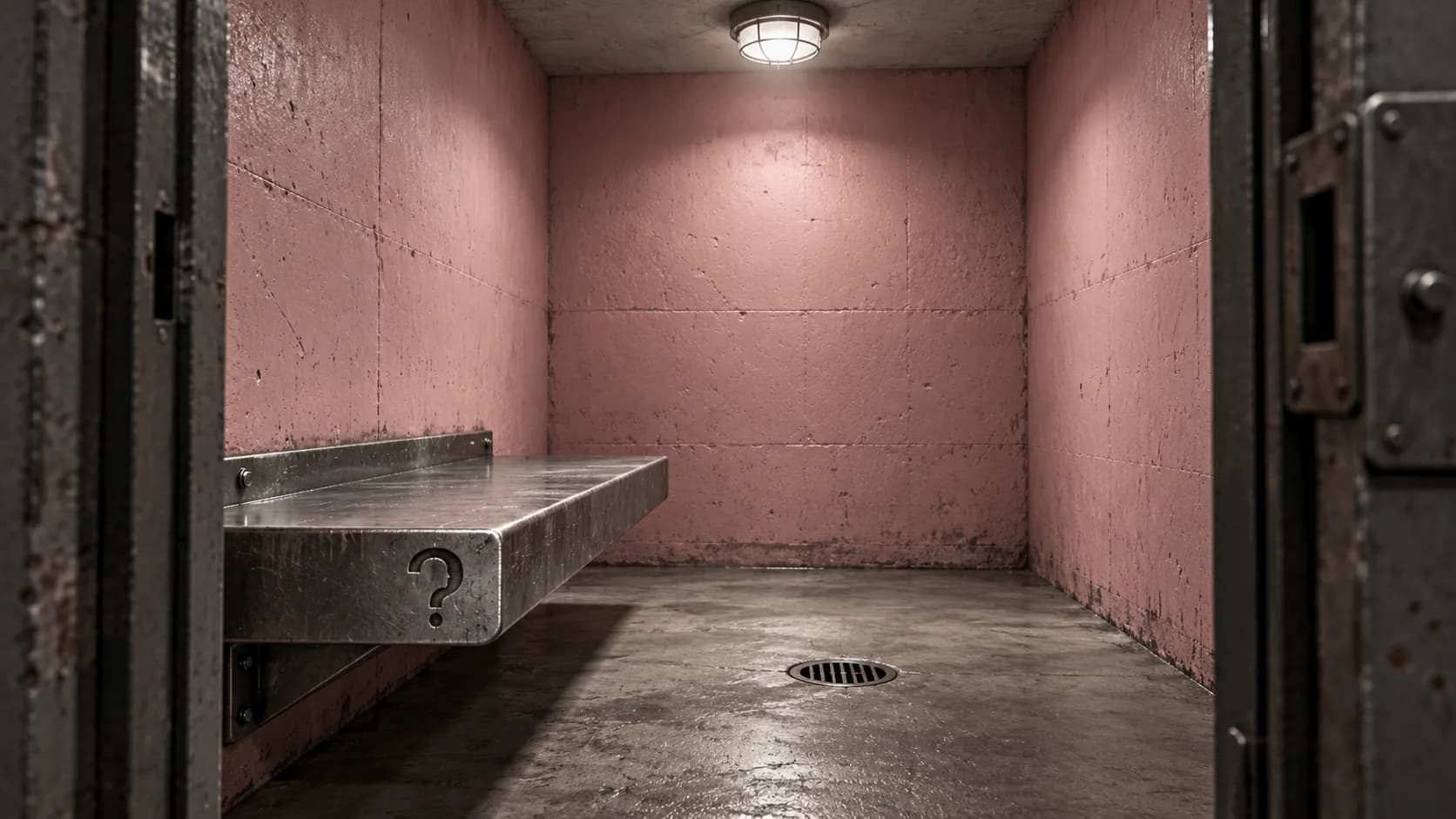
A pink cell in Seattle in 1979 gave a colour its name and a claim its reputation. The tests with a comparison group, in a county facility and in Swiss detention cells, found no calming effect of the colour.
Answer to the question
Does pink really calm people down?
Not in the tests with a comparison group that were read for this piece. A 1981 county-facility comparison found incidents fell in the first month and then rose, and a 2015 randomised trial of 59 Swiss prisoners found aggression fell in pink and white cells alike. The original strength claim and the Seattle cell had no comparison cell.
Key takeaways
- Alexander Schauss reported in 1979 that 153 men were judged weaker after looking at a pink card for a minute. The Seattle cell that gave Baker-Miller pink its name had no comparison cell.
- A 1981 comparison of a Santa Clara County detention room before and after it was painted pink found incidents fell in the first month, then rose and peaked in the second half of the pink year.
- In 2015 Oliver Genschow and colleagues randomly assigned 59 Swiss prisoners to pink or white cells. Aggression fell in both and the colour made no difference at any point.
- Iowa's football coach told the Cedar Rapids Gazette in 1989 that the pink visitors' locker room was a psychological tactic, and the room was still pink in 2013.
Two officers at a naval correctional centre in Seattle had a holding cell painted pink, and the shade took their names. Baker-Miller pink became the colour of a claim, that looking at it calms people down. Detention centres across the Western world later painted cells the same way.
1979: The Seattle Cell
The cell was a field observation, not an experiment. Over seven months, agitated new arrivals at the Seattle centre reportedly calmed within about fifteen minutes of being put in it, and no violent incidents were recorded. The account Adam Alter gives in Drunk Tank Pink has no comparison cell and no measure beyond what staff saw.
The laboratory side of the claim came from Alexander Schauss, who published two small experiments in the final 1979 issue of a journal, Orthomolecular Psychiatry, that closed that year. In the first, 153 men looked at a pink card for a minute and all but two were judged weaker afterwards. In the second, 38 men were measured on a dynamometer, a grip-strength device, and none was an exception. The inference that carried into prisons, as Oliver Genschow's team later summarised it, was that a colour that weakens physical strength should lower aggression.
Alter, a psychologist at NYU Stern, named his 2013 book after the effect, but his endnotes, on page 229, say that Schauss "continued to test the effect, sometimes but not always finding support", and print the papers in two columns, supporting and not. The body of the book says only that by the late 1990s "some researchers found weaker evidence for the original effect."
Most of the pink literature Alter's notes cite appeared in Orthomolecular Psychiatry and Perceptual and Motor Skills. The chapter on colour never returns to pink and takes up red and blue instead, a story told in What Red Actually Does and Why Brands Reach for Blue. The book appeared in 2013, as the replication reckoning was starting, which is the subject of The Psychology You Learned Didn't Replicate.
1981: A Holding Room Repainted
One of the papers in the non-supporting column is Schauss's own. The 1981 paper, which Schauss co-wrote, compared aggressive encounters between officers and detainees in the year before and the year after the strip-search room of a Santa Clara County detention facility was repainted from pale blue to hot pink. Incidents fell in the first month, then rose, and peaked in the second half of the pink year. The authors read the early drop as possibly an artefact of the intervention, and the annotation that summarises the paper concludes that overall rates differed little.
The room measured about 13 feet 4 inches by 15 feet 6 inches, which the authors noted was considerably larger than the holding rooms in facilities that had reported success.
I have capitalized on that just from a psychological standpoint.
Support of a kind came from a sheriff's intake facility in California, where a report the same year followed 50 aggressive detainees through a pink room for an average of 14.58 minutes and found improvement in every category of aggression but one. Its own summary notes that it had no control group.
The belief outlasted the evidence. At the University of Iowa, the visiting team's locker room at Kinnick Stadium was painted pink, and the football coach confirmed to the Cedar Rapids Gazette in 1989 that he had started the tradition. The Toledo Blade reported that he thought the colour calming, and he described its use as tactical: "I have capitalized on that just from a psychological standpoint." If opponents worry "about the color of a dressing room," he said, that "gives us an advantage." The pink ran to the urinals, towels and shower tiles, the Gazette reported, and the room was still pink in 2013.
2015: Swiss Cells, Randomised
A controlled test inside cells came more than thirty years after the first claims. Oliver Genschow and colleagues assigned 59 male prisoners, held in special detention in Switzerland for breaking institutional rules, at random to an entirely pink cell or to a white cell with a grey floor of the same size. Guards rated each man's aggression on arrival and again after three days.
The paper also goes back over the original methods. The British Psychological Society's Research Digest, summarising the paper, describes one early study of strength in which the experimenter could see the card's colour, which leaves room for experimenter expectancy, the way a measurer's hopes can leak into the measurement. It describes another that compared the two kinds of cell in different years without random assignment.
Aggression fell over the three days in both kinds of cell, and the colour made no difference at any point. The result held when prisoners who began calm and prisoners who began aggressive were analysed separately. The authors allowed that 59 men might be too few to detect a small effect, and raised the opposite worry, that the colour could backfire by attacking inmates' "perceived manhood" or causing feelings of humiliation.
Common questions
Does pink really calm people down?
Not in the tests with a comparison group that were read for this piece. A 1981 county-facility comparison found incidents fell in the first month and then rose, and a 2015 randomised trial of 59 Swiss prisoners found aggression fell in pink and white cells alike. The original strength claim and the Seattle cell had no comparison cell.
What is Baker-Miller pink?
It is the shade of pink painted in a Seattle naval correctional cell in 1979, named after the two officers who did it. Alexander Schauss had claimed that looking at it briefly weakened men and calmed aggression. The name now stands for the claim as much as for the colour.
Why is a football locker room pink?
At Iowa's Kinnick Stadium the visiting locker room has been painted that colour since the coach began the tradition, and in 1989 he called it a psychological tactic. He thought the colour calming, and said that opponents worried about the room's colour gave Iowa an advantage.
Sources
Alter, A. (2013). Drunk Tank Pink: And Other Unexpected Forces That Shape How We Think, Feel, and Behave. New York: Penguin Press. Prologue and endnote on p. 229, which describe Schauss's two 1979 experiments; the originals were not read. Mixed reliability, recorded in the vault hub.
Pellegrini, R. J., Schauss, A. G., & Miller, M. E. (1981). 'Room Color and Aggression in a Criminal Detention Holding Cell: A Test of the Tranquilizing Pink Hypothesis.' Journal of Orthomolecular Psychiatry, 10(3), 174-181. NCJ 89729.
Genschow, O., Noll, T., Wänke, M., & Gersbach, R. (2015). 'Does Baker-Miller pink reduce aggression in prison detention cells? A critical empirical examination.' Psychology, Crime & Law, 21(5), 482-489. doi:10.1080/1068316X.2014.989172.
Caudill, C. (1981). 'Pink Room: A Color and Aggression Study in a Correctional Environment.' NCJ 76932, National Criminal Justice Reference Service.
British Psychological Society Research Digest (2014, 2 December). 'Are prisoners calmer when their cells are painted pink?' Summary of Genschow et al.
Toledo Blade (2013, 21 November). 'Iowa wants visiting teams to think pink.' Quoting the head coach's 1989 interview with the Cedar Rapids Gazette.