Fear of Missing Out at the Till
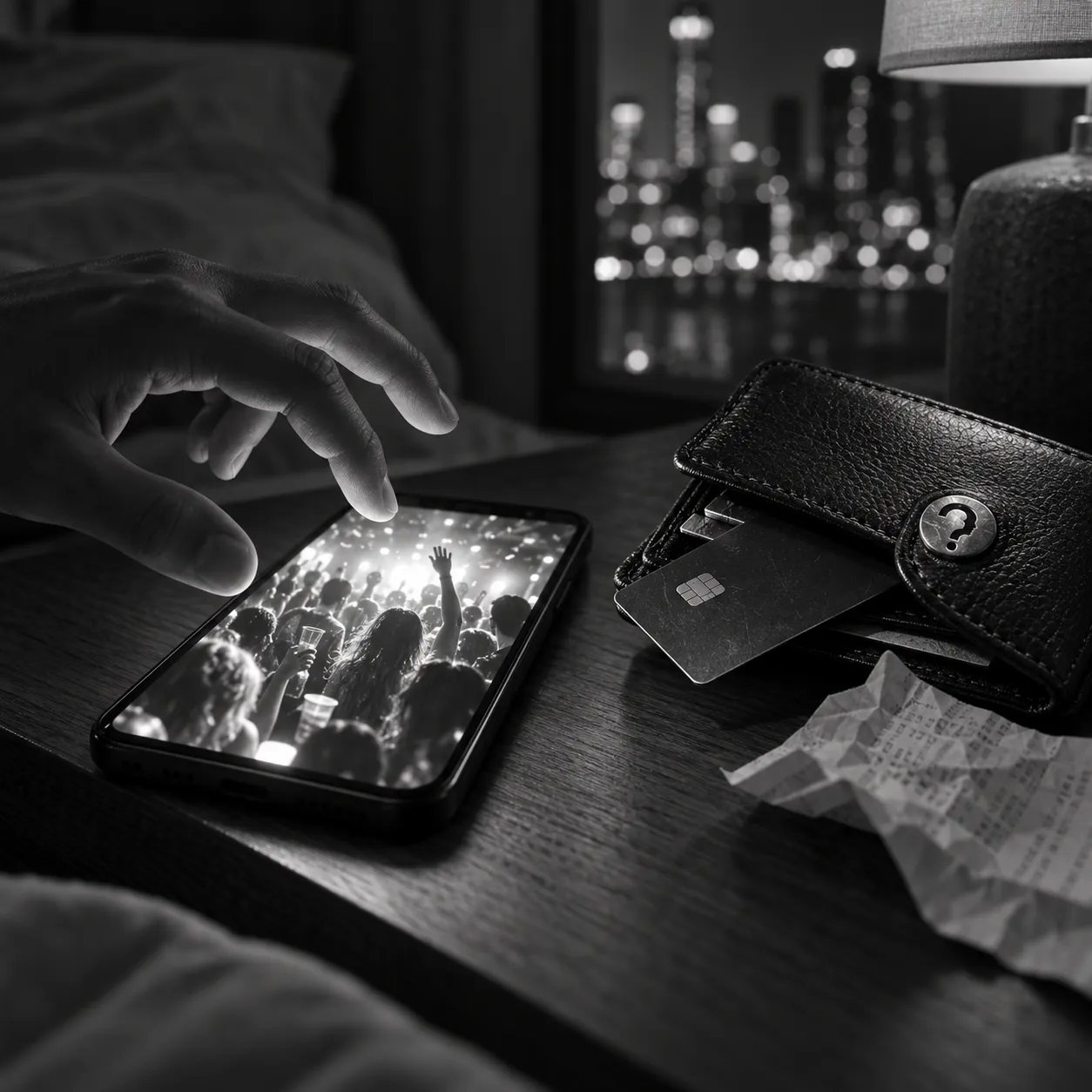
A humour column at Harvard Business School named FOMO in 2004, and psychologists turned it into a ten-item scale in 2013. Its route from there to the shop floor runs through four shopping studies and a book on scarcity.
Answer to the question
Does fear of missing out make people spend more?
Possibly, but it is unproven. Surveys link stronger fear of missing out with more impulse buying, including a 2019 study of 386 women in Turkey, and Megan Good and Michael Hyman's 2021 experiment found that messages built on the feeling could raise or lower intentions to buy. The studies measured intentions and self-reports, not receipts.
Key takeaways
- Andrew Przybylski and colleagues built the ten-item fear of missing out scale in 2013 from three one-time surveys of more than 3,000 people, none of which asked about money.
- In 2019 Işıl Karapınar Çelik and colleagues found, among 386 women in Turkey, that higher fear of missing out went with more impulse buying, and impulse buying with regret.
- In Megan Good and Michael Hyman's 2021 experiment, messages built on missing out raised intentions to buy through anticipated elation and lowered them through anticipated regret about the expense.
Say it is a Thursday night. Your phone shows three friends at a gig you decided to skip, and a resale site still has tickets at twice the face value. Ten minutes later you have paid, and the explanation you give yourself is fear of missing out.
2004: a student column names it
The acronym first appeared in student comedy. Patrick McGinnis, then an MBA student at Harvard Business School, wrote a column for the humour section of the school paper, The Harbus, called "Social Theory at HBS: McGinnis' Two FOs". It described the anxieties of a student social life crowded with options.
Its definition of the new acronym fitted in one sentence:
> "In this state of social flux, FOMO, or Fear Of Missing Out, weighs heavily on the psyche."
Its partner was FOBO, the fear of a better option, which the column said drives people in the other direction. The column ran in May, as its author neared graduation, and the paper later credited McGinnis with creating the term while he was a student there. Its subject was social life, not money. It described invitations, back-to-back evening events and the risk of accepting one plan before a better offer arrived. It made no claim about shops, prices or purchases, and it offered the feeling as a piece of campus comedy rather than as anything that could be measured.
A loose word is hard to study. To test whether the feeling changes behaviour, a researcher needs a definition, a fixed set of questions and a way of telling one person's level of worry from another's. That arrived in the following decade, from psychologists interested in social media rather than from anyone studying shoppers.
2013: psychologists build a scale
A team led by Andrew Przybylski then published a ten-item measure in Computers in Human Behavior, built on a definition that ties the feeling to other people rather than to things.
Their definition reads in full:
> Fear of missing out is "a pervasive apprehension that others might be having rewarding experiences from which one is absent".
They added that it is marked by a desire to stay continually connected with what others are doing, and they grounded it in self-determination theory, the account developed by Edward Deci and Richard Ryan, which holds that people need to feel competent, autonomous and connected to others.
The team began with 32 candidate statements and kept the ten that worked best together. They then ran three surveys. The first reached 1,013 adults online, most of them in the United States or India. The second covered 2,079 working-age adults in Great Britain. The third asked 87 first-year university students about their habits.
The pattern was consistent. Younger people reported more fear of missing out. So did people whose basic psychological needs were less well met, and the fear was linked to heavier social media use, lower mood and lower satisfaction with life. Among the students, those who scored higher used Facebook more during lectures, and among the 62 who drove regularly, they used their phones more at the wheel.
None of the three surveys asked about money, prices or anything the participants had bought. The authors were also clear about what their design could show: their studies were "one-time surveys" that "reflect snapshots of individuals in time", and they called for experiments to test causal accounts.
2019 to 2021: researchers go shopping
Marketing researchers took the idea, and versions of the scale, to the shops, and asked whether the feeling shows up in what people buy.
Four studies from the next wave show the range.
- In 2019 Işıl Karapınar Çelik and colleagues surveyed 386 women in Turkey who follow weekly store offers. Higher fear of missing out went with more impulse buying, and impulse buying with regret afterwards.
- In 2020 Megan Good and Michael Hyman reported that adverts praising the future experiences of close friends or family can produce a spike of the feeling.
- In 2021 an online survey of 243 people linked imitating social media influencers with social comparison, materialism and the fear, and all three with intentions to buy what influencers endorse.
- In 2021 Good and Hyman tested such messages in a vignette experiment and found they could raise or lower intentions to buy.
The fourth study is the one that changed something on purpose and watched what followed, and its result ran in two directions. A message built on missing out raised purchase intentions when it made people anticipate elation and a boost to how they saw themselves. It lowered them when it made people anticipate regret about the expense. A message that pulls one reader towards a booking can remind another of the bill.
A message that pulls one reader towards a booking can remind another of the bill.
The first study is the closest to real spending, and it measured impulse buying by asking the women to describe their own habits. In its own regression results, the direct link between fear of missing out and later regret explained almost none of the variation, while the link between impulse buying and regret was clearer. Anyone tempted to blame the feeling itself for the remorse should notice that gap.
2021: the evidence is mostly snapshots
Each survey in the list asked people once, at one moment, about a feeling and a habit, and then looked at how the two moved together. A design like that leaves the order open. Anxious people may shop more on impulse. People who shop on impulse may also describe themselves as anxious about missing things. Or a third factor, such as age, may drive both, since younger people report more of the fear.
In 2021 Akbari and colleagues pooled 86 effects from 55,134 participants in a meta-analysis of fear of missing out and internet use. The association was always positive, but it ranged from weak to strong between studies, the pandemic was the only factor that significantly strengthened it, and they found no evidence of a two-way relationship. A link with time spent online, however steady, says little about what happens at the checkout.
The measure itself is still being argued over. In 2020 a paper in Psychology & Marketing proposed a new scale, on the grounds that existing ones confine fear of missing out to social media. The new version splits it into a personal and a social dimension, which means two studies using different scales may not be measuring quite the same thing.
People who score high on fear of missing out do report more impulse buying, and messages built on the feeling can shift what people say they will buy, upwards or downwards. None of these studies measured money actually spent, and none followed the same shoppers over time, so the claim that the feeling raises spending rests on intentions and self-reports.
2023: a scarcity book adopts it
The commercial version of the idea arrives in Mindy Weinstein's The Power of Scarcity, a book for marketers, whose fourth chapter puts its thesis in the title:
> "FOMO: Why We're More Afraid of Loss Than We Are of Gain"
The chapter, at pages 61 to 76, argues that restocks, waiting lists, expiring coupons and limited-time offers work because shoppers dread losing a chance more than they value an equal gain, and it uses fear of missing out as the name for that dread. The acronym is spelled out once, at page xiv, and the chapter supports its findings on regret and framing with cited studies.
Elsewhere it is candid about the tool it describes, calling scarcity "a force that is extremely fragile", easily spoiled by overuse or by claims that are not true.
The scarcity effect the chapter describes has its own evidence. In 2022 Belinda Barton and colleagues pooled 416 effects from 131 studies and found that scarcity cues generally made products more desirable, with the best type depending on the product. Messages that something is popular worked best for practical goods, limited supply for experiences, and time limits for high-involvement purchases. Claims that only a few are left, and deadlines that end tonight, can move people without any help from a personality trait.
What is missing is the bridge between the two literatures. The scarcity studies vary the offer, and the fear of missing out studies measure the person. The chapter's mechanism joins the two, and the studies above leave that join unmeasured, so it stays plausible and unproven. For a shopper, that shifts attention from the feeling to the offer, since a deadline is a fact about the seller's plan and can be checked. The scarcity evidence stands up without fear of missing out.
The scarcity studies vary the offer, and the fear of missing out studies measure the person.
Common questions
Does fear of missing out make people spend more?
Possibly, but it is unproven. Surveys link stronger fear of missing out with more impulse buying, including a 2019 study of 386 women in Turkey. Megan Good and Michael Hyman's 2021 experiment found that messages built on the feeling could raise or lower intentions to buy. The studies measured intentions and self-reports, not receipts.
Who coined the term FOMO?
Patrick McGinnis used the acronym in a May 2004 humour column for The Harbus, the Harvard Business School paper, alongside FOBO, the fear of a better option. The research definition and the ten-item scale came later, from Andrew Przybylski and colleagues in 2013.
How is fear of missing out measured?
A common measure is the ten-item scale that Przybylski and colleagues published in 2013, built from 32 candidate statements and tested on more than 3,000 people across three surveys. A 2020 paper in Psychology & Marketing proposed a two-part alternative, separating personal and social fear of missing out.
Sources
McGinnis, P. J. (2004). Social Theory at HBS: McGinnis' Two FOs. The Harbus, humour section, May 2004; republished in The Harbus archive, 23 August 2023. Full text read (republished version): 'In this state of social flux, FOMO, or Fear Of Missing Out, weighs heavily on the psyche'; FOBO, the fear of a better option; no mention of shopping, prices or purchases. Date and authorship from Deliakis, M. (2019), 'Help, I'm a FOMO Sapiens', The Harbus, 10 November 2019, full text read: McGinnis (MBA '04) 'created the term FOMO while a student at HBS'; column ran in the Humor section in May 2004.
Przybylski, A. K., Murayama, K., DeHaan, C. R., & Gladwell, V. (2013). Motivational, emotional, and behavioral correlates of fear of missing out. Computers in Human Behavior, 29(4), 1841-1848. doi:10.1016/j.chb.2013.02.014. Full text read: definition quoted; 32 candidate items reduced to 10; Study 1, 1,013 adults via Mechanical Turk, 41.1 per cent United States and 35.9 per cent India; Study 2, 2,079 British adults aged 22 to 65; Study 3, 87 first-year undergraduates, 62 regular drivers; FoMO negatively related to age; all one-time surveys, 'reflect snapshots of individuals in time'.
Karapınar Çelik, I., Eru, O., & Çop, R. (2019). The effects of consumers' FoMo tendencies on impulse buying and the effects of impulse buying on post-purchase regret: an investigation on retail stores. BRAIN: Broad Research in Artificial Intelligence and Neuroscience, 10(3), 124-138. Full text read: online survey July to October 2018; 507 respondents, 386 analysed, women who follow retail stores' weekly offers in Turkey; FoMo affects impulse purchasing, impulse purchasing influences post-purchase regret; direct FoMo to regret regression R squared .002.
Good, M. C., & Hyman, M. R. (2020). 'Fear of missing out': antecedents and influence on purchase likelihood. Journal of Marketing Theory and Practice, 28(3), 330-341. doi:10.1080/10696679.2020.1766359. Abstract read: anticipated elation and anticipated envy boost FOMO; comforting rationalisations decrease it; FOMO-laden appeals extolling the future experiences of close friends or family members can induce a FOMO spike.
Dinh, T. C. T., & Lee, Y. (2022). 'I want to be as trendy as influencers': how 'fear of missing out' leads to buying intention for products endorsed by social media influencers. Journal of Research in Interactive Marketing, 16(3), 346-364. doi:10.1108/JRIM-04-2021-0127. Abstract read: online survey of 243 respondents via Mechanical Turk; imitation of influencers affects social comparison, materialism and FOMO, which affect buying intention toward endorsed products. Published online 2021.
Good, M. C., & Hyman, M. R. (2021). Direct and indirect effects of fear-of-missing-out appeals on purchase likelihood. Journal of Consumer Behaviour, 20(3), 564-576. doi:10.1002/cb.1885. Abstract read: vignette-based experiment; FOMO-laden appeals can strengthen purchase intentions by boosting anticipated elation and self-enhancement or weaken them by boosting anticipated expense regret.
Akbari, M., Seydavi, M., Palmieri, S., Mansueto, G., Caselli, G., & Spada, M. M. (2021). Fear of missing out (FoMO) and internet use: a comprehensive systematic review and meta-analysis. Journal of Behavioral Addictions, 10(4), 879-900. doi:10.1556/2006.2021.00083. Abstract read: 86 effect sizes, 55,134 participants; association varies from r = 0.11 to r = 0.63; COVID-19 the only significant moderator; no evidence of interaction or bi-directional association.
Zhang, Z., Jiménez, F. R., & Cicala, J. E. (2020). Fear Of Missing Out Scale: a self-concept perspective. Psychology & Marketing, 37(11), 1619-1634. doi:10.1002/mar.21406. Abstract read: extant scales confine FOMO to social media; new two-dimensional scale, personal and social FOMO, across four studies.
Barton, B., Zlatevska, N., & Oppewal, H. (2022). Scarcity tactics in marketing: a meta-analysis of product scarcity effects on consumer purchase intentions. Journal of Retailing, 98(4), 741-758. doi:10.1016/j.jretai.2022.06.003. Abstract read: 416 effect sizes from 131 studies; demand-based scarcity most effective for utilitarian products, supply-based for experiences, time-based for high-involvement products.
Weinstein, M. (2023). The Power of Scarcity: Leveraging Urgency and Demand to Influence Customer Decisions. McGraw Hill. Read in full by this publication, with a reliability audit. Ch. 4, 'FOMO: Why We're More Afraid of Loss Than We Are of Gain', pp. 61-76; FOMO expanded once at p. xiv; no citation for the construct.