Reciprocity at the Sample Tray
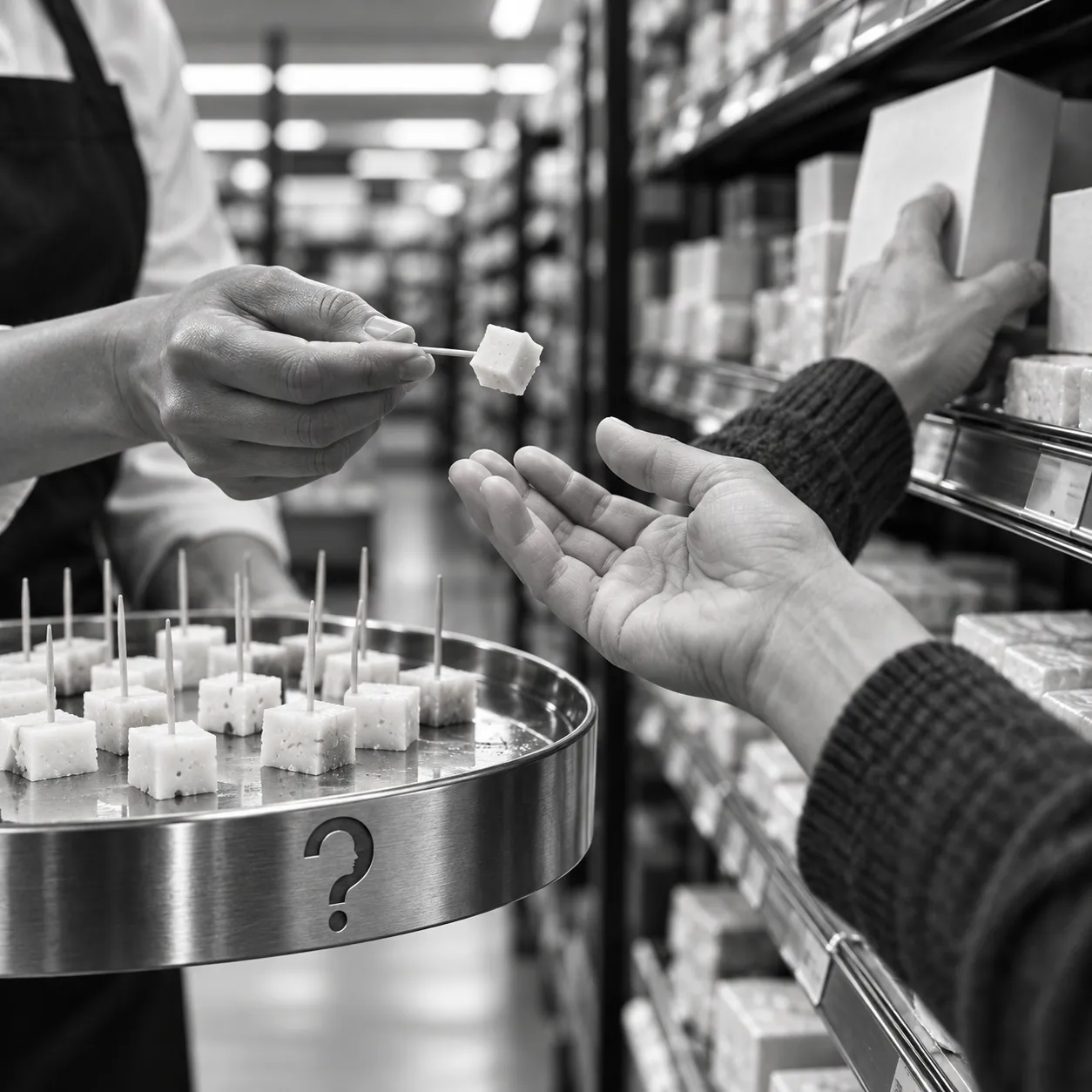
A cube of cheese on a cocktail stick is a gift, and shoppers treat it like one. In a 1971 study an unasked-for Coke nearly doubled what people bought from the person who gave it.
Answer to the question
Do free samples really make people buy more?
Often, yes, at least in the short run. A 2011 field study of a US grocery chain found free samples very effective at getting people to try a product, and 2004 field experiments found sales effects up to 12 months later. Part of the push is reciprocity: in Dennis Regan's 1971 study, an unasked-for Coke nearly doubled ticket purchases.
Key takeaways
- In Dennis Regan's 1971 study, men given an unasked-for Coke bought 1.73 raffle tickets on average from the giver, against 0.92 for men given nothing.
- A 2011 field study of a US grocery chain found free samples very effective at prompting trial, and 2004 field experiments found sales effects up to 12 months later.
- In Jerry Burger's 1997 study, 93.8 per cent agreed to a request five minutes after a free drink, but only 75.8 per cent a week later, close to the 65.6 per cent who got nothing.
A free drink raised raffle sales from 0.92 tickets a head to 1.73. The figures come from a study by Dennis Regan, run with first-year men at Stanford. Each rated paintings beside another young man who was secretly working for the experimenter. In some sessions he slipped out during a break and came back with two bottles of Coke, one of them for the subject, unasked.
Later he asked the subject to buy raffle tickets at 25 cents each. The gap between those two averages is the standard laboratory result for reciprocity, and it is the reason a supermarket hands you a cube of cheese on a cocktail stick.
Shops do not describe their tasting trays as favours, still less as reciprocity at work. The research says the shopper holding the toothpick treats the tray as one, and buys accordingly.
The favour sold the tickets
Regan's 1971 design had a third condition that is often left out of retellings. In some sessions the experimenter, not the fellow subject, handed over the Coke. Those subjects bought 1.08 tickets on average, barely more than the people who received nothing. A pleasant break with a free drink did little by itself. What moved purchases was owing something to the person who asked.
Regan also measured how much each subject liked the man selling tickets. Overall, liking predicted buying: the more subjects liked him, the more tickets they bought. Among people who had received his Coke, the link was weak and not statistically reliable. The favour also made people like him more, but Regan concluded that the relationship between favours and compliance appeared to be "mediated, not by liking for the favor-doer, but by normative pressure to reciprocate."
Regan's result describes an obligation that does its work whether or not you warm to the giver. It comes from one laboratory study, with 77 people in the final analysis, and the field studies that followed found the same pull outside the laboratory.
A sweet raises the tip
Restaurants supply some of that evidence. David Strohmetz and colleagues, writing in the Journal of Applied Social Psychology in 2002, began from a practice they described as common: servers giving diners an unexpected sweet with the bill. In two experiments in restaurants, diners who received a small piece of chocolate tipped more than diners who received none, and in the second experiment the tip varied with how much candy was given and with how it was offered.
The authors weighed two rival explanations, impression management and good mood, and judged reciprocity "a stronger explanation" than either.
A restaurant bill is a near-perfect setting for the rule. The gift comes from the person who will benefit, the chance to repay arrives within minutes, and the repayment is a sum the diner chooses alone.
A sample is a gift
Robert Cialdini puts the free sample at the centre of his chapter on reciprocation in Influence, and the argument is a strong one. A sample looks like information, a chance to try before you buy. His point (pp. 38 to 39 of the 2021 edition) is that "it is also a gift", and that a promoter who offers one can release the indebting force of a gift "while innocently appearing to have only the intention to inform." He adds that, according to Costco's sales figures, sampled products from beer to lipstick get big lifts that come almost entirely from the shoppers who accept the sample.
Support for his reading comes from what people buy after a taste. In a 1991 study of a chocolate shop in a suburban shopping mall, customers who received a free chocolate as they entered bought more straight away. The rise was confined to small purchases, and it came from varieties other than the one sampled. Influence reports a candy-shop result with the same shape on p. 38. People were paying back the shop, not stocking up on a flavour they had just discovered.
So the shopper repaying a gift is under no pressure to buy the same thing. She needs to buy something.
The shopper repaying a gift is under no pressure to buy the same thing. She needs to buy something.
Grocery samples work two ways
Supermarket studies show the information route running alongside the gift. Carrie Heilman, at the University of Virginia, with Kyryl Lakishyk and Sonja Radas, studied a free-sample programme run by a US grocery chain across six products and six weekends. They found sampling very effective at getting people to try a product, especially less-educated shoppers. Among people who already planned to buy in the category, a sample could switch them to the promoted brand. Among people with no such plan, it could draw them into the category.
One finding from that study matches the reciprocity account closely. Shoppers who interacted with the person handing out the sample, or with other samplers at the stand, seemed more likely to buy afterwards. A gift with a giver attached appears to do more than food on a plate. A tray left at the end of an aisle has the food without the giver, and so loses part of what makes a sample persuade.
Two field experiments reported in Marketing Science in 2004 looked further ahead. They found that free samples, unlike coupons, could lift a brand's sales for as long as 12 months after the promotion. The same work found that the effect varied widely, even between brands in the same category, and broke it into three parts: people settling into the brand sooner, people not paying for a trial they would have bought anyway, and new buyers who would never have considered the brand. Each of those three parts is a story about getting to know a product.
In the chocolate shop, where buying went to other varieties within minutes, obligation does most of the work. In the long-run sales data, where sales rose months later, tasting and liking the product does. A sample can do both at once, and the supermarket has no reason to care which one closes the sale.
The two accounts do make different predictions, which is how a shopper can tell them apart. Reciprocity predicts a quick purchase of almost anything from the person who gave, and a pull that weakens once the giver is out of sight. Learning predicts a later purchase of the sampled product itself, wherever it is sold. A staffed tasting stand is set up to collect on both.
Timing decides the repayment
The obligation is strongest at once. In a 1997 study at Santa Clara University, Jerry Burger and colleagues had a fellow participant hand people a free soft drink and later ask them to carry an envelope across campus. When the request came about five minutes after the drink, 93.8 per cent agreed. When it came a week later, 75.8 per cent agreed, which was not reliably different from the 65.6 per cent who agreed when there had been no drink at all. In hypothetical scenarios, people said they felt less bound to return a favour as time passed.
Burger's team concluded that the norm of reciprocity "does not mandate an open-ended obligation to return a favor." In a later set of experiments, published in 2006, they found that even a brief swap of small favours with a stranger raised compliance, and suggested that the exchange may set off a friendship heuristic, a rule of thumb for how to treat a friend.
Across these studies, four conditions keep recurring where the effect was strongest:
- The gift came from the person who later asked. Regan's drink from the experimenter barely moved ticket sales.
- The chance to repay came quickly. Burger's favour worked after five minutes and not after a week.
- The purchase was small. The 1991 chocolate shop saw its rise only in small sales.
- The giver was there. Heilman's shoppers who talked to the person at the stand seemed more likely to buy.
Because the pull of reciprocity is strongest in the minutes after a gift, tasting the cheese and deciding about it a few aisles later puts some distance between the gift and the decision.
Those four conditions describe a tasting stand doing its job. Put a small gift in someone's hand, have a person give it, and ask for a modest purchase within minutes, and the evidence from Regan's sessions through restaurant tables to a US grocery chain says that the free sample will move people to buy, and to buy from the giver, often something other than the thing they tasted, and within the same visit.
Common questions
Do free samples really make people buy more?
Often, yes, at least in the short run. A 2011 field study of a US grocery chain found free samples very effective at getting people to try a product, and two 2004 field experiments found effects on a brand's sales up to 12 months later, though the size varied widely between brands. Part of the push is reciprocity, the felt duty to repay a gift.
Why did a free Coke make people buy raffle tickets?
In Dennis Regan's 1971 study, men given an unasked-for Coke by a fellow participant bought 1.73 raffle tickets on average from him, against 0.92 for men given nothing. Regan concluded that normative pressure to reciprocate, more than liking, drove the extra buying.
Does a favour still work a week later?
Much less well, for small favours. In Jerry Burger's 1997 study, 93.8 per cent of people agreed to a request five minutes after receiving a free drink, against 75.8 per cent a week later, a figure not reliably different from the 65.6 per cent who received no drink.
Sources
Regan, D. T. (1971). 'Effects of a favor and liking on compliance.' Journal of Experimental Social Psychology, 7(6), 627-639. doi:10.1016/0022-1031(71)90025-4. Full text read: 81 freshman males of Stanford University, 4 excluded; 3 x 2 design; tickets 25 cents; mean purchases 1.73 (favour from confederate), 1.08 (Coke from experimenter), 0.92 (no favour); liking correlated with compliance overall (r = .43) and among controls (r = .46) but not in the favour conditions (r = .14, ns).
Strohmetz, D. B., Rind, B., Fisher, R., & Lynn, M. (2002). 'Sweetening the till: the use of candy to increase restaurant tipping.' Journal of Applied Social Psychology, 32(2), 300-309. doi:10.1111/j.1559-1816.2002.tb00216.x. Abstract read: two experiments; chocolate with the check raised tips; tips varied with the amount of candy and the manner of offering; reciprocity argued to explain the results better than impression management or mood.
Lammers, H. B. (1991). 'The effect of free samples on immediate consumer purchase.' Journal of Consumer Marketing, 8(2), 31-37. doi:10.1108/07363769110034992. Abstract read: three days in a chocolate store in a suburban shopping mall; a free sample on entry increased sales immediately; the effect was restricted to small purchases and to varieties other than the one sampled.
Heilman, C. M., Lakishyk, K., & Radas, S. (2011). 'An empirical investigation of in-store sampling promotions.' British Food Journal, 113(10), 1252-1266. doi:10.1108/00070701111177674. Abstract read: field study of a US grocery chain's sampling programme, six products over six weekends; sampling very effective at inducing trial, especially among less-educated consumers; brand switching among planned category buyers and category draw among others; interaction with the distributor or other samplers seemed to boost purchase.
Bawa, K., & Shoemaker, R. (2004). 'The effects of free sample promotions on incremental brand sales.' Marketing Science, 23(3), 345-363. doi:10.1287/mksc.1030.0052. Abstract read: two field experiments; acceleration, cannibalisation and expansion effects; long-term sales effects observable up to 12 months after the promotion; effectiveness varied widely, even between brands in one category.
Burger, J. M., Horita, M., Kinoshita, L., Roberts, K., & Vera, C. (1997). 'Effects of time on the norm of reciprocity.' Basic and Applied Social Psychology, 19(1), 91-100. doi:10.1207/s15324834basp1901_7. Full text read: Santa Clara University; Experiment 1, 97 undergraduates, free soft drink from a confederate, request to deliver an envelope; agreement 93.8 per cent (about 5 minutes), 75.8 per cent (1 week), 65.6 per cent (control); immediate differed from control and from delayed, delayed did not differ from control; Experiment 2 used hypothetical scenarios.
Burger, J. M., Ehrlichman, A. M., Raymond, N. C., Ishikawa, J. M., & Sandoval, J. (2006). 'Reciprocal favor exchange and compliance.' Social Influence, 1(3), 169-184. doi:10.1080/15534510600819693. Abstract read: three experiments; exchanging small favours with a stranger raised compliance; the authors suggest a friendship heuristic.
Cialdini, R. B. (2021). Influence, New and Expanded: The Psychology of Persuasion. Harper Business. Read in full by this publication, with a reliability audit. Ch. 2, "Reciprocation: The Old Give and Take", pp. 38-39: the free sample as a gift, and Costco's sales figures, for which the book gives no numbers; candy-shop result, p. 38.