Does a “vagus nerve reset” actually work?
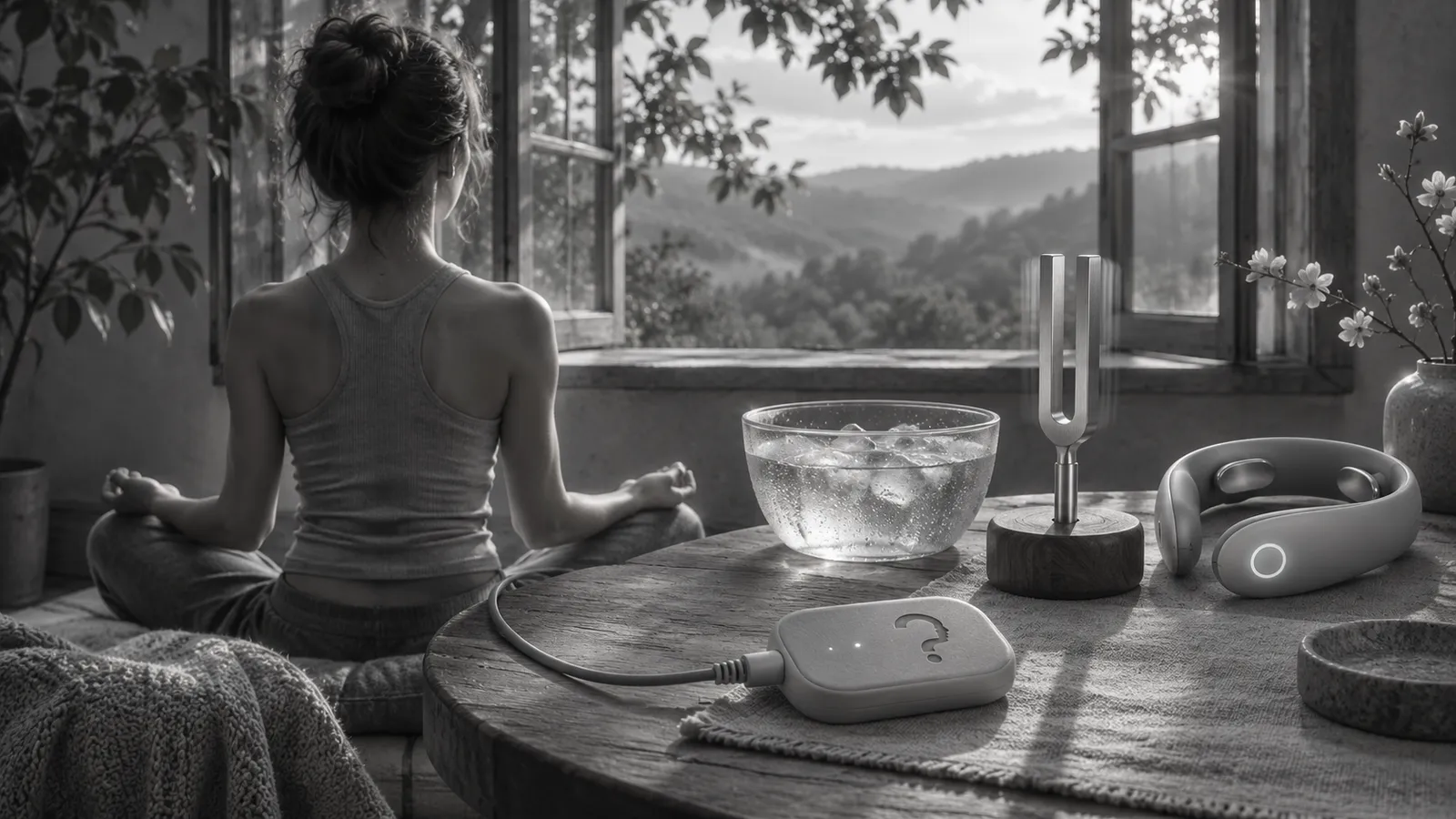
What a pooled review of slow-breathing studies measured, why nerve vocabulary makes a wellness idea travel, and how to read the claim.
Answer to the question
Does a “vagus nerve reset” actually work?
A vagus nerve reset is a popular label for slow breathing and similar practices. In a review of 31 studies with 1,133 participants, slow breathing raised heart rate variability, while the effect on self-reported negative emotion was marginal. The studies do not show that a nerve is reset, so the phrase goes further than the evidence.
Key takeaways
- A review of 31 studies with 1,133 participants found that deliberately slow breathing raised two time-domain measures of heart rate variability (Shao and colleagues, 2024).
- The same review found the effect on self-reported negative emotion, perceived stress in particular, was marginal, and its authors described the emotional effect as modest.
- Nonexperts rated logically flawed explanations as satisfying when they contained irrelevant neuroscience, while experts did not (Weisberg and colleagues, 2008).
- People overestimate how deeply they understand how things work, and the overestimate is larger for explanations of mechanisms than for facts or procedures (Rozenblit and Keil, 2002).
- Susan Magsamen and Ivy Ross, in Your Brain on Art, describe humming as a way to engage the vagus nerve.
This article is general information about research on slow breathing and how wellness ideas spread. It is not medical advice, and nothing in it is a reason to change any treatment or to stop seeking care. Speak to a GP or another clinician about your own health. Medical review: Reja Batool.
Slow breathing moved a number on a monitor, not a nerve. A vagus nerve reset starts out as a measurement. In a review that pooled 31 studies and 1,133 participants, deliberately slow breathing raised two standard measures of heart rate variability, a signal physiologists link to vagal influence on the heart. The effect on self-reported negative emotion, perceived stress in particular, was marginal. The measurable change is smaller than the word reset suggests.
What the pooled review measured
The review was led by Robin Shao and published in Mindfulness in 2024. It defined slow-paced breathing as breathing deliberately slowed to about the pace of the body's own cardiovascular oscillation, and it searched four databases through August 2023. In the authors' terms, the findings were these:
- Both time-domain measures of heart rate variability rose.
- Heart rate fell slightly.
- The effect on emotion was modest.
- The lasting effects of the practice had not been established.
These are physical signals recorded while people breathe slowly, which is a different thing from a sustained change in how a person feels or functions.
Each step from that result to a vagus nerve reset adds a claim. The vagus nerve is a long nerve that links the brain with organs including the heart, so a change in heart rate variability is a reasonable thing to watch. A reset, though, implies a return to a baseline state, and the studies measure change during and shortly after the breathing, not a restored setting. Nothing in the pooled results isolates the vagus nerve as the route, which is why the phrase vagus nerve reset describes a belief about the mechanism and not a finding about it.
The same distinction sits at the centre of The Breathing Exercise That Beat Meditation, which compares breathing patterns head to head. The question here is narrower: what the phrase promises beyond the breathing itself.
Why a vagus nerve reset spreads so easily
Deena Skolnick Weisberg, Frank Keil and colleagues gave adults brief explanations of psychological phenomena, some good and some logically flawed, with and without neuroscience details that added nothing. All three groups, naive adults, students and experts, preferred the good explanations over the flawed ones when neuroscience was absent. Experts could tell the details were irrelevant. Nonexperts rated the flawed explanations as satisfying when they carried neuroscience, and the added detail masked the flaw. A phrase like vagus nerve reset arrives with exactly that kind of detail attached.
Leon Rozenblit and Keil found a second effect. People believe they understand how complex things work in far more depth than they do, and the overestimate is larger for explanations of mechanisms than for facts or procedures. Almost everyone has heard of the vagus nerve, and few could say what it does. A familiar organ name gives the feeling of an explanation with none of the work. Brain-based shorthand has done the same job in marketing talk, a pattern examined in Is the Lizard Brain Real in Marketing, where a vivid anatomical image carries more weight than the evidence under it.
Susan Magsamen and Ivy Ross, in Your Brain on Art, describe humming as a way to engage the vagus nerve and the parasympathetic system, as one of several sensory practices that fit comfortably beside the arts and everyday well-being. The idea sits naturally in that company because each practice is short, free and felt at once. That is how a vagus nerve reset travels: a body-based demonstration, a vocabulary of nerves that sounds scientific, and a payoff the viewer can notice within a minute.
Short demonstrations also suit how people learn about their own bodies. A viewer breathes out slowly, notices something, and credits the video with the explanation that came attached. Because the noticing is private and the vocabulary is shared, the claim is hard to check from the inside, and that is part of why it holds. Noticing a change in one's own body is a real experience, and the study of that skill is called interoception. A felt shift after a long exhale is not in dispute, and people who try a vagus nerve reset from a video often report exactly that. The research question is different: whether the shift is what the label says it is.
Where the label outruns the data
The data and the label part ways in three places. Heart rate variability is a useful signal but a single number, and different researchers read it in different ways. The reviewed studies assess effects during and soon after slow breathing, so whether a reset lasts is a separate question. And the breathing result stands without any claim about which nerve did the work, so the nerve detail adds persuasion, not evidence.
The pattern is the same one that moves other wellness trends, covered in Why You Drop a Trend When Others Join: a short demonstration spreads faster than the caveats that come with it.
Much online vocabulary about nervous system states comes from polyvagal theory, which Stephen Porges set out in 1995 and whose physiological premises specialists continue to discuss. The slow-breathing results do not depend on that theory, so a viewer can take the first and hold the second lightly. A practical test for any vagus nerve reset claim is to ask what was measured and for how long. Then ask what the nerve explanation adds beyond the breathing itself, because a persuasive label is not the same as a demonstrated mechanism.
Common questions
Does a “vagus nerve reset” actually work?
Slow breathing reliably changes heart rate variability, and its effect on self-reported negative emotion was marginal in a review of 31 studies. The studies do not show that a nerve is reset, so the phrase goes further than the evidence does.
What is a vagus nerve reset?
It is a popular label for short practices such as slow breathing, long exhales or humming, said to restore a calm baseline through the vagus nerve. The research measures changes in signals like heart rate variability, not a restored state.
Why do neuroscience terms make wellness claims more convincing?
In experiments by Weisberg, Keil and colleagues, nonexperts rated flawed explanations as satisfying when they included irrelevant neuroscience, while experts did not.
Is the vagus nerve explanation needed for slow breathing to work?
The slow-breathing results are reported without it. Which pathway carries the effect is a separate matter. The pooled studies did not settle it.
Sources
Magsamen, S., & Ross, I. Your Brain on Art. Seed book; vault hub Books/Your Brain on Art.
Shao, R., Man, I. S. C., & Lee, T. M. C. (2024). The effect of slow-paced breathing on cardiovascular and emotion functions: A meta-analysis and systematic review. Mindfulness, 15(1), 1-18. doi:10.1007/s12671-023-02294-2 https://doi.org/10.1007/s12671-023-02294-2
Weisberg, D. S., Keil, F. C., Goodstein, J., Rawson, E., & Gray, J. R. (2008). The seductive allure of neuroscience explanations. Journal of Cognitive Neuroscience, 20(3), 470-477. doi:10.1162/jocn.2008.20.3.470 https://doi.org/10.1162/jocn.2008.20.3.470
Rozenblit, L., & Keil, F. (2002). The misunderstood limits of folk science: An illusion of explanatory depth. Cognitive Science, 26(5), 521-562. doi:10.1207/s15516709cog2605_1 https://doi.org/10.1207/s15516709cog2605_1