Wanting Is Not Liking
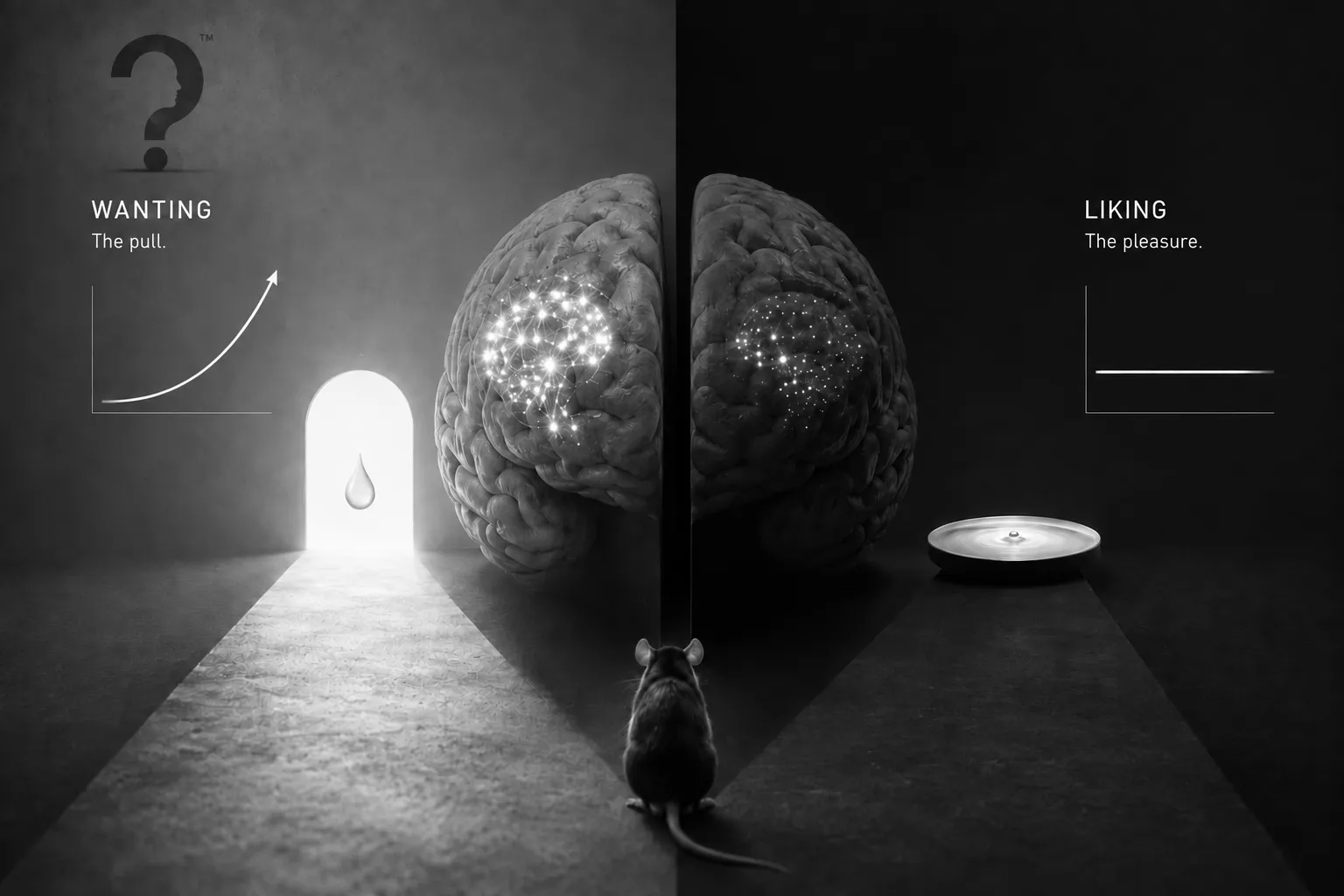
Engagement measures wanting more readily than it measures liking, and the two are not the same system
Key takeaways
- Dopamine drives wanting, the pull toward a reward, rather than liking, the pleasure of getting it. They are separate systems running on separate circuitry.
- Rats with 98 to 99 per cent of their dopamine destroyed stopped eating entirely, but still produced normal pleasure reactions to sugar placed on the tongue.
- Wanting is anatomically broad and durable. Liking runs on hedonic hotspots of roughly a cubic millimetre each, and Kent Berridge calls it tiny and fragile by comparison.
- Under repeated exposure wanting grows disproportionately while liking stays where it was. Robinson and Berridge are explicit that liking does not have to fall, and their 1993 paper caused years of confusion by implying it did.
- Engagement metrics measure wanting. Satisfaction measures liking. A rising engagement number is evidence of a stronger pull, not of a better product.
In the late 1980s a lab at Michigan destroyed 98 to 99 per cent of the dopamine in a group of rats' brains. The rats stopped eating. Food sat in front of them and they would have starved beside it.
Terry Robinson and Kent Berridge then put a drop of [sugar water](https://thewhyweproject.com/articles/why-do-we-crave-sugar) on the animals' tongues. They produced the same rhythmic tongue protrusions rats always produce for sweetness. The pleasure was intact. What had gone was whatever made them cross the cage to get it.
Dopamine, on the model most people still carry, is the [pleasure chemical](https://thewhyweproject.com/articles/is-the-lizard-brain-real-in-marketing), the thing you get a hit of. The old three-layer brain, with a reptile at the bottom, is a second tidy story of the same kind that marketing has kept. It governs pursuit.
The wrong chemical
Robinson and Berridge call the pursuit half incentive salience, or "wanting". The pleasure half is hedonic impact, or "liking". Their thirty-year review of the theory, published in the Annual Review of Psychology in 2025, puts it without much hedging: dopamine drives the motivational pull, the wanting, and does not produce the pleasure, the liking. Later in the same paper they report a consensus that the main job of mesolimbic dopamine in reward is to drive wanting, not liking.
Dopamine antagonists and near-total lesions leave liking reactions to sweetness unchanged.
Most people have a private version of this already. The app opened without a decision having been made. The programme still being watched at one in the morning that nobody would recommend to a friend. What the rats supplied was a way to measure it, and a reason to stop treating the two as one thing.
The two systems are not built to the same scale. Berridge's lab has mapped the sites where opioid stimulation genuinely amplifies pleasure reactions, the hedonic hotspots, and they run to roughly a cubic millimetre each in a rat brain, in the nucleus accumbens shell and the ventral pallidum. Move the injection a millimetre and the animal eats more without liking it more. Wanting responds across most of the region. Liking responds in the hotspot.
Berridge's own summary, reported in Adam Alter's Irresistible, is worth keeping: the wanting system is far larger and stronger, while the liking system is small in anatomical terms and easily disrupted.
Which makes the phrase "dopamine hit", now standard in product writing, a description of the wrong half of the machine. The half it describes happens to be the half with almost no bearing on whether anyone is enjoying themselves.