Why Rolling the Dice Yourself Feels Luckier
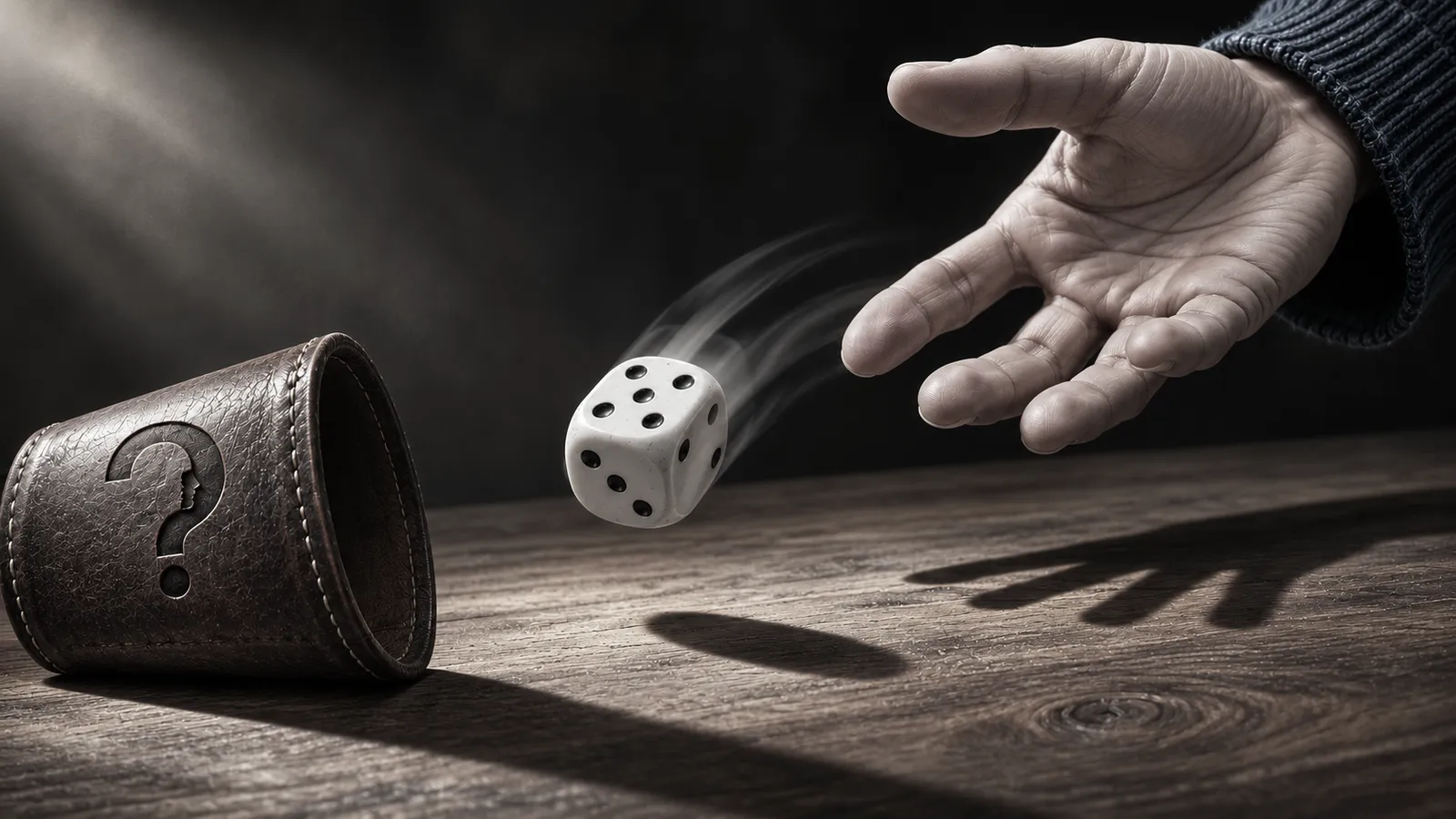
A die lands the same way whoever throws it, yet people prefer to throw it themselves. The research on the illusion of control shows how acting and planning raise the sense of influence, and what that sense does for effort.
What is the illusion of control?
The illusion of control is an expectation of influencing an outcome that a person cannot influence. In experiments, people more often chose to roll a die themselves after recalling a time of power, and those who acted more often developed stronger illusions. The same belief went with optimism in role-play studies, so it has an error side and a motivating side.
Key takeaways
- When people chose whether to roll a die themselves or leave it to the experimenter, every participant who had recalled a time of power chose to roll, against 58 per cent of the low-power group and 69 per cent of the baseline group (Fast and colleagues, 2009).
- Participants who acted more often in tasks with uncontrollable outcomes developed stronger illusions of control, and so did yoked partners who only watched the same sequence (Yarritu and colleagues, 2014).
- A review proposed a control heuristic that combines the perceived intentionality of an action with its perceived connection to the outcome (Thompson and colleagues, 1998).
- Managers in a role-play reported more control and more optimism about a fictional agency, and the extra control accounted for the extra optimism (Fast and colleagues, 2009).
- When a light came on often whatever the button did, participants in a planning frame claimed control that participants in a deliberating frame did not (Gollwitzer and Kinney, 1989).
The illusion of control is an expectation of influencing an outcome that nothing the person does can influence. A student is offered an extra payment for predicting one roll of a six-sided die, and the only choice is who does the rolling, the student or the experimenter. The odds are identical either way, and in an experiment led by Nathanael Fast, more students asked to roll it themselves once they had been made to feel powerful. The payment depends only on a correct call, so the throw changes nothing about the odds, yet many reach for the die as though the hand that throws could bend the result.
Look at three accounts of the illusion of control
The name comes from Ellen Langer, who decades ago showed that features borrowed from skilled activity, such as choice, familiarity and personal involvement, raise confidence in tasks decided by chance. Other researchers have since asked what builds that confidence.
Daniel Kahneman, in Thinking, Fast and Slow, places the illusion of control among the effects of a mind that builds a coherent story from whatever it has in front of it. In explaining the past and predicting the future, he argues, people focus on the causal part played by skill and neglect the part played by luck. The die experiment catches that habit earlier than most, at the moment of choosing, before any result has come in. The belief that fortune attaches to particular people or rituals is a close relative.
A review by Suzanne Thompson, Wade Armstrong and Craig Thomas proposed that people judge their control with a shortcut. The control heuristic combines two impressions: intentionality, meaning whether the person meant the outcome, could foresee it and could have produced it, and connection, meaning whether the action seems tied to the outcome through timing, shared meaning or prediction. When both impressions are strong, a feeling of control follows, and where the link is not real that feeling is an illusion of control. The same review listed five conditions that shape control judgments: skill-related factors, an emphasis on success or failure, the need for the outcome, mood, and how far reality intrudes.
A paper from the middle of the last decade, by Ion Yarritu, Helena Matute and Miguel Vadillo tested a more specific route. In two experiments with outcomes that no one could control, they used a yoked design, in which one person acted and a partner saw the same actions and outcomes without acting. Participants who acted more often developed a stronger illusion of control, and so did their yoked partners, who only watched the same sequence.
The authors concluded that involvement works largely through how often an action occurs, because frequent action makes a coincidence with an outcome more likely to be read as cause. A die thrown by hand is an action followed at once by an outcome every time, which is the condition this account says matters.
Read the die choice and the card task in numbers
Fast and colleagues asked 38 undergraduates to write about one of three things: a time they had power over others, a time someone had power over them, or an ordinary shopping trip. Each person then had a chance to earn extra money by predicting one roll of a die, and chose whether to roll it or to have the experimenter do it. All 13 people in the high-power group chose to roll. In the low-power group 58 per cent did, and in the baseline group 69 per cent. The authors took the choice to roll as a sign of the illusion of control, since the throw itself changes nothing about the result.
A card task gave a second view of the same pattern. In a study of 78 students led by Juliette Tobias-Webb, people tried to find an ace among 13 face-down cards. On some trials they could not influence the draw, on some they could take control for nothing, and on others they could take it for a small payment. Confidence was higher when they took control, and people were more likely to take control when they felt confident, a link that was stronger when control cost them something.
On a separate task, where a light came on whatever button the person pressed, participants showed an illusion of control in every condition, and most when the light came on often and the result was a win.
Check whether a belief in influence keeps effort going
The same power studies show a motivating side. In a second experiment, Fast and colleagues assigned 30 students the role of manager or worker and then rated the prospects of a fictional agency. Managers reported more control over the agency's future and more optimism about its performance, and the extra control accounted for the extra optimism. In a third experiment with 79 adults, recalling a time of power raised perceived control and self-esteem, and control accounted for the rise in self-esteem. A fourth, with 43 adults role-playing a negotiation, found that positive mood did not explain the higher optimism and self-esteem of those holding the stronger position.
The ratings came from role-play and recall, so what they show is an association between felt control and outlook, with nothing said about results. Read plainly, the authors' account is that a belief in influence, even where influence is overstated, is part of why holding power makes people optimistic and ready to act. Optimism about one's own prospects, the subject of What is optimism bias, is one of the things the extra sense of control accounted for here. The illusion lets effort proceed before the evidence is in, and its cost appears when the thing being judged is a die, a card or a light that no action touches.
Test how weighing a choice and planning it change control
Does the mindset a person is in change how well they judge control? Peter Gollwitzer and Ronald Kinney tested deliberating over a choice against implementing a plan, and so how much of an illusion of control each produces. In their first study, participants worked with two apparatuses, each with a target light and a response button, and neither button affected the light. The light came on either often, on three trials in four, or rarely, on one in four. Some participants alternated between the two to find out which worked better, which is a deliberative frame.
Other participants fixed their plan in advance and tried to make the light come on as often as possible, which is an implemental frame. Deliberating participants judged their control accurately in both conditions. Planning participants judged accurately when the light was rare and claimed control they lacked when it came on often.
A second study gave participants one apparatus on which the light came on often. Beforehand, some weighed a personal matter still undecided, others named a personal goal and planned each step towards it, and a third group went straight to the task. Weighers reported the least control, which was the most accurate rating, the third group reported more, and planners reported the most. The pattern follows the one in the card and light tasks above: frequent outcomes and an active stance both pushed ratings of control upward.
In the die study the cue was who threw, while here it was the mindset beforehand; within the groups, the deliberative weighers rated their control lower the more important their matter was to them, while the planners rated theirs higher the more frustrated they expected to feel if they failed, so the mindset left its mark on the rating itself.
| Study | What people did | What it showed |
|---|---|---|
| Fast and colleagues, die choice | Chose whether to roll a die or leave it to the experimenter | All of the high-power group rolled, against 58 and 69 per cent of the other two groups |
| Tobias-Webb and colleagues, card task | Guessed an ace, with control free, paid or unavailable | Higher confidence when they took control |
| Yarritu and colleagues, yoked pairs | Acted, or watched the same actions and outcomes | Stronger illusions with more frequent action, for actors and watchers |
| Fast and colleagues, manager roles | Rated a fictional agency's future as manager or worker | More perceived control and more optimism for managers |
| Gollwitzer and Kinney, mindsets | Weighed a choice or planned a goal, then judged control | Planners claimed control that deliberators did not |
Common questions
What is the illusion of control?
The illusion of control is an expectation of influencing an outcome that a person cannot influence. In experiments, people were more likely to choose to roll a die themselves after recalling a time of power, and people who acted more often developed stronger illusions in tasks where nothing they did affected the outcome.
Does rolling the dice yourself change the odds?
No. A fair die lands the same way whoever throws it. In an experiment with 38 students, all of those who had recalled a time of power chose to roll the die themselves, against 58 per cent of the low-power group and 69 per cent of the baseline group, though the throw could not alter the result.
Can the illusion of control be useful?
In role-play and recall studies, a stronger sense of control went with more optimism and higher self-esteem, and people planning how to reach a goal rated their control higher than people weighing a choice. The same studies show ratings that overstated influence where there was none, so what they establish is a link with outlook, not with results.
Sources
Kahneman, D. Thinking, Fast and Slow. Seed book.
Fast, N. J., Gruenfeld, D. H., Sivanathan, N., & Galinsky, A. D. (2009). Illusory control: A generative force behind power's far-reaching effects. Psychological Science, 20(4), 502-508. doi:10.1111/j.1467-9280.2009.02311.x https://doi.org/10.1111/j.1467-9280.2009.02311.x
Tobias-Webb, J., Limbrick-Oldfield, E. H., Gillan, C. M., Moore, J. W., Aitken, M. R. F., & Clark, L. (2017). Let me take the wheel: Illusory control and sense of agency. Quarterly Journal of Experimental Psychology, 70(8), 1732-1746. doi:10.1080/17470218.2016.1206128 https://doi.org/10.1080/17470218.2016.1206128
Thompson, S. C., Armstrong, W., & Thomas, C. (1998). Illusions of control, underestimations, and accuracy: A control heuristic explanation. Psychological Bulletin, 123(2), 143-161. doi:10.1037/0033-2909.123.2.143 https://doi.org/10.1037/0033-2909.123.2.143
Yarritu, I., Matute, H., & Vadillo, M. A. (2014). Illusion of control: The role of personal involvement. Experimental Psychology, 61(1), 38-47. doi:10.1027/1618-3169/a000225 https://doi.org/10.1027/1618-3169/a000225
Gollwitzer, P. M., & Kinney, R. F. (1989). Effects of deliberative and implemental mind-sets on illusion of control. Journal of Personality and Social Psychology, 56(4), 531-542. doi:10.1037/0022-3514.56.4.531 https://doi.org/10.1037/0022-3514.56.4.531
Gollwitzer, P. M. (2003). Why we thought that action mind-sets affect illusions of control. Psychological Inquiry, 14(3-4), 261-269. doi:10.1080/1047840x.2003.9682890 https://doi.org/10.1080/1047840x.2003.9682890
Langer, E. J. (1975). The illusion of control. Journal of Personality and Social Psychology, 32(2), 311-328. doi:10.1037/0022-3514.32.2.311 https://doi.org/10.1037/0022-3514.32.2.311
Related concepts
People
More articles
- Why Giving Money Away Feels Better Than Spending It
People predict that a windfall spent on themselves would please them most. Studies of prosocial spending find the reverse in many settings, and the largest replications show where the effect weakens.
- Why We Order the Same Lunch Every Day
A lunch plan made on Sunday and a lunch ordered on Thursday are different choices. Studies of variety-seeking behaviour show how timing, audience and memory pull between variety and routine.
- Why the Urgent Task Beats the Important One
A larger reward with no deadline lost to a smaller one that looked about to expire. The research on the mere urgency effect shows how a clock can decide which task gets done.
- Why We Copy the Shopper Ahead of Us
The shopper ahead of us leaves traces: a count, a rank, a gap on a shelf. Studies from the laboratory to the screen to the aisle show when we follow them.