Why We Order the Same Lunch Every Day
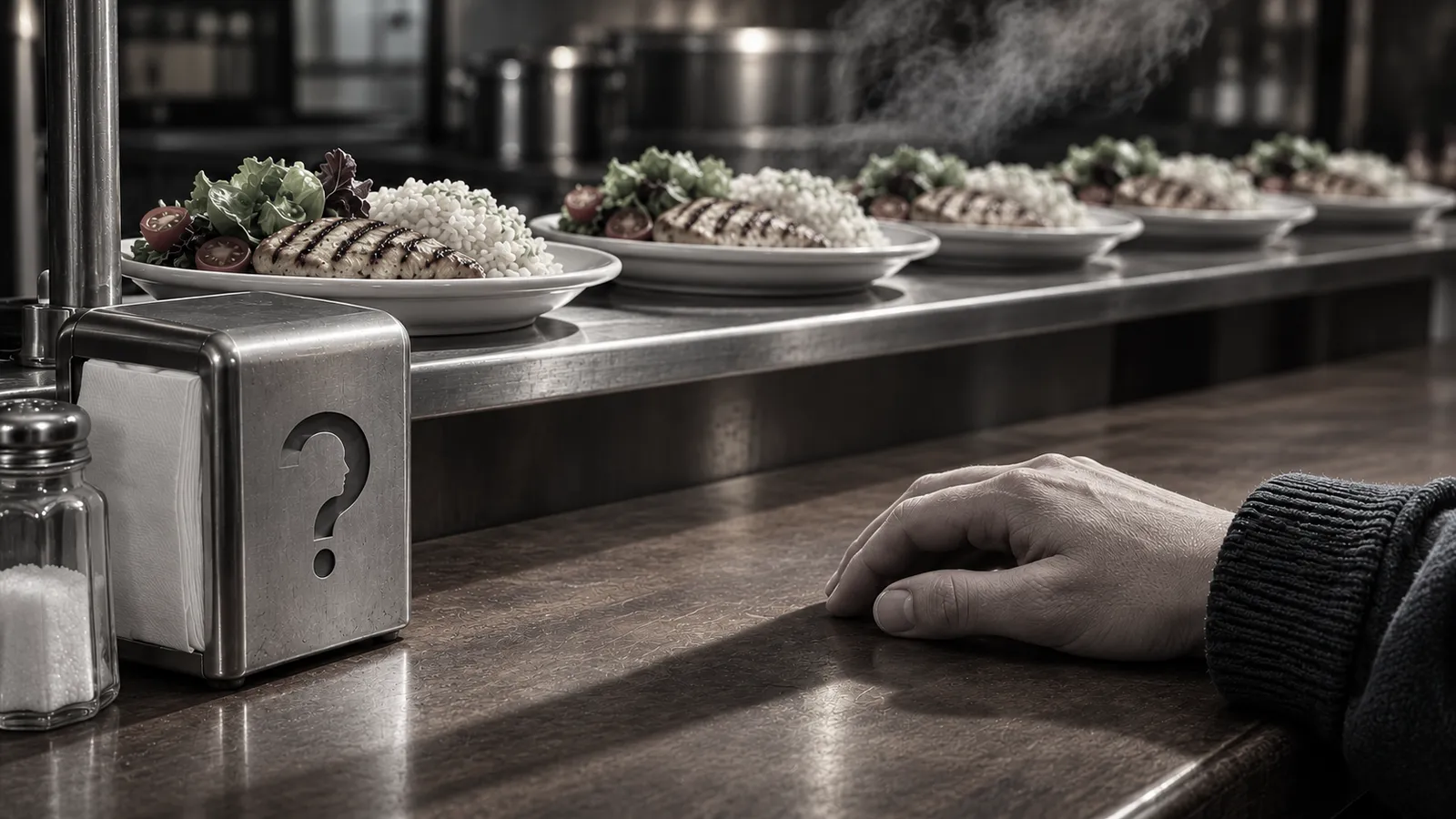
A lunch plan made on Sunday and a lunch ordered on Thursday are different choices. Studies of variety-seeking behaviour show how timing, audience and memory pull between variety and routine.
What is variety-seeking behaviour?
Variety-seeking behaviour is the tendency to choose something different from the last choice, even when the last one was liked. Studies find it is stronger when several items are chosen ahead than when one is chosen just before use, stronger when choices are visible to others, and sometimes at the cost of enjoyment in the moment.
Key takeaways
- Shoppers who chose several items in one trip for later use showed more variety seeking than shoppers who bought one item shortly before each use (Simonson, 1990).
- People who chose several items for future consumption selected more variety than people who chose each item separately for immediate use, an effect the authors named diversification bias (Read and Loewenstein, 1995).
- In three experiments, people chose more variety when their decisions were visible to others, and the effect faded when cues made repeating a favourite seem acceptable (Ratner and Kahn, 2002).
- Participants switched to options they liked less even when repeating a favourite would have been more enjoyable, and later rated varied sequences more favourably (Ratner, Kahn and Kahneman, 1999).
- Recalling the varieties consumed earlier reduced satiation, yet people did not recall it spontaneously (Galak, Redden and Kruger, 2009).
Take a worker who plans a week of lunches on Sunday. The plan lists five different dishes, because the same meal five days running seems dull from a distance. Then Monday arrives, the usual counter is open, the usual order is easy to say, and by Thursday the favourite has been ordered four times. The Sunday list was written far from the counter, and the Thursday order was spoken at it. The Sunday plan is variety-seeking behaviour, the tendency to pick something different from what was chosen before, even when the earlier choice was liked. The Thursday order is routine.
Neither choice is odd. Routine is a choice that repeats because repeating it takes almost no thought. Research on variety-seeking behaviour shows that the two pull in different directions depending on when the choice is made, who can see it and what is remembered.
Planning ahead produces more variety than choosing in the moment
Choosing several items at once yields more variety than choosing them one at a time. Itamar Simonson compared two ways of buying from one product category. In the first, shoppers chose a set of items in a single trip and used them over several occasions. In the second, they bought one item at a time, shortly before each use. Across three studies, two of them with real products and real choices, buying in advance produced more variety-seeking behaviour. Simonson pointed to two factors that come with choosing ahead: uncertainty about what one will want later, and a wish to simplify the decision by spreading the choice across the set.
Daniel Read and George Loewenstein reached a similar result and called it diversification bias. People who chose several items for future consumption selected more variety than people who chose each item separately for immediate use. The pair first ruled out several standard utility explanations, then traced the effect mainly to two mechanisms. One is that people treat long intervals as if they were short. The other is choice bracketing, in which choices framed together are handled differently from choices framed apart.
Both studies held the item constant and changed only the timing of the choice, which separates the moment of choosing from taste for the item itself. The result is a pattern in variety-seeking behaviour that depends on how a choice is framed.
Applied to the worker's week, which neither study tested directly, the Sunday plan is a bracketed set, and the five lunches are chosen together. By Monday the set has dissolved into a single lunch, and the only question left is what to order now.
An audience nudges choices toward variety
Variety-seeking behaviour also has a social side. Choices that others can see lean toward variety. In three experiments, Rebecca Ratner and Barbara Kahn found that people chose more variety when their decisions were visible to others. The first two studies suggested that consumers expect others to view varied choices more favourably, even when that meant passing up their own favourites. In the third, self-monitoring, a trait describing how closely people watch and adjust how they come across, shaped the strength of the effect. The pressure to diversify faded when cues signalled that repeating one's favourites was socially acceptable.
A lunch ordered at a shared table, in front of colleagues, may therefore carry a pull toward a different dish that the same order placed alone at a counter carries less of. That route to variety has little to do with taste. In the first two studies, people passed up favourites because of what they expected others to think, and the same people might well have repeated the favourite when ordering alone.
| Situation | Direction of the pull | Study |
|---|---|---|
| Choosing several items ahead for later use | More variety | Simonson (1990); Read and Loewenstein (1995) |
| Choosing one item just before use | Less variety by comparison | Simonson (1990); Read and Loewenstein (1995) |
| Choosing where others can see | More variety | Ratner and Kahn (2002) |
| Recalling varied items consumed earlier | Satiation eases | Galak, Redden and Kruger (2009) |
Variety-seeking behaviour can lower enjoyment in the moment
People also vary when repeating would serve them better. In experiments by Ratner, Kahn and Daniel Kahneman, participants switched to options they liked less even when they would have enjoyed repeating a more-preferred one. The authors tested two explanations built on contrast, in which weaker options make a favourite seem better, and found no evidence for either. Three further studies found that people looking back rated varied sequences more favourably, including sequences that contained less-preferred items, even though those sequences had reduced enjoyment while they were being consumed.
That gap between the moment and the memory gives variety-seeking behaviour a different profile from routine, because the benefit shows up in the evaluation afterwards more than in the experience itself. The finding concerns sequences of experiences, so the pull toward variety reaches beyond shopping to anything chosen in a series. A varied week can read as a better week in retrospect, while the person who repeats a favourite may have enjoyed each meal more as it happened.
Routine runs on a different logic
Charles Duhigg, in The Power of Habit, describes habits as a loop of cue, routine and reward, and follows how repeated actions come to run with little deliberation. The lunch counter fits the pattern. The hour and the walk past the door act as the cue, the usual order is the routine, and a meal that tastes as expected is the reward.
The parts of that loop are set out in What is a habit loop, and How Much of What You Do Is Habit looks at how large the habitual share of daily action turns out to be. A repeated lunch needs no planning, no comparison and no memory of last week's choice, which makes it easy to keep on a busy Tuesday even when the Sunday plan said otherwise.
Repeating a favourite is not a failure of imagination. Why is rewatching a favourite film so satisfying looks at what a known experience can offer on a second pass, and the same reasoning applies to a dish that is reliably good.
Repetition does have a limit, and research on that limit points back to memory. Galak, Redden and Kruger studied satiation, the loss of enjoyment that comes with continued consumption. Across a pilot study and two experiments using three types of stimuli, people did not spontaneously recall the variety they had consumed earlier, even though doing so would have reduced their satiation. The authors read this as a sign that satiation is partly constructed in the moment and not only a fixed process, and they gave the lapse its name, variety amnesia.
For the lunch question, the finding adds that the wear of repetition is not fixed, since it eases when earlier choices are recalled. Recalling the varieties consumed earlier was enough, in their studies, to reduce satiation, even though the people taking part had not brought those earlier options to mind on their own.
Common questions
What is variety-seeking behaviour?
Variety-seeking behaviour is the tendency to choose something different from the last choice, even when the last choice was liked. Consumer researchers study it by comparing what people pick when choices are made together, apart, in public or in private.
Why do people plan variety but repeat in the moment?
In studies of buying several items at once, people chose more variety when picking ahead for later use than when picking one item shortly before use. The researchers pointed to uncertainty about later tastes, a wish to simplify the decision, and the way choices framed together are treated differently from choices framed apart.
Does variety make people enjoy things more?
Not always. In experiments on sequences of experiences, people switched to less-preferred options even when repeating a favourite would have been more enjoyable, and later rated varied sequences more favourably than the enjoyment they reported at the time would suggest.
Does choosing in front of others change what people pick?
In three experiments, people chose more variety when their choices were visible to others, and the effect weakened when cues signalled that repeating a favourite was acceptable.
Sources
Duhigg, C. The Power of Habit. Seed book.
Simonson, I. (1990). The effect of purchase quantity and timing on variety-seeking behavior. Journal of Marketing Research, 27(2), 150-162. doi:10.2307/3172842 https://doi.org/10.2307/3172842
Read, D., & Loewenstein, G. (1995). Diversification bias: Explaining the discrepancy in variety seeking between combined and separated choices. Journal of Experimental Psychology: Applied, 1(1), 34-49. doi:10.1037/1076-898X.1.1.34 https://doi.org/10.1037/1076-898X.1.1.34
Ratner, R. K., Kahn, B. E., & Kahneman, D. (1999). Choosing less-preferred experiences for the sake of variety. Journal of Consumer Research, 26(1), 1-15. doi:10.1086/209547 https://doi.org/10.1086/209547
Ratner, R. K., & Kahn, B. E. (2002). The impact of private versus public consumption on variety-seeking behavior. Journal of Consumer Research, 29(2), 246-257. doi:10.1086/341574 https://doi.org/10.1086/341574
Galak, J., Redden, J. P., & Kruger, J. (2009). Variety amnesia: Recalling past variety can accelerate recovery from satiation. Journal of Consumer Research, 36(4), 575-584. doi:10.1086/600066 https://doi.org/10.1086/600066
Related concepts
People
More articles
- Why the Urgent Task Beats the Important One
A larger reward with no deadline lost to a smaller one that looked about to expire. The research on the mere urgency effect shows how a clock can decide which task gets done.
- Why We Copy the Shopper Ahead of Us
The shopper ahead of us leaves traces: a count, a rank, a gap on a shelf. Studies from the laboratory to the screen to the aisle show when we follow them.
- Why a Smell Brings the Past Back
A smell reaches fewer memories than a picture does, but the ones it reaches are older and feel closer. The research on the Proust effect sets out how, and how far the evidence goes.
- Why Repeating a Claim Makes It Feel True
A statement that has appeared before is rated as more likely true than a new one, and the rise does not depend on whether it is true. The research asks why a second hearing carries so much and what…