What is the Mandela effect?
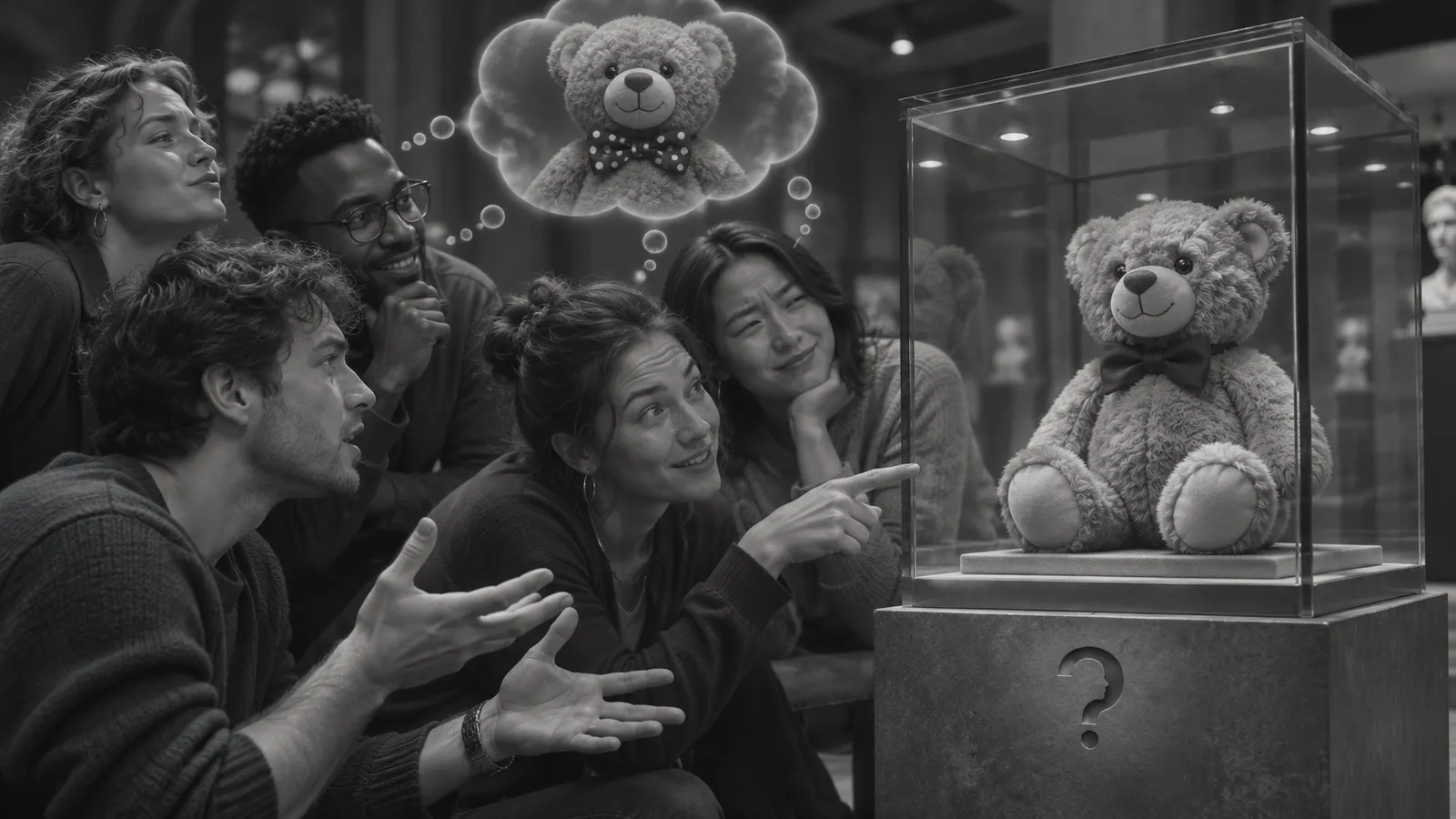
What experiments on familiar images found, how talk spreads a shared error, and why agreement among many people is not proof.
Answer to the question
What is the Mandela effect?
The Mandela effect is a false memory shared by many people, in which the same specific wrong detail is recalled. In experiments with 100 adults, certain familiar images drew consistent false memories that attention did not explain. Talking with others can spread such errors.
Key takeaways
- In an experiment with 100 adults, certain images from popular iconography produced consistent, specific false memories (Prasad and Bainbridge, 2022).
- A second experiment with 60 adults found no attentional or visual differences that drive the visual Mandela effect, and a fourth with 50 adults found the same errors in spontaneous recall.
- A 2024 preprint replicating the first experiment, not yet peer reviewed, reports that the findings held.
- Hirst and Echterhoff's review describes how conversation can reshape listeners' memories and how those effects spread across social networks to help form collective memories.
- Charan Ranganath's Why We Remember describes memory as social, with group recall growing more uniform as people interact.
A board-game mascot in a top hat and a moustache turns up in many memories wearing a monocle, and the character never had one. Researchers who showed people familiar icons found that certain details drew the same wrong answer again and again. That shared, consistent error, the same specific detail recalled wrongly by many people who have seen the image hundreds of times, is what the internet named the Mandela effect. Two situations produce this shared kind of error: a picture seen constantly and recalled wrongly, and a fact passed from person to person.
Mandela effect in pictures
Prasad and Bainbridge gave the picture case a name, the visual Mandela effect, and measured it across four experiments. In the first, 100 adults saw images from popular iconography, and certain images produced consistent, specific [false memories](https://thewhyweproject.com/articles/how-do-false-memories-form). The obvious explanation is that people simply never looked closely. A second experiment with 60 adults used eye-tracking-like methods and found no attentional or visual differences that drive the phenomenon.
Two further results make the pattern harder to dismiss. Natural visual experience of these images showed no clear difference that would explain the errors, and most of what people have seen is the correct version. In the fourth experiment, 50 adults made the same errors spontaneously when recalling the images. A 2024 replication of the first experiment is a preprint, not yet peer reviewed, and it reports that the findings held, which makes it early support and not a settled result.
The design lets a shared error be told apart from a random one. Random mistakes scatter across many wrong details, while a shared error piles up on one. In an earlier version of the work, 100 participants saw 40 familiar icons, each in its original form and in two altered forms, chose the original and rated their confidence. For some alterations, the changed version was picked more often than the true one. The tested items were popular logos and characters. Online, the same label is also applied to the spelling of a children's book title or the wording of a familiar phrase, but those cases have not been measured in the experiments above.
| Picture seen often | Fact passed along | |
|---|---|---|
| Typical example | An accessory on a mascot, a detail in a logo | A date, a spelling, a story told among friends |
| What the research found | Same specific wrong detail across people, not explained by attention | Talk reshapes what listeners remember and can spread across networks |
| Where the shared error seems to come from | Not settled; an expected typical version is one candidate | Other people's recall taken on in conversation |
Talk spreads the slip
William Hirst and Gerald Echterhoff reviewed what talking about the past does to memory. Conversation helps in some ways, because partners can fill each other's gaps. It also has costs. Listeners can take on what a speaker says through social contagion, and talking can make related details harder to retrieve. The review follows these effects out across social networks, where they help form collective memories.
The same review lists ways a conversation can narrow what a group remembers. Audience tuning is the habit of shaping what is said to suit the listener. Information sampling bias means discussion favours what everyone already knows. Collaborative inhibition means people recalling together produce less than the same people would recalling apart. Each of these trims the range of versions in circulation, and a narrower range makes one version look like the only one. In Why We Remember, Charan Ranganath adds that group recall grows more uniform as people interact, especially when dominant or confident voices lead, and that people took on items a partner had falsely recalled while warnings did little to stop it.
For a fact passed along, then, the sequence is simple. One person gets a detail slightly wrong, the others hear it, and the version that circulates is the wrong one. Each person who repeats it adds confidence. The feeling of agreement is real, which links to What is the false consensus effect, where people overestimate how widely their views are shared. In the Mandela effect many people do share the memory, and that shared belief is exactly why the error feels like evidence.
Certain, shared and still checkable
The picture case suggests that certainty does not track accuracy. If attention does not explain the errors, something else supplies the wrong detail. One candidate is that memory stores the gist of a familiar image and fills the rest with what a typical version would contain. A mascot in formal dress could be expected to carry a monocle, and the expectation completes the picture.
That reading fits the older idea that remembering rebuilds an event from fragments each time. The reconstruction is shaped by what we expect, which is the thread running through Your Nostalgia Is Lying to You. Ranganath's account of schemas, the stored expectations that help experts predict what comes next, supports the general mechanism, though it was not tested on these images.
The Mandela effect also differs from the frequency illusion described in What is the Baader-Meinhof phenomenon. There, something already known seems to appear more often once it has been noticed. Here the question is what the remembered content actually contains, and the answer is wrong in the same direction for many people at once.
Agreement among many people is a fact about the people, and it says little about the original, so the check is to return to the record. For a picture, find the official image and compare it detail by detail. For wording, find the printed original. For a date, find a dated source. Each takes a few minutes, and each settles a question that no amount of discussion can.
Most people have met these images mostly in their canonical form, so seeing a picture often does not prevent the slip, and in the fourth experiment the same errors appeared spontaneously in recall, so a shared mistake of the kind called the Mandela effect can come from within memory itself.
Common questions
What is the Mandela effect?
It is the name for a false memory shared by many people, in which the same specific wrong detail is recalled. In experiments with 100 adults, certain familiar images drew consistent false memories.
Is the Mandela effect real?
The pattern has been measured. In four experiments, certain images drew consistent, specific false memories, and a 2024 preprint replicating the first experiment, not yet peer reviewed, reports that the findings held. Why it happens is still being worked out.
Does the Mandela effect happen because people did not look closely?
Not on the evidence in that paper. Tests with 60 adults found no attentional or visual differences that drive the phenomenon.
How can I check a shared memory?
Compare it with the original record, such as the image itself or a dated source, because many people agreeing does not show that the detail is right.
Sources
Ranganath, C. Why We Remember. Seed book; vault hub Books/Why We Remember.
Prasad, D., & Bainbridge, W. A. (2022). The visual Mandela effect as evidence for shared and specific false memories across people. Psychological Science, 33(12), 1971-1988. doi:10.1177/09567976221108944 https://doi.org/10.1177/09567976221108944
Prasad, D., & Bainbridge, W. A. (2021). The visual Mandela effect: Evidence for specific shared false memories in popular iconography. Journal of Vision, 21(9), 2121. doi:10.1167/jov.21.9.2121 https://doi.org/10.1167/jov.21.9.2121
Hirst, W., & Echterhoff, G. (2012). Remembering in conversations: The social sharing and reshaping of memories. Annual Review of Psychology, 63(1), 55-79. doi:10.1146/annurev-psych-120710-100340 https://doi.org/10.1146/annurev-psych-120710-100340
Handley-Miner, I. J., & Metskas, A. K. (2024). Replication of a study from The Visual Mandela Effect as Evidence for Shared and Specific False Memories Across People. PsyArXiv. doi:10.31234/osf.io/3pejm https://doi.org/10.31234/osf.io/3pejm