Why We Enjoy a Rival's Stumble
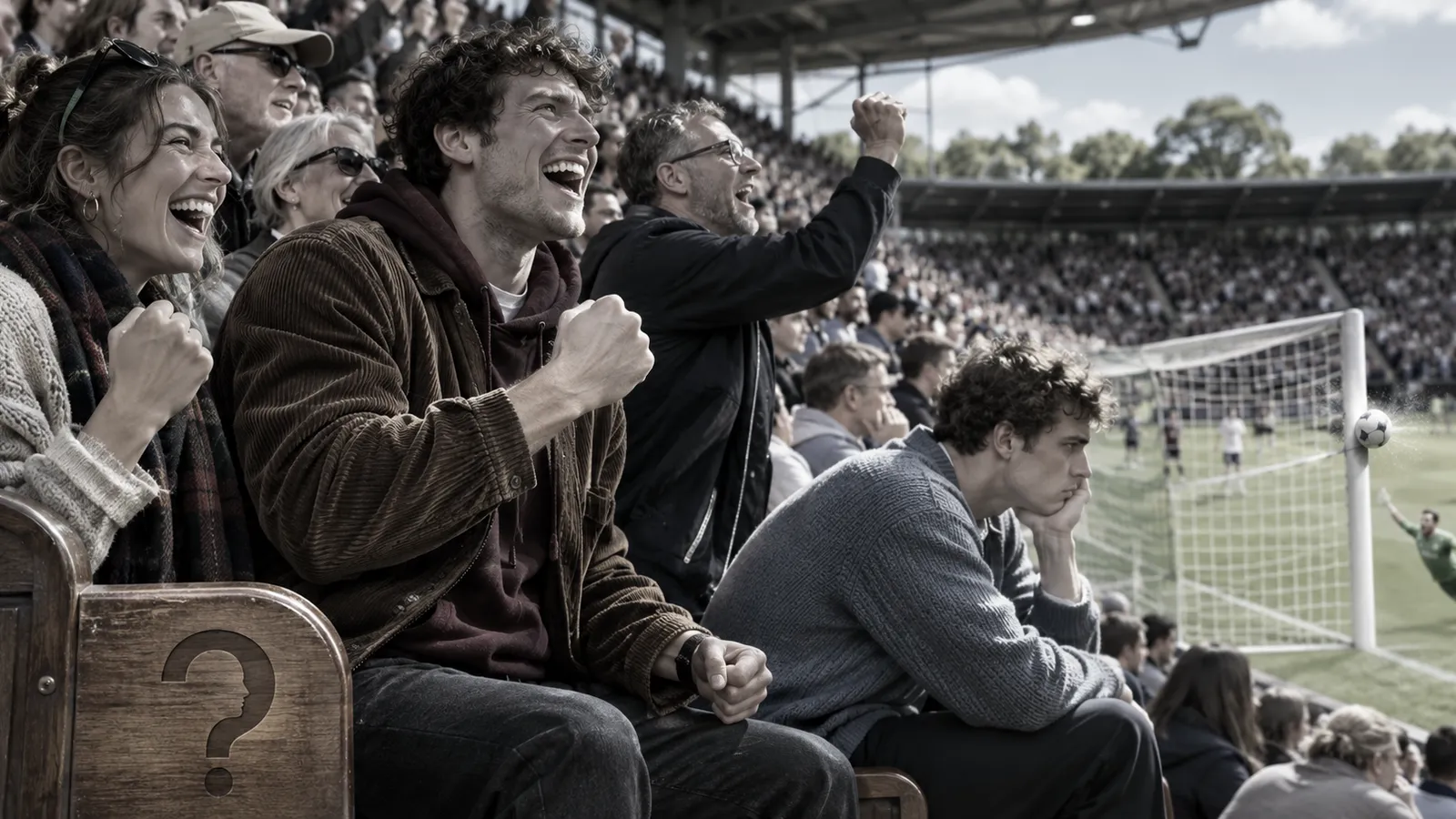
A rival's near miss draws a laugh from one set of stands and a shrug from another. The research on schadenfreude ties the pleasure to group identity, to the pain of feeling behind, and to envy of a close comparison.
Why do people feel schadenfreude?
People feel schadenfreude most when a rival group's setback touches a group they care about. In brain-scanning work, fans' reward regions responded to a rival's failure, and in later studies the pain of their own group's inferiority explained the pleasure better than dislike of the rival did.
Key takeaways
- In a brain-scanning study of fans of two long-standing rivals, a rival's failure activated the ventral striatum, a central part of the reward system, while a setback for the favoured team activated the anterior cingulate cortex and the insula (Cikara and colleagues, 2011).
- Pleasure at the loss of a rival national soccer side rose with interest in the sport and with threats to the standing of one's own side (Leach and colleagues, 2003).
- Pain about a group's inferiority explained pleasure at a successful out-group's failure better than dislike of the out-group, interest in the domain or a belief that its success was illegitimate (Leach and Spears, 2008).
- Pleasure at seeing adversity (schadenfreude) and pleasure at causing it (gloating) differed in situation, appraisal, experience and expression (Leach and colleagues, 2015).
- Envy predicted schadenfreude only when the person who suffered was similar to the observer in gender (van Dijk and colleagues, 2006), and malicious envy, not benign envy, was related to it (van de Ven and colleagues, 2015).
Schadenfreude, pleasure at a rival's setback, is easy to wave away as spite, and the research points somewhere less obvious. In brain scans, surveys and experiments, the strength of the feeling follows how a person stands toward their own group, and the rival's fall is only the trigger. Three findings carry that picture: the feeling follows the line between groups, it grows with the pain of feeling behind, and it sharpens when the comparison is close.
Schadenfreude follows the line between our group and theirs
Avid fans of two long-standing baseball rivals watched plays while Mina Cikara, Matthew Botvinick and Susan Fiske recorded their brain activity. A setback for the favoured team, or a success for the rival, activated the anterior cingulate cortex and the insula, regions associated with distress. A success for the favoured team, or a setback for the rival, activated the ventral striatum, a central part of the reward system. Nothing personal rode on any play, yet the fortunes of the group were enough to engage the reward response.
Interest in the sport mattered, and so did standing. In work by Colin Wayne Leach, Russell Spears and colleagues on the loss of a rival national soccer side, pleasure was higher among people more interested in soccer and among those whose sense of their own side's standing was under threat. A second study replicated the pattern with losses by two other sides, and the effect of threat was especially strong among people less interested in soccer, so devotion is not required.
The same identification that leads supporters to say we won after a victory, a habit covered in Why We Say We Won When Our Team Wins, is what lets a stranger's missed chance register as a private gain. The authors concluded that schadenfreude is an emotion shaped by the relations between groups. Three conditions recur in these studies and in the ones that follow:
- The people involved belong to groups the watcher cares about, so the event reads as about us and them.
- The watcher's own side feels behind or under threat.
- The one who stumbles is a relevant comparison, someone in the same race and not a distant stranger.
Supporters who feel they trail enjoy a rival's fall most
Standing is relative, and a rival's visible rise lowers our own. That is how Will Storr, in The Status Game, accounts for resentment of those who climb above us and satisfaction when they fall. Experiments on groups put a measurement behind the idea. In two studies by Leach and Spears, participants considered a fictitious competition between real institutions and rated how they felt about its outcome. Pleasure at the successful side's failure was best explained by the pain participants felt about their own group's inferiority, better than by dislike of the other group, interest in the field of competition or a belief that the other group's success was illegitimate. Measures of envy and anger explained less still.
The authors read the result as concern with the self more than hostility toward others. That reading fits the arithmetic of rank. If standing is a ladder with one place per rung, a rival's drop counts as a step up for everyone below, which is the fixed-pie reasoning examined in Why Their Gain Feels Like Our Loss. It also fits what Leach, Spears and Antony Manstead found when they compared pleasure at seeing someone's adversity, which is schadenfreude, with pleasure at causing it, which is gloating. People described the two episodes differently in what happened, how they appraised it, how it felt and how it was expressed, and the individual and group versions of each differed little.
Envy toward a close comparison sharpens pleasure at their fall
Envy and schadenfreude are linked, but only under conditions. Wilco van Dijk and colleagues found that envy predicted schadenfreude when the person who suffered the misfortune was similar to the observer in gender, so the pleasure is strongest when the misfortune befalls a relevant comparison. Hidehiko Takahashi and colleagues followed the link into the brain in two imaging studies reported in 2009. Reading about people who held something that mattered to the reader raised activity in the anterior cingulate cortex, more so when the possession was self-relevant. When those people then met misfortune, the ventral striatum responded more strongly, and the earlier cingulate activity predicted the later striatal response.
Not every envy leads there. Niels van de Ven and colleagues separated malicious envy, aimed at the person ahead, from benign envy, which moves a person to improve their own standing, the distinction described in Why do we want what other people have. Across three studies, malicious envy was related to schadenfreude in two countries and benign envy was not. The result held after allowing for feelings of inferiority, dislike of the person, anger and perceived deservedness, which helps explain why earlier studies of envy and schadenfreude disagreed.
Put together, the laugh in the crowd says little about the rival and a good deal about the one laughing. The delight grew with the pain of feeling behind, it needed a comparison that mattered, and it attached to the group a person had folded into their own sense of self. Glee at a stumble is a reading of attachment, which is why the same missed chance can leave one neutral viewer shrugging while the person beside them, who has folded the whole side into their own sense of who they are and has felt behind all season, is up on their feet.
Common questions
Why do people feel schadenfreude?
People feel schadenfreude most when a rival group's setback touches a group they care about. In brain-scanning work, fans' reward regions responded to a rival's failure, and in later studies pain about their own group's inferiority explained the pleasure better than dislike of the rival did.
What is intergroup schadenfreude?
Intergroup schadenfreude is pleasure at the misfortune of another group, such as a rival team. Studies find it rises with interest in the contest and with threats to the standing of one's own side.
Is schadenfreude the same as envy?
No. Envy is a painful reaction to someone who is ahead, and schadenfreude is a rewarding reaction to that person's misfortune. In studies, malicious envy was related to schadenfreude and benign envy was not.
Sources
Storr, W. The Status Game. Seed book.
Cikara, M., Botvinick, M. M., & Fiske, S. T. (2011). Us versus them: Social identity shapes neural responses to intergroup competition and harm. Psychological Science, 22(3), 306-313. doi:10.1177/0956797610397667 https://doi.org/10.1177/0956797610397667
Leach, C. W., Spears, R., Branscombe, N. R., & Doosje, B. (2003). Malicious pleasure: Schadenfreude at the suffering of another group. Journal of Personality and Social Psychology, 84(5), 932-943. doi:10.1037/0022-3514.84.5.932 https://doi.org/10.1037/0022-3514.84.5.932
Leach, C. W., & Spears, R. (2008). A vengefulness of the impotent: The pain of in-group inferiority and schadenfreude toward successful out-groups. Journal of Personality and Social Psychology, 95(6), 1383-1396. doi:10.1037/a0012629 https://doi.org/10.1037/a0012629
Leach, C. W., Spears, R., & Manstead, A. S. R. (2015). Parsing (malicious) pleasures: Schadenfreude and gloating at others' adversity. Frontiers in Psychology, 6, 201. doi:10.3389/fpsyg.2015.00201 https://doi.org/10.3389/fpsyg.2015.00201
van Dijk, W. W., Ouwerkerk, J. W., Goslinga, S., Nieweg, M., & Gallucci, M. (2006). When people fall from grace: Reconsidering the role of envy in schadenfreude. Emotion, 6(1), 156-160. doi:10.1037/1528-3542.6.1.156 https://doi.org/10.1037/1528-3542.6.1.156
Takahashi, H., Kato, M., Matsuura, M., Mobbs, D., Suhara, T., & Okubo, Y. (2009). When your gain is my pain and your pain is my gain: Neural correlates of envy and schadenfreude. Science, 323(5916), 937-939. doi:10.1126/science.1165604 https://doi.org/10.1126/science.1165604
van de Ven, N., Hoogland, C. E., Smith, R. H., van Dijk, W. W., Breugelmans, S. M., & Zeelenberg, M. (2015). When envy leads to schadenfreude. Cognition and Emotion, 29(6), 1007-1025. doi:10.1080/02699931.2014.961903 https://doi.org/10.1080/02699931.2014.961903
Related concepts
People
More articles
- Why Doing Harm Feels Worse Than Allowing It
Harm that follows an action is judged more harshly than the same harm that follows inaction. The research on omission bias shows where that comes from, why it can work as cover, and when it reverses.
- Why a Cliffhanger Keeps Us Watching
A cliffhanger ends a story at its most unresolved point. Research on suspense and curiosity shows why viewers want the next instalment, and what the ending does not change.
- Why an Unexpected Extra Delights More Than a Promised One
A promised extra is counted into the stay before it arrives. An unannounced one is measured against nothing, and experiments on reward, mood and gifts suggest that gap is where the extra delight…
- Why a Small Win Softens a Big Loss
A credit of 5 beside a charge of 100 can be booked as one net loss or as two separate entries. The research on the silver lining effect sets out when the second booking feels better.