Why We Feel Guilty About Treats
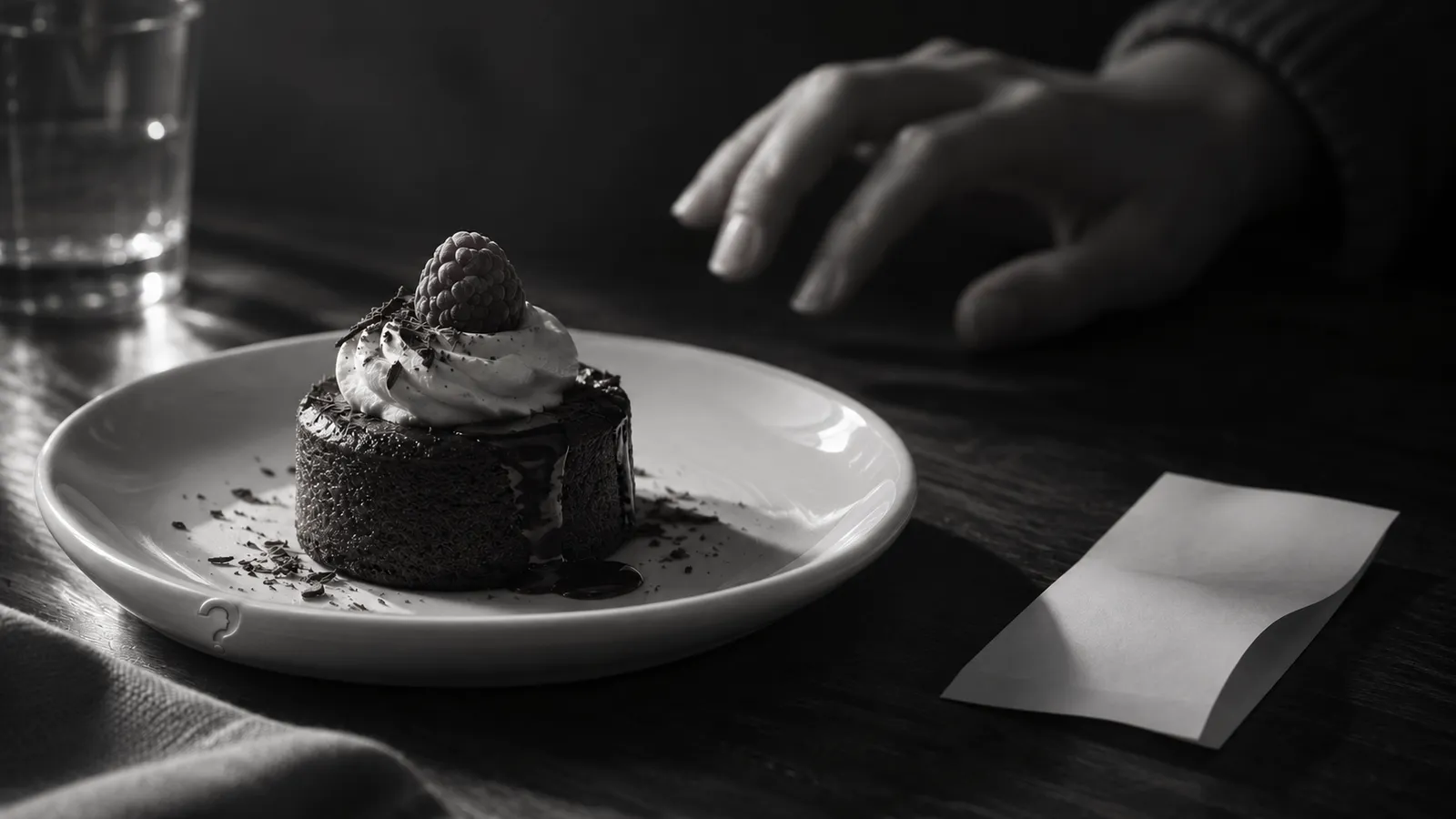
How a treat gets wanted, defended and paid for in advance, and what studies of effort, restraint and real reports say about the guilt.
Answer to the question
Why do treats make us feel guilty?
Because a treat is wanted before it is allowed, and a reason has to be supplied. In a study of about 3,100 consumers, higher effort requirements pushed choices toward luxury rewards, which the authors tie to guilt. Yet when Jing Xu and Norbert Schwarz asked how indulgences actually felt, having a reason made no difference.
Key takeaways
- In a study of about 3,100 consumers, higher effort requirements shifted preferences toward luxury rewards, and the authors tie the shift to lower guilt over luxuries.
- People chose the hedonic option more often for another person than for themselves in two studies, and anticipatory guilt accounted for the gap.
- Resisting a tempting purchase made people more likely to reward themselves later when the restraint was salient and could serve as a justification.
- Asked in advance, people expected an indulgence without a reason to feel worse, but reports after and during the indulgence showed no effect of having a reason.
- General memories of how indulging feels matched people's expectations, not their actual reports.
Raise the effort needed to earn a reward, and more people choose a luxury over a necessity. That was the pattern in Ran Kivetz and Itamar Simonson's study of reward programmes, and their account of it was guilt: effort makes a luxury easier to choose. The shift grew stronger among consumers prone to feeling guilty about luxuries, which is what that account predicts. On it, the guilt over a treat is a charge that comes due when no reason is on file for it.
Why treats feel guilty before the treat has even arrived
The pull of a treat comes first and the permission comes later. Daniel Lieberman and Michael Long's The Molecule of More calls dopamine the anticipation molecule and keeps anticipation apart from enjoyment, which gives a useful frame: wanting something small and sweet is one event, and deciding that one may have it is another. The split between wanting and liking, set out in Wanting Is Not Liking, leaves a gap between the two, and the gap is where the charge gets written.
The size of the charge depends on the kind of good. Jingyi Lu, Zhengyan Liu and Zhe Fang build on earlier work showing that people feel more anticipatory guilt when they contemplate hedonic consumption than practical consumption, and they asked what happens when the choice is for someone else. In two studies, people were more likely to pick the hedonic option for another person than for themselves, and anticipatory guilt accounted for the gap. The contrast was built from product attributes in the first study and from different products in the second. The same treat looked easier to hand over than to take.
That helps explain why the guilt is felt in advance. At the moment of choosing, the only things on the table are the wish and the question of whether it can be defended, and the wish has no defence of its own.
Erica Okada found that the company an option keeps changes which one wins. Rated alone, a hedonic option scored higher than a comparable practical one, but people weighing the two side by side more often chose the practical one. Her studies also showed a difference in what people were willing to give up: more time for hedonic goods and more money for practical ones. A treat is easiest to choose when nothing sensible sits next to it.
| Situation | What shifted | Study |
|---|---|---|
| Treat chosen for another person | Hedonic option picked more often; anticipatory guilt explained the gap | Lu, Liu and Fang, 2016 |
| Treat judged beside a practical option | Practical option chosen more often | Okada, 2005 |
| Treat preceded by effort | Luxury rewards chosen more as the requirement rose | Kivetz and Simonson, 2002 |
| Treat after visible restraint | Indulgent option chosen more often | Mukhopadhyay and Johar, 2009 |
Effort and restraint pay for the permission in advance
Kivetz and Simonson studied reward programmes, where customers earn a prize by meeting a requirement, and their sample ran to roughly 3,100 consumers. Higher requirements shifted preferences toward luxury rewards, and this held even when consumers proposed their own rewards. The shift was stronger for consumers prone to luxury-related guilt and stronger when the effort was work-related. Two further checks sharpen the picture. The shift persisted when personal effort was higher while the programme requirements stayed the same, and a higher monetary cost lowered the preference for luxuries. Effort raised the pull of luxuries and cost lowered it, which fits Okada's finding that people trade time for hedonic goods.
Everyday versions are easy to find: an evening out after a deadline met, a small purchase after a month of skipped ones, a dessert shared in celebration. Each arrives with its reason attached, and these are our illustrations of the studies, not cases from them.
Restraint can do the same job. Anirban Mukhopadhyay and Gita Johar ran four experiments in which resisting a tempting purchase made people more likely to reward themselves afterwards by choosing an indulgent option. The effect appeared when the earlier restraint was salient and could serve as a justification. A skipped purchase from last week and a long shift this week are the same kind of entry in the ledger.
Moral Licensing is the broader pattern in which a good act clears room for a lapse, and the treat studies are a close cousin of it, since the licence is issued by the person's own record. A reason can also be a matter of timing. Why do gift cards go unspent? follows how money filed in a pleasure account gets put off until an occasion feels right, and the logic is the same: the treat waits until the reason is in place.
The two routes differ in what they spend. Effort costs time and energy that a person may have little of, while restraint costs only a purchase that was never made, so restraint is the cheaper route to permission and the easier one to claim afterwards. That is our reading, and the studies do not test it.
The studies, then, describe the guilt as a function of the reason on file, not of the treat itself. The same dessert, trinket or afternoon off weighs less when the effort or the restraint came first, and weighs more when it arrives unearned and alone.
The guilt sits in the forecast and the memory
The moment of enjoyment is the stage the permission studies leave aside, and Jing Xu and Norbert Schwarz measured it. Asked in advance, people expected an indulgence without a reason to feel worse, and less pleasant, than an indulgence with a reason such as consolation or a reward. That forecast is what the permission studies depend on, because it is the forecast that decides whether the treat is chosen.
Then the authors compared it with reports of the real thing, which they gathered in two ways: after people's most recent indulgence and while an indulgence was under way. Feelings reported after people's most recent indulgence showed no effect of having a reason, and reports made during the experience showed no difference either. The reason changed what people predicted and left what they felt largely where it was.
For anyone about to choose a treat, the comparison changes the question. The forecast can be checked against what the last treat actually felt like, and in these studies that report did not vary with having a reason.
One more result completes the sequence. When people were asked how they usually feel about indulging, their general memories matched their expectations and not their actual reports. People's general memories of how indulging feels matched what they had expected and not what they had reported, so the charge is written before the treat, repeated in memory afterwards, and missing from the moments in between.
Common questions
Why do treats make us feel guilty?
A treat is wanted before it is allowed, and people expect more guilt when no reason is on file. Effort, restraint and the presence of a practical alternative all change how easy the treat is to choose.
Does earning a treat make it feel better?
Effort made luxury rewards more attractive in a study of about 3,100 consumers, and the authors tie this to lower guilt. Reports of how an indulgence actually felt did not differ with or without a reason.
Why do we give treats more easily than we take them?
In two studies, people chose the hedonic option more often for another person than for themselves, and anticipatory guilt accounted for the difference.
Is treat guilt a lasting feeling?
In the research above, the guilt showed up mainly in what people expected and in their general memories, not in reports made during or just after the indulgence.
Sources
Lieberman, D. Z., & Long, M. E. The Molecule of More. Seed book; vault hub Books/The Molecule of More.
Kivetz, R., & Simonson, I. (2002). “Earning the right to indulge: Effort as a determinant of customer preferences toward frequency program rewards.” Journal of Marketing Research, 39(2), 155-170. doi:10.1509/jmkr.39.2.155.19084 https://doi.org/10.1509/jmkr.39.2.155.19084
Okada, E. M. (2005). “Justification effects on consumer choice of hedonic and utilitarian goods.” Journal of Marketing Research, 42(1), 43-53. doi:10.1509/jmkr.42.1.43.56889 https://doi.org/10.1509/jmkr.42.1.43.56889
Mukhopadhyay, A., & Johar, G. V. (2009). “Indulgence as self-reward for prior shopping restraint: A justification-based mechanism.” Journal of Consumer Psychology, 19(3), 334-345. doi:10.1016/j.jcps.2009.02.016 https://doi.org/10.1016/j.jcps.2009.02.016
Lu, J., Liu, Z., & Fang, Z. (2016). “Hedonic products for you, utilitarian products for me.” Judgment and Decision Making, 11(4), 332-341. doi:10.1017/s1930297500003764 https://doi.org/10.1017/s1930297500003764
Xu, J., & Schwarz, N. (2009). “Do we really need a reason to indulge?” Journal of Marketing Research, 46(1), 25-36. doi:10.1509/jmkr.46.1.25 https://doi.org/10.1509/jmkr.46.1.25