Why Do We Blame People for Bad Luck
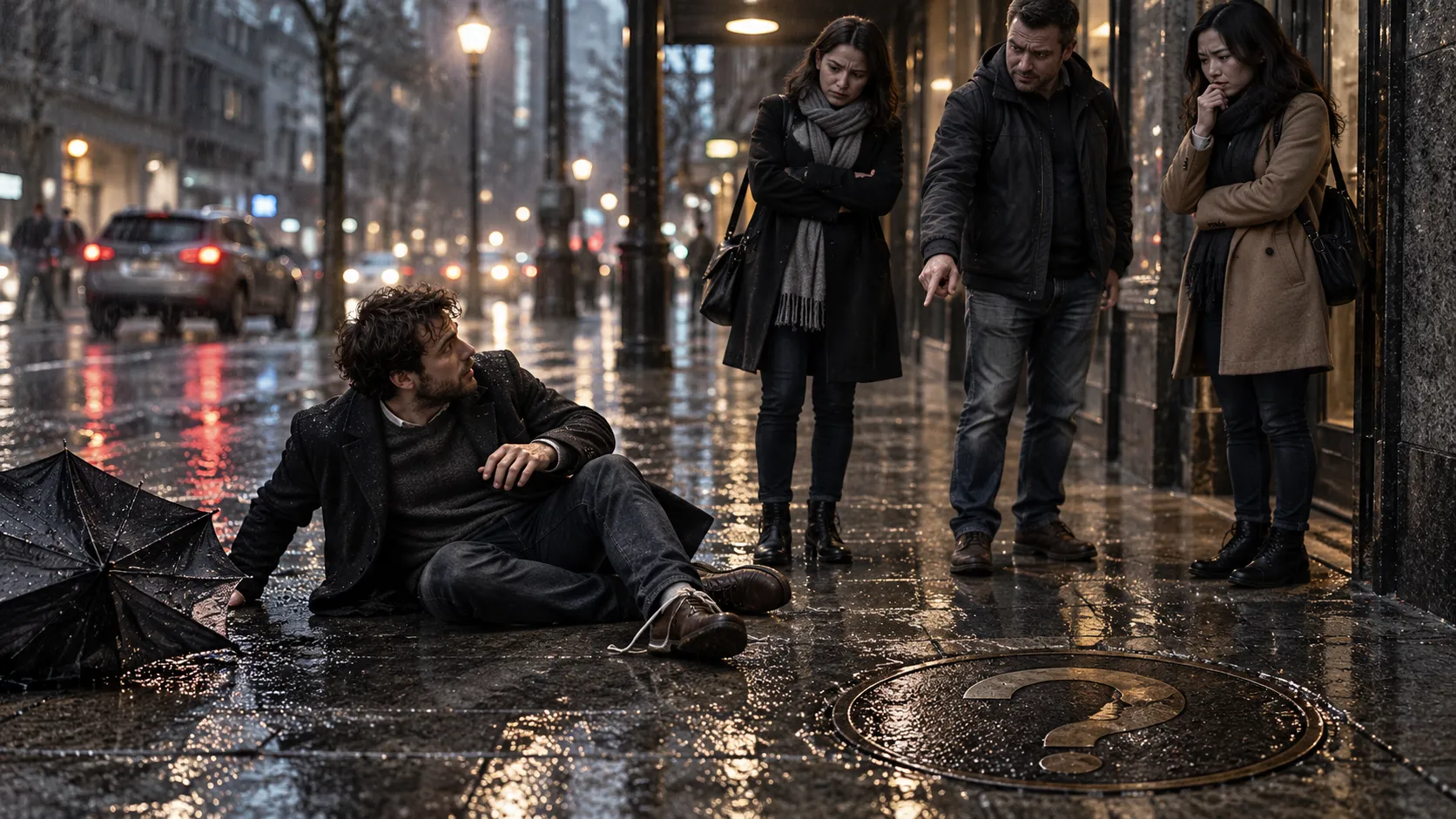
Adrian Furnham's The New Psychology gives belief in a just world a chapter with two faces, blaming victims and coping. The experiments behind the first face pool to a small effect that depends on how vivid the scene is.
Answer to the question
Why do we blame people for bad luck?
Suffering that looks undeserved threatens the belief that the world is fair, and thinking less of the person removes the threat. The effect is real in experiments but small on average across 55 studies, and it is stronger when the scene is vivid and close and the suffering cannot be fixed.
Key takeaways
- Lerner and Simmons (1966) showed 72 female undergraduates a staged victim apparently being shocked. Observers who expected her suffering to continue rated her lower than observers told a vote to reward her had succeeded.
- Dawtry and colleagues (2020) pooled 55 studies and 5,947 participants from 1966 to 2016. The average derogation effect was small, varied widely, and was larger for vivid, close and emotionally impactful scenes.
- Published studies showed larger effects than unpublished ones, and the authors' sensitivity analyses suggest the true average is probably below the pooled figure.
- Dalbert (1999) separated personal belief that the world is just for me from general belief, across four questionnaire studies and one experiment. Furnham's three-worlds split is a proposal without data in the chapter.
A colleague is made redundant through no fault of their own, and a thought can arrive before the sympathy does: what did they do? It is a small piece of arithmetic. If bad things happen to people who earned them, an unexplained run of bad luck is a puzzle, and marking the person down is one way to solve it.
That reflex is the belief in a just world, the idea that people broadly get what they deserve, and it is the subject of research on why we blame people for bad luck. Adrian Furnham's chapter on it in The New Psychology, headed Justice Motivation, treats it as one belief with two faces. The first is blaming the victim: if outcomes are deserved, a person's bad luck says something about them. The second is a resource, since the same belief makes effort feel worth making. He dates the field's turn from the first view to the second to around the millennium, and leaves open which causes which: coping or the belief.
This piece takes the faces in the opposite order from the chapter. The coping face comes first, because it rests on a distinction that changes how the blaming evidence reads.
Is the Belief About Me or About the World?
The research distinction that matters most is Dalbert's. Her 1999 paper in Social Justice Research reports four questionnaire studies and one experiment on a Personal Belief in a Just World scale. Personal belief, that the world is just for me, could be reliably distinguished from general belief, that the world is just. People endorsed the personal version more strongly. It also predicted self-esteem and well-being questionnaire scores after general belief and favourable self-perceptions were taken into account. Dalbert read just-world beliefs as both world views and a personal contract between a person and the social world.
Furnham proposes a different split, between beliefs about the personal, interpersonal and social worlds, along with a third position in which the world is neither fair nor rigged but arbitrary. He offers both as proposals. Dalbert's two-way split is the one that comes with data in the sources checked for this piece.
Dawtry and colleagues, working from the blaming side of the literature, still describe belief in a just world as linked to pursuing long-term goals with confidence, and they treat derogation as one way of protecting that belief. That is the point on which the chapter and the research agree, and it leaves the blaming half to be tested on its own.
A Staged Victim and Seventy-Two Observers
The belief is Melvin Lerner's construct, set out at length in his book The Belief in a Just World: A Fundamental Delusion. Furnham's chapter does not name him, so the trail runs upstream of the book. The experiment is Lerner and Simmons, reported in the Journal of Personality and Social Psychology. Seventy-five female undergraduates volunteered and three were excluded for knowing the true purpose, which left seventy-two who watched a video of a woman who appeared to receive painful shocks for wrong answers. She was a confederate and was not shocked. Each observer was then placed in one of several conditions that changed what she expected to happen next.
Those who expected her suffering to continue in a second session rated her lower than observers who had voted for her to be rewarded and been told the vote succeeded. Ratings were lowest when she seemed to suffer for the observers' sake, agreeing to carry on so that they could earn course credit, and lower than when the experiment was described as over. Lerner and Simmons read the pattern as a need to believe that the world is just. When the bad luck could not be undone, the person who had it came to look less likeable.
Fifty Years of Studies Gave a Small and Uneven Average
The behaviour has a name, victim derogation: devaluing the character of an innocent person who suffered. The logic runs that in a just world bad things happen only to bad people, so marking the person down removes the apparent injustice. Dawtry and colleagues (2020) ran the first meta-analysis of derogation experiments, covering 55 studies and 5,947 participants from 1966 to 2016, a span of fifty years of work on how observers treat bad luck that was not earned. The average effect was small and the differences between studies were larger than chance would produce. The authors note that since 1980 some studies have found derogation, some none, and a few the opposite.
Two features of the scene predicted who found it. Studies with more emotionally impactful material, meaning vivid and close to the observer, found larger effects, while whether the event was real or invented made no clear difference. Older studies also found larger effects than newer ones, but emotional impact is tangled up with year, so the authors could not fully separate the two. Published studies showed larger effects than unpublished ones, and their sensitivity analyses suggest the true average is probably below the pooled figure. Two further experiments by the same team found that more impactful contexts increased derogation.
Four pieces of evidence carry the argument, and they differ in design.
| Source | What it examined | What it reported |
|---|---|---|
| Lerner and Simmons (1966) | 72 female undergraduates watching a staged victim | Lower ratings when suffering was expected to continue and could not be changed, lowest when the victim seemed to suffer for the observers |
| Hafer and Bègue (2005) | Experimental research since 1980 | Unsystematic in places, with two conceptions of the belief |
| Dawtry and colleagues (2020) | 55 studies, 5,947 participants, 1966 to 2016 | Small average effect, wide variation, larger for vivid and close scenes, probable publication bias |
| Dalbert (1999) | Four questionnaire studies and one experiment | Personal belief separable from general belief |
Hafer and Bègue (2005) had reviewed the experiments since 1980 and described the research as unsystematic in places. They also catalogued the common experimental designs and the studies published since then, and set out two ways of understanding the belief itself. The original experiment holds the most practical detail. Observers who could change the victim's fate rated her more kindly than observers who expected the suffering to go on without recourse. In that design, derogation tracked the situation the observers were in. The meta-analysis points the same way, since the closer and more vivid the scene, the larger the effect.
Blame Adds a Motive to Familiar Mistakes
Two neighbouring ideas work differently. The Fundamental Attribution Error explains why we credit people's character for what circumstance produced, and needs no motive to protect a fair world. What Outcome Bias Does to a Good Call covers judging a decision by how it turned out, and Survivorship Bias in Success Stories covers the failures we never see. Blaming people for bad luck adds a motive to those mechanisms: fairness is easier to keep if the person is marked down than if the rule is questioned.
Furnham's chapter reads the field as having moved from the harsh view to the coping view. The record is less tidy. Both findings sit in the literature, and this piece takes the social cost of the belief, thinking less of people for their bad luck, to be real but smaller and more conditional than its fame suggests, with the coping evidence checked here resting on the personal version of the belief.
Common questions
Why do we blame people for bad luck?
Just-world theory, introduced by Melvin Lerner, holds that people are motivated to see the world as fair, and an innocent person's suffering threatens that. Marking the person down restores a sense of fairness. In experiments the effect is small on average, and it depends on how vivid, close and unfixable the bad luck seems.
Does a belief in a fair world always lead to blaming victims?
The research does not support that shortcut. The 2020 meta-analysis pooled experiments with innocent victims and found a small average effect that varied widely, with larger effects for more emotionally impactful scenes. Dalbert's work separates a personal belief that the world is just for me from a general belief that it is just.
Who first described the belief in a just world?
Melvin Lerner, whose 1966 experiment with Carolyn Simmons and 1980 book set out the idea. Furnham's The New Psychology covers the belief without naming him.
Sources
Furnham, A. (2024). The New Psychology: The 50 Newest Concepts That Are Shaping How We Live and Work. Bloomsbury Business. Seed book; vault hub Books/The New Psychology.
Lerner, M. J., & Simmons, C. H. (1966). “Observer's reaction to the 'innocent victim': Compassion or rejection?” Journal of Personality and Social Psychology, 4(2), 203-210. doi:10.1037/h0023562 https://doi.org/10.1037/h0023562
Dawtry, R. J., Callan, M. J., Harvey, A. J., & Gheorghiu, A. I. (2020). “Victims, vignettes, and videos: Meta-analytic and experimental evidence that emotional impact enhances the derogation of innocent victims.” Personality and Social Psychology Review, 24(3), 233-259. doi:10.1177/1088868320914208 https://doi.org/10.1177/1088868320914208
Hafer, C. L., & Bègue, L. (2005). “Experimental research on just-world theory: Problems, developments, and future challenges.” Psychological Bulletin, 131(1), 128-167. doi:10.1037/0033-2909.131.1.128 https://doi.org/10.1037/0033-2909.131.1.128
Dalbert, C. (1999). “The world is more just for me than generally: About the Personal Belief in a Just World Scale's validity.” Social Justice Research, 12(2), 79-98. doi:10.1023/A:1022091609047 https://doi.org/10.1023/A:1022091609047
Lerner, M. J. (1980). The Belief in a Just World: A Fundamental Delusion. New York: Plenum Press.