Why We Love the Music of Our Teens
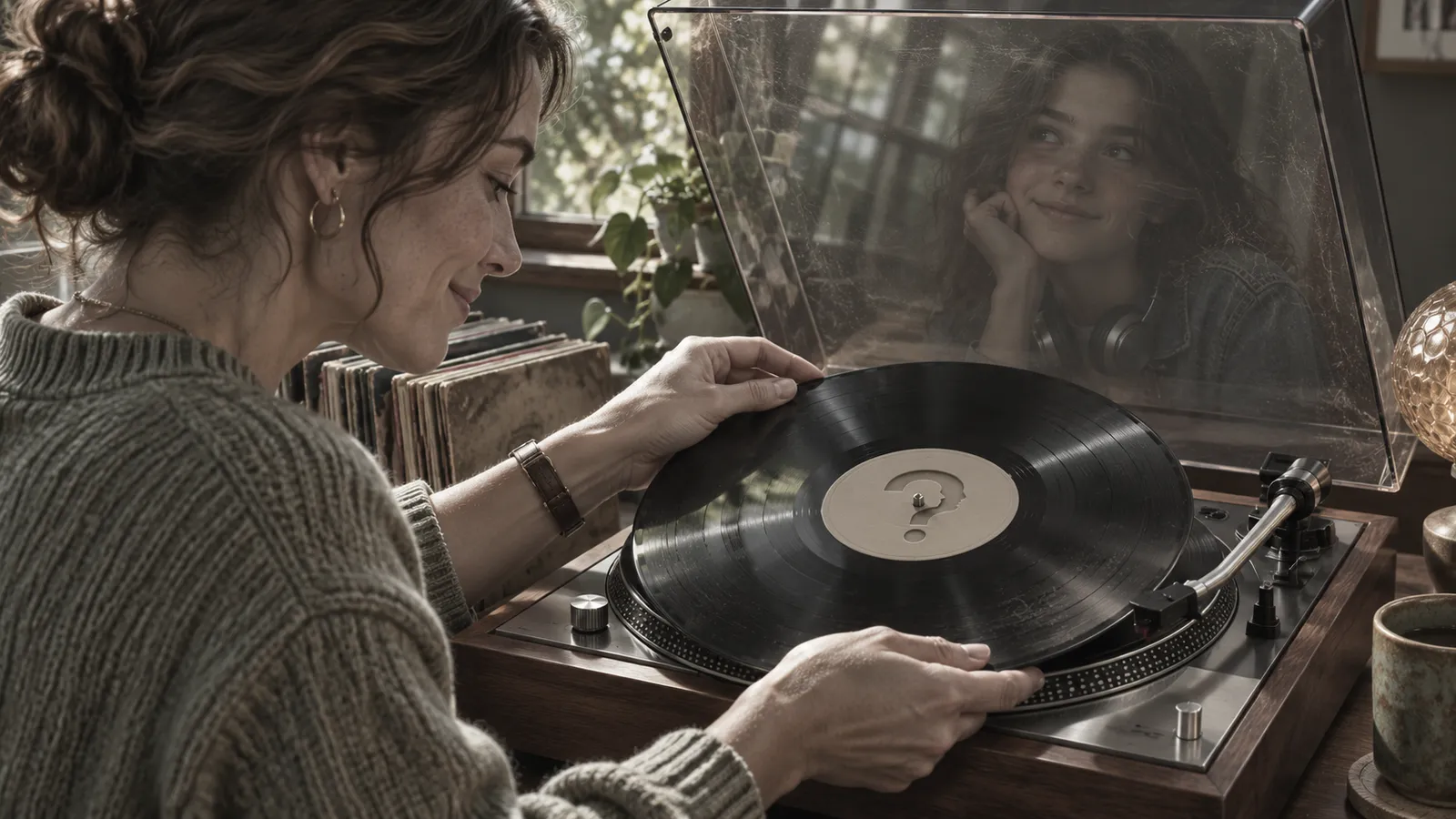
What studies of chart songs say about the age when music sticks, whether liking and memory peak together, and why a parents' playlist can count too.
Why do we love the music of our teens?
Largely because the teens and early twenties hold a disproportionate share of lasting memories, and songs heard then become attached to them. Studies of chart songs find memory associations and familiarity peaking near age fourteen and liking peaking a few years later. Why those years stick is still debated.
Key takeaways
- In a study of about 470 adults aged 18 to 82 rating 111 chart songs from 1950 to 2015, memory associations and familiarity peaked for songs from around age 14.
- Liking peaked later: a US panel of just over a thousand people placed the peak near 17, earlier than an estimate of about 23.5 from a 1989 study.
- Young adults also gave high ratings to music from their parents' generation, a pattern its authors call cascading reminiscence bumps.
- In a 1999 study, older adults rated songs from their youth as the most emotional and remembered more about them, though the excerpts rarely brought back a specific event.
- Liking varied more with the listener's current age than memory did, so taste can move on while the music of the teens keeps its place.
Songs that charted when a listener was about fourteen carry more memories and more familiarity than songs from any other stretch of life. The music of our teens holds its place even when taste moves on, a pattern found among about 470 adults aged 18 to 82.
The Peak Sits Between Fourteen and Seventeen
Kelly Jakubowski and colleagues asked those adults to rate one hundred and eleven chart songs from 1950 to 2015. Three measures sit behind the question, and they do not peak at the same age. Memory association asks how strongly a song brings back something personal. Familiarity asks whether the listener knows it. Liking asks whether the listener enjoys it. Each has been tested with chart songs, and the answers differ by measure, by sample and by decade of study.
- Memory associations and familiarity: around fourteen, in the study of adults aged eighteen to eighty-two by Jakubowski and colleagues, published in 2020.
- Liking: near seventeen, in a US panel of just over a thousand people who rated thirty-four thirty-second excerpts of top-ten songs from 1950 to 2016, reported by Callum Davies and colleagues in 2022.
- An earlier estimate for liking: about twenty-three and a half, from a 1989 study by Morris Holbrook and Robert Schindler, as Davies and colleagues describe it.
Davies and colleagues used a newer way of finding the top of a curve, the two-lines test, and confirmed that preference rises and then falls. They placed the top earlier than the 1989 estimate and found that individual peaks varied. They raise the possibility that easier access to music through streaming is one reason the peak now falls in the mid to late teens, and they ask for further work to test it. The older estimate and the newer one agree on the shape, and they differ on the age.
The larger sample also revealed differences between generations, and the authors conclude that for any narrow age group the music most likely to be preferred is the music released in late adolescence or early adulthood.
Parents' Playlists Leave Their Mark Too
Young adults favour more than the music of their own teens. Carol Krumhansl and Justin Zupnick asked young adults about personal memories tied to top hits from roughly five and a half decades. Ratings rose for music from the participants' own youth, as expected, and they rose again, unexpectedly, for music from their parents' generation. The measures covered memory context, recognition, preference, quality judgments and emotional reactions to the music. The authors link the second rise to the music heard at home in childhood and call the pattern cascading reminiscence bumps, because a bump in one generation passes down to the next.
Jakubowski and colleagues found the same cascade in liking: young adults in their sample favoured music from their parents' adolescent years. The finding suggests that a teenager's playlist has two audiences. It becomes the soundtrack of that teenager's own memories, and it may also become part of the background that a later generation grows up in.
Why Would the Teens Stick So Well?
The teens and early twenties are crowded with firsts: first concerts, first friends chosen for oneself, first time away from home. Charan Ranganath argues in Why We Remember that memory is built around prediction, and that the moments the brain stores best are those that depart from what it expected. A song heard among such moments is attached to events that were new, which is one plausible reason it stays reachable, though none of the studies above tested that link directly, so it stays a reading of the book beside the music findings and not a result.
The general pattern is known as the reminiscence bump, the tendency of people to recall more from roughly ages ten to thirty than from other periods, and Your Nostalgia Is Lying to You shows how it decides which years people end up missing. Jakubowski and colleagues report that music-related memories seem to draw on similar retrieval processes as memories cued by words. That fits music being one more route into a store that is already weighted towards the teens and early twenties, and not a separate system with its own rules.
Matthew Schulkind, Laura Hennis and David Rubin tested older and younger adults on twenty-second excerpts of popular songs from across the twentieth century in 1999. Older adults rated songs from their youth as the most emotional and remembered more about them. The excerpts rarely brought back a specific event, though. In that study emotion and memory were positively linked, and the link was stronger for older adults, so a song that felt more emotional was also better remembered. The result suggests that a song from the teens marks a period and a feeling more often than a single scene, which fits the idea that songs bind to a whole stretch of life.
A tune from those years can still produce a physical response, which Why a Song Gives You Chills takes up, but the studies in this article measured memory, familiarity and liking and not that shiver.
Taste Moves On but Memory Stays Put
Memory is not the only thing that changes with age, and the 2020 data show liking and memory parting ways: each participant rated every song for memory association, familiarity and liking, so the three curves could be set side by side. Liking varied more with the participant's current age, so what people enjoy now is shaped by where they are in life. The ratings of how personal a song felt and how well it was known stayed pinned to the teens. A listener can enjoy new releases more than the old favourites and still find that the music of the teens means more.
Memory also favours some days of a single holiday over others, as Why You Remember the End of a Holiday explains, and the same selectivity shows up across a whole life, with the teens as the favoured period. We read the music results as the reminiscence bump with a soundtrack: the years hold the events, and the songs of those years hold the key to them. At eighteen or at eighty-two, the songs best known and most tied to personal memory were the ones released around the fourteenth birthday, whatever the playlist looks like today.
Common questions
Why do we love the music of our teens?
The teens and early twenties hold a disproportionate share of lasting memories, and songs heard then are tied to them. In a study of adults aged eighteen to eighty-two, memory associations and familiarity for chart songs peaked around age fourteen. Why the period is so memorable is still debated.
At what age does musical taste peak?
It depends on the measure. Familiarity and memory associations peaked near fourteen in one study, and liking peaked near seventeen in another. An earlier study put the peak of liking at about twenty-three and a half.
Do younger people like their parents' music?
Often more than other music from before their time. Young adults in two studies gave higher ratings to music from their parents' generation, which the authors link to hearing it at home as children.
Do older adults remember songs from their youth better?
In a 1999 study, older adults rated songs from their youth as the most emotional and knew more about them. The excerpts rarely brought back a specific event.
Sources
Ranganath, C. Why We Remember: Unlocking Memory's Power to Hold on to What Matters. Seed book; vault hub Books/Why We Remember.
Jakubowski, K., Eerola, T., Tillmann, B., Perrin, F., & Heine, L. (2020). “A cross-sectional study of reminiscence bumps for music-related memories in adulthood.” Music & Science, 3. doi:10.1177/2059204320965058 https://doi.org/10.1177/2059204320965058
Davies, C., Page, B., Driesener, C., Anesbury, Z., Yang, S., & Bruwer, J. (2022). “The power of nostalgia: Age and preference for popular music.” Marketing Letters, 33(4), 681-692. doi:10.1007/s11002-022-09626-7 https://doi.org/10.1007/s11002-022-09626-7
Krumhansl, C. L., & Zupnick, J. A. (2013). “Cascading reminiscence bumps in popular music.” Psychological Science, 24(10), 2057-2068. doi:10.1177/0956797613486486 https://doi.org/10.1177/0956797613486486
Schulkind, M. D., Hennis, L. K., & Rubin, D. C. (1999). “Music, emotion, and autobiographical memory: They're playing your song.” Memory & Cognition, 27(6), 948-955. doi:10.3758/bf03201225 https://doi.org/10.3758/bf03201225
Holbrook, M. B., & Schindler, R. M. (1989). “Some exploratory findings on the development of musical tastes.” Journal of Consumer Research, 16(1), 119-124. doi:10.1086/209200 https://doi.org/10.1086/209200
Related concepts
People
More articles
- Why Harry Potter Is Getting a TV Series So Soon
The last film premiered in 2011 and the first season of the new series is set for Christmas 2026. Research on choice, familiarity and shared experience shows why a known story is an easy one to come…
- What is a liminal moment?
The word comes from the study of ceremonies and now describes the gaps in a working day. The evidence sits with the older meaning: what happens to habits, and to choices, in the interval between two…
- Why do people collect things?
Belk tied possessions to identity, and a 2025 study tied collecting to the desire for control. Pine and Gilmore add the keepsake that holds an occasion.
- Why We Root for the Underdog
What studies of Olympic matches, the World Cup and brand stories show about sympathy for the weaker side, and where people still back the favourite.
In these themes
- Memory and Nostalgia
What we remember, what we forget, and why the past keeps selling.
- Generations and Life Stages
How what we want changes as life moves on.