Why do we spend more at Christmas?
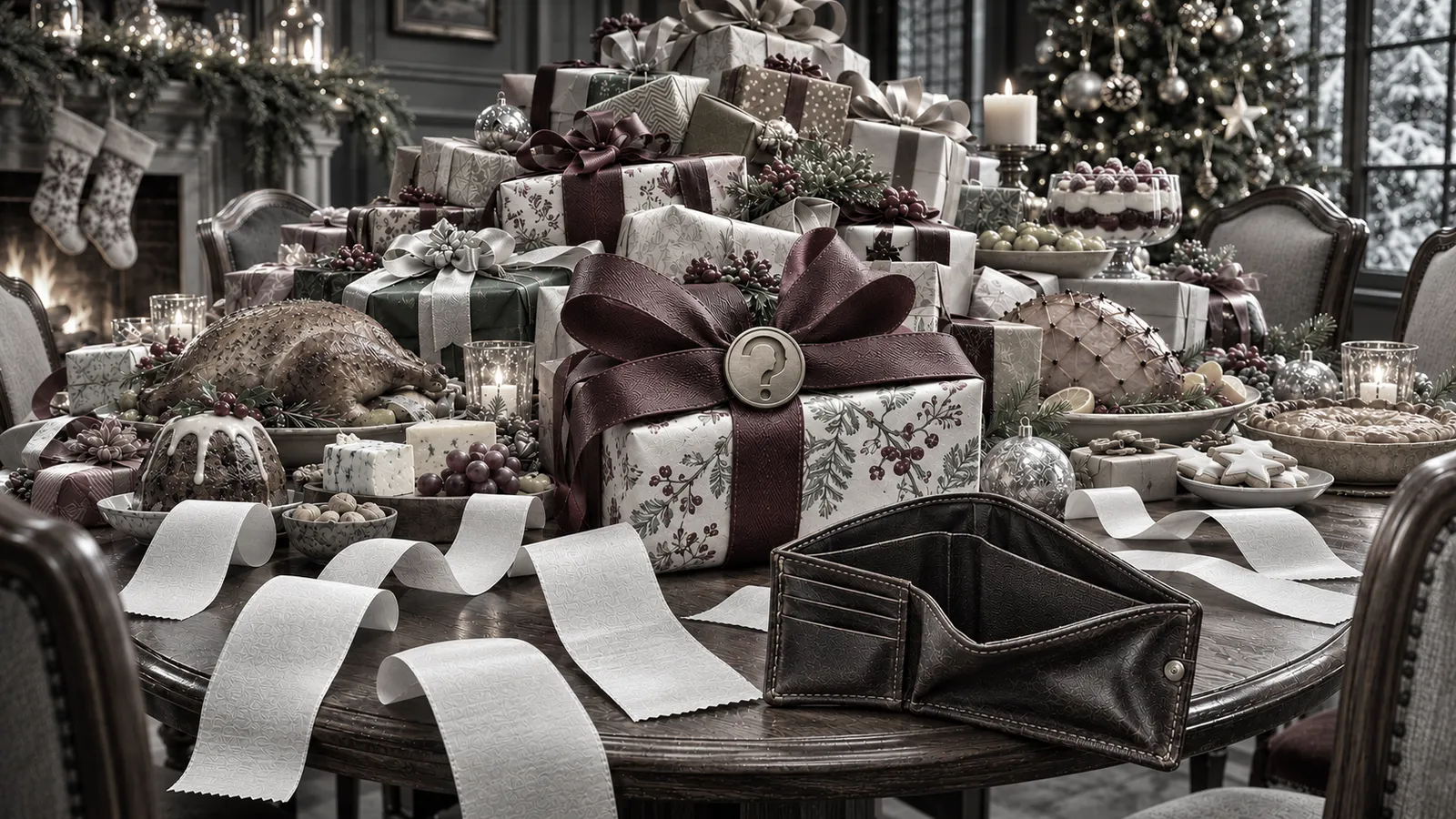
What gift-giving research says about the December budget: why the price goes up, and where the extra money buys less.
Answer to the question
Why do we spend more at Christmas?
We spend more at Christmas because givers expect a higher price to raise the recipient's appreciation, they buy across a long list of relationships, and gifts live in a social frame where the amount spent stands in for care. In three studies, recipients reported no link between price and appreciation.
Key takeaways
- Joel Waldfogel's 1993 survey of undergraduates found that gifts were valued at between a tenth and a third less than their price, with friends and romantic partners giving the most efficient gifts.
- Across three studies, givers expected a higher price to raise appreciation while recipients reported no link between price and appreciation (Flynn and Adams, 2009).
- Dan Ariely's Predictably Irrational describes a gift as keeping an exchange in the social frame and a named price as moving it into the market frame.
- In four studies, large visible gift expenditures made recipients suspicious of the giver's motives and lowered appreciation, while experiential gifts were appreciated more (Mutluoglu and colleagues, 2024).
Undergraduates at a US university were asked what they would pay for the gifts they had received, and what cash they would take in place of them. Joel Waldfogel's survey found the answers fell short of the price by a tenth to a third. Why do we spend more at Christmas, then?
Why givers pay more
Waldfogel estimated holiday gift spending by comparing December retail sales with the months on either side, which gave an estimate in the tens of billions of dollars a year in the United States at the time. The extra money in December is, in large part, money that changes hands as presents. A Christmas gift has an unusual structure, because the person who pays for it is not the person who will use it, and the gap between the two is where the economist saw value lost. The question for the spender is then what a higher price is meant to buy.
The belief has been tested. Francis Flynn and Gabrielle Adams found across three studies that givers expected a higher price to raise the recipient's appreciation, while recipients reported no such link, so a Christmas budget can grow on a belief that the other side does not share.
Dan Ariely's Predictably Irrational supplies a frame for why the belief is so hard to test. In his account of the experiments on social and market norms, a gift keeps an exchange in the social frame, where people give without keeping accounts, while naming a price pulls the same exchange into the market frame, where payment is measured. At Christmas the giving is social, and a price tag on the present would break the frame. One way to read this is that the amount spent becomes the private measure of care, a measure [the giver](https://thewhyweproject.com/articles/why-is-gift-giving-so-stressful) can see and the recipient cannot.
A long list of relationships adds to the total. Each person on the list tends to get a budget of their own, and money set aside for gifts is judged inside that account and not against the household's whole month, the pattern described in What is mental accounting. Ten modest accounts can sum to a figure that no one chose, and the season gives every one of those accounts a date, which makes the spending feel obligatory and not optional. The calendar is also shared. Everyone on the list is buying at once, so a gift that would feel generous in March feels ordinary in December, and the budget drifts upward with the crowd.
Where Christmas spending buys less
The same survey that found the loss also found where it was smallest. Gifts from friends and romantic partners were the most efficient, while noncash gifts from extended family, such as aunts, uncles and grandparents, lost about a third of their value. Those relatives were also the most likely to give cash. Money tends to go further where the giver knows the recipient's tastes, and the extra dollar tends to go less far where the giver does not. The same Christmas outlay is therefore worth more in one relationship than in another, even when the price on the receipt is identical. Waldfogel noted that undergraduates may not represent the wider population, so the estimate describes one group.
Recent work on gifts asks what happens to appreciation when the bill is large and visible. Aybike Mutluoglu, Laurence Ashworth and Nicole Robitaille reported four studies in 2024. Large gift expenditures made recipients suspicious of the giver's motives, and that suspicion lowered their appreciation. Experiential gifts, which take time and effort, drew less suspicion and were appreciated more. Their starting point matched Flynn and Adams: recipients had been found to be surprisingly indifferent to how much a giver spent.
Cash and cards seem to answer the taste problem, since the recipient chooses. They bring a pattern of their own, though, and Why We Leave Gift Cards Unspent sets out how a card meant as a convenience can end up waiting in a drawer.
Fitting both into one budget
Both sides can be true inside one household Christmas budget, and the table sets the evidence for each side by side.
| Question | The case for spending more | Where it holds less |
|---|---|---|
| What do givers expect? | A higher price will raise appreciation | Recipients report no link between price and appreciation |
| Which relationships? | A long list, each with its own budget | Friends and partners lose the least value; extended family the most |
| What kind of gift? | A visible, costly object | Gifts of time and effort draw less suspicion |
| Where does the number show? | In the giver's private sense of care | Nowhere the recipient can see |
A giver who wants the Christmas spending to land can start from the first column's honest question, which is what the recipient would choose. The second column offers three places to put effort in place of money: a shorter list kept for people whose tastes are known, a gift that takes time, and a price that stays out of sight. Ariely's frame points the same way, since a present that stays social does not invite the recipient to total it up.
The research gives the Christmas budget a reasonable basis: people give to show care, and the price is the one measure of care they can control. It also shows the limit of that basis. On the receiving side, the studies point toward fit, effort and a giver who seemed to know them.
Common questions
Why do we spend more at Christmas?
Givers expect a higher price to raise the recipient's appreciation, they give across a long list of relationships, and gifts are exchanged in a social frame where the amount spent stands in for care. Recipients report no link between price and appreciation.
Do recipients value gifts at what they cost?
In Waldfogel's 1993 survey of undergraduates, gifts were valued at between a tenth and a third less than their price. The loss was smallest for gifts from friends and romantic partners.
Does a pricier gift make someone more appreciative?
Across three studies by Flynn and Adams, recipients reported no such link, although givers expected one.
Which gifts hold their value best?
Gifts from people who know the receiver's tastes held their value best in the early survey, and a 2024 set of studies found experiential gifts were appreciated more than large visible expenditures.
Sources
Ariely, D. Predictably Irrational. Seed book; vault hub Books/Predictably Irrational.
Waldfogel, J. (1993). The deadweight loss of Christmas. American Economic Review, 83(5), 1328-1336. https://openeclass.panteion.gr/modules/document/file.php/TMA110/Waldfogel%20Joel%20%281993%29%20--%20The%20Deadweight%20Loss%20of%20Christmas.pdf
Flynn, F. J., & Adams, G. S. (2009). Money can't buy love: Asymmetric beliefs about the link between gift price and feelings of appreciation. Journal of Experimental Social Psychology, 45(2), 404-409. doi:10.1016/j.jesp.2008.11.003 https://doi.org/10.1016/j.jesp.2008.11.003
Mutluoglu, A., Ashworth, L., & Robitaille, N. (2024). Looking a gift horse in the mouth: Suspicion of large gift expenditures undermines gift appreciation. Psychology & Marketing, 41(6), 1333-1345. doi:10.1002/mar.21983 https://doi.org/10.1002/mar.21983