Why the First Bite Tastes Best
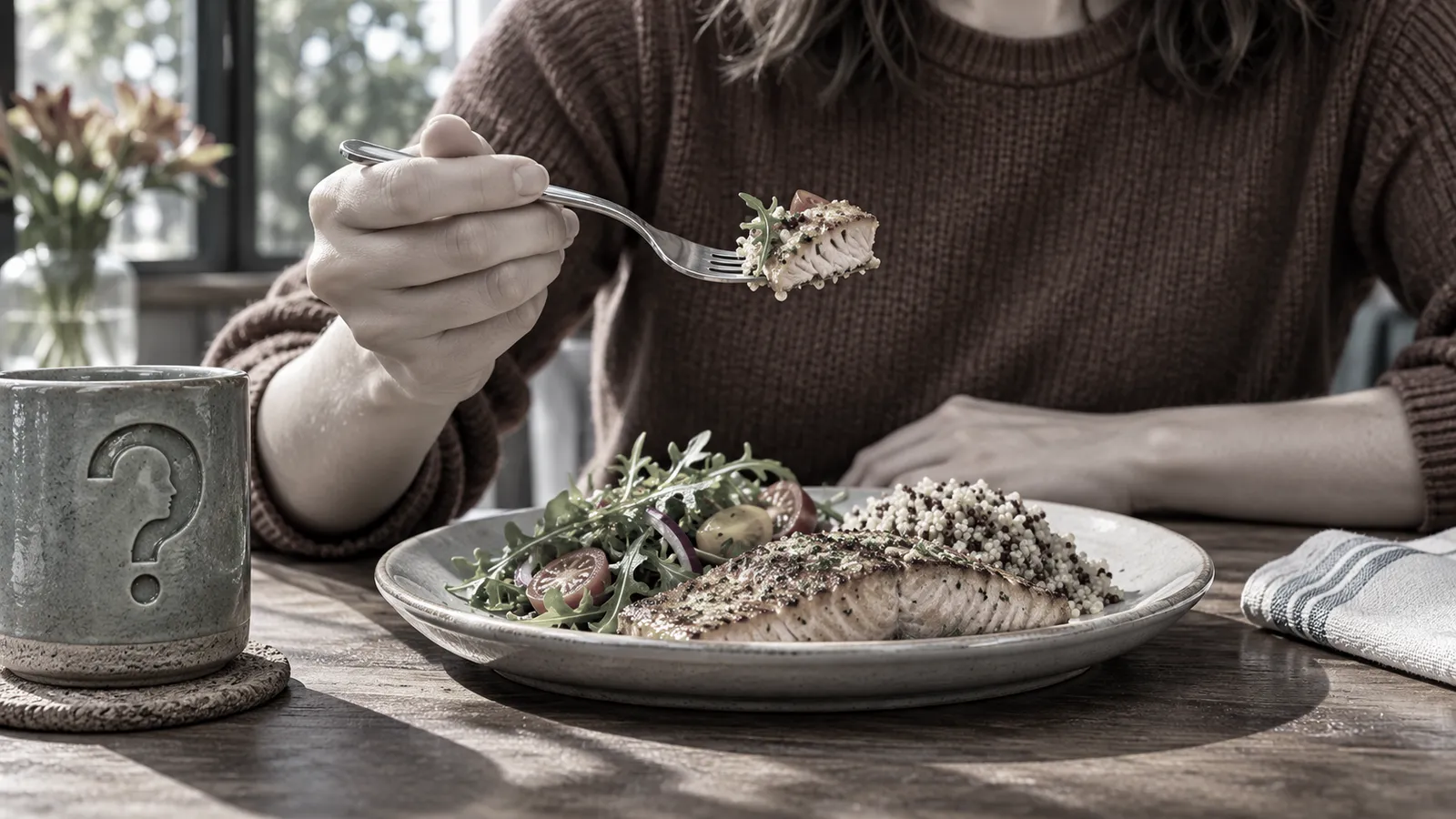
A food loses appeal as it is eaten, and the loss follows that food alone. Neurons, brain scans and ratings show the same pattern, and it starts within minutes.
Why does food taste less good with each bite?
Food tastes less good with each bite because the pleasantness of a food falls as it is eaten, while foods not yet eaten keep more of their appeal. In ratings, the steepest drop came within two minutes of eating, and in brain scans a region that tracks pleasantness responded less to the food eaten.
Key takeaways
- In monkeys fed to satiety, neurons that responded to the sight and taste of food responded less to the food just eaten, while responses to other foods stayed largely the same (Rolls and colleagues, 1986).
- Women's pleasantness ratings fell most steeply 2 minutes after eating, across every sensory measure and every food eaten (Hetherington and colleagues, 1989).
- In people, orbitofrontal activation to the odour of a food fell as they became satiated on it, and a similar odour from an uneaten food showed no such fall (O'Doherty and colleagues, 2000).
- Activity in one orbitofrontal region fell with pleasantness as people ate a liquid food, and the change was specific to the food eaten (Kringelbach and colleagues, 2003).
- After a set amount of chocolate milk, volunteers showed lower liking and lower motivation to earn more of it than a comparison group playing for crisps (Havermans and colleagues, 2009).
Monkeys fed to satiety had neurons that responded less to the food just eaten than to other foods, a food-specific fall that bears on why food can taste less good with each bite. Edmund Rolls and colleagues recorded these neurons, which in hungry monkeys respond to the sight of a food, its taste, or both. That fall is sensory-specific satiety, a food losing appeal as it is eaten while other foods keep theirs. The first bite of a dish often seems the best, and each bite after it seems duller.
Why does food taste less good with each bite?
Pleasantness falls fastest in the first two minutes after eating, so each bite is rated against a food already fading. That was the pattern when Marion Hetherington and colleagues had women rate nine foods for appearance, smell, texture and taste, and then eat as much as they liked of one of three foods: cheese on crackers, tomato soup or orange gelatin. Ratings taken at two, twenty, forty and sixty minutes showed the steepest drop at two minutes, across every sensory measure and every food eaten.
The same study bears on what drives the fade. When the women were offered a second course, either cheese on crackers or a chocolate bar, they ate about as much whether it matched the first food or not. The authors concluded that sensory-specific satiety develops mainly from the sensory experience of eating, rather than from the physiological effects that follow digestion and absorption. The fade belongs to the eyes, the nose and the mouth. It also sits comfortably beside the account in Why There Is Always Room for Dessert of how a different course revives interest late in a meal, since a fade that follows one food leaves the others untouched.
The fade has been recorded at three scales:
- single neurons in monkeys fed to satiety, where responses to the food eaten fell and other foods stayed largely the same
- rated pleasantness in women, steepest at two minutes
- brain scans in people, where a region that tracks flavour responded less to the food eaten
Each scale shows the same specificity from one bite to the next, and that agreement across very different methods is why researchers treat the fade as a property of the eating experience and not of any single measure.
Do scans follow the food eaten?
Later imaging studies in people found the same specificity in the orbitofrontal cortex, a region that tracks how pleasant a flavour is. In a scanning study led by John O'Doherty, activation in that region to the odour of a food decreased as people became satiated on it, while a similar odour from a food that had not been eaten showed no such decrease.
Morten Kringelbach and colleagues scanned volunteers as they ate a liquid food. Activity in one part of the region fell as the food became less pleasant, followed each person's pleasantness ratings, and was specific to the food eaten. The authors presented this as a neural correlate of sensory-specific satiety.
Gordon Shepherd's Neurogastronomy supplies the setting for these results. He treats flavour as something the brain builds from smell, taste and touch, with the orbitofrontal cortex as the place where Rolls's recordings found the pleasantness of smells. He also argues that adaptation to one smell does not carry over to others, so a meal assembled from several separate flavour sources keeps meeting inputs that have not yet faded. How smell reaches that system in the first place is traced in Why Flavour Lives in the Nose, and it is the route by which each bite reaches the region that scores it.
Do liking and wanting fall together?
Enjoying a food and wanting more of it can be pulled apart in the research on reward, a distinction set out in Wanting Is Not Liking, so it matters that after eating the two fell together. In a study by Remco Havermans and colleagues, volunteers drank a set amount of chocolate milk, and then about half played a game to earn more chocolate milk while the rest played to earn crisps. The chocolate milk group rated its taste and smell as less pleasant than the crisps group did, and was less motivated to earn more of it. The authors concluded that in humans, sensory-specific satiety lowers both liking and wanting for the food.
A longer run of eating shows how far the fall can go. In a brain-imaging study led by Dana Small, volunteers ate chocolate past the point of feeling full and rated each piece for pleasantness and for whether they wanted more. Regions including the orbitofrontal cortex, the insula, the striatum and the midbrain were more active when the chocolate was very pleasant. Other regions, including the parahippocampal gyrus and parts of the prefrontal cortex, were more active when volunteers were full but still eating. The chocolate and the act of eating stayed the same, and the motivation to eat changed with each bite.
Does imagining a food speed its fade?
Satiation depends partly on how repetitive an experience seems. Joseph Redden proposed that it depends on perceptions of repetition within a category of experiences, and that by subcategorising episodes people can slow the decline in enjoyment from further consumption. Subcategorising draws attention to what differs between episodes, so similar episodes seem less repetitive and less satiating. Four studies supported this for enjoyment, for the desire to continue a repeated experience and for predicted satiation, in both concurrent and retrospective evaluations.
The fade does not even need a mouthful. In two studies by Jeffrey Larson, Joseph Redden and Ryan Elder, people who repeatedly rated or chose among pictured foods that resembled one another became less pleased with a food offered afterwards. Enjoyment dropped most for foods with a similar taste profile, much as it would after actually eating. The authors' analysis pointed to mental simulation: thinking about a food spontaneously evokes its taste, and that simulation alone was enough to produce satiation.
What these studies share is that the thing being judged is never a bite alone. A neuron, a rating at the two minute mark, a scan, a game played for more milk and a run of pictured dishes all compare the present mouthful, or the thought of one, with what came just before it.
Categorising and imagining change what counts as before: an eater who notices how the parts of a dish differ keeps each bite distinct, and one who has pictured the dish many times arrives with the comparison already made. Pleasure from food behaves like a running tally of recent contact, so it can fall while the plate stays the same, whether the eater is a monkey in a laboratory, a volunteer in a scanner or a reader looking at pictures of dishes, and the only thing that has changed is what each mouthful, real or imagined, is being compared with in the eater's own recent experience of the same food.
Common questions
Why does food taste less good with each bite?
Because the pleasantness of a food falls as it is eaten, and the fall follows that food and not others. The steepest drop in rated pleasantness came within about two minutes of eating, so each bite after the first meets a lower value.
What is sensory-specific satiety?
Sensory-specific satiety is the fall in how pleasant a food is as it is eaten, while other foods that have not been eaten keep more of their appeal. It has been recorded in neurons in monkeys, in brain scans of people and in pleasantness ratings, and in each case the fall follows the food that was eaten.
Do liking and wanting both fall as we eat?
In a study with chocolate milk, volunteers who had drunk a set amount rated its taste and smell as less pleasant and were less motivated to earn more of it than a comparison group playing for crisps. The authors concluded that the effect lowers both liking and wanting.
Sources
Shepherd, G. M. Neurogastronomy. Seed book.
Rolls, E. T., Murzi, E., Yaxley, S., Thorpe, S. J., & Simpson, S. J. (1986). Sensory-specific satiety: Food-specific reduction in responsiveness of ventral forebrain neurons after feeding in the monkey. Brain Research, 368(1), 79-86. doi:10.1016/0006-8993(86)91044-9 https://doi.org/10.1016/0006-8993(86)91044-9
Hetherington, M., Rolls, B. J., & Burley, V. J. (1989). The time course of sensory-specific satiety. Appetite, 12(1), 57-68. doi:10.1016/0195-6663(89)90068-8 https://doi.org/10.1016/0195-6663(89)90068-8
O'Doherty, J., Rolls, E. T., Francis, S., Bowtell, R., McGlone, F., Kobal, G., Renner, B., & Ahne, G. (2000). Sensory-specific satiety-related olfactory activation of the human orbitofrontal cortex. NeuroReport, 11(4), 893-897. doi:10.1097/00001756-200003200-00046 https://doi.org/10.1097/00001756-200003200-00046
Kringelbach, M. L., O'Doherty, J., Rolls, E. T., & Andrews, C. (2003). Activation of the human orbitofrontal cortex to a liquid food stimulus is correlated with its subjective pleasantness. Cerebral Cortex, 13(10), 1064-1071. doi:10.1093/cercor/13.10.1064 https://doi.org/10.1093/cercor/13.10.1064
Small, D. M., and colleagues (2001). Changes in brain activity related to eating chocolate: From pleasure to aversion. Brain, 124(9), 1720-1733. doi:10.1093/brain/124.9.1720 https://doi.org/10.1093/brain/124.9.1720
Havermans, R. C., Janssen, T., Giesen, J. C. A. H., Roefs, A., & Jansen, A. (2009). Food liking, food wanting, and sensory-specific satiety. Appetite, 52(1), 222-225. doi:10.1016/j.appet.2008.09.020 https://doi.org/10.1016/j.appet.2008.09.020
Redden, J. P. (2008). Reducing satiation: The role of categorization level. Journal of Consumer Research, 34(5), 624-634. doi:10.1086/521898 https://doi.org/10.1086/521898
Larson, J. S., Redden, J. P., & Elder, R. S. (2014). Satiation from sensory simulation: Evaluating foods decreases enjoyment of similar foods. Journal of Consumer Psychology, 24(2), 188-194. doi:10.1016/j.jcps.2013.09.001 https://doi.org/10.1016/j.jcps.2013.09.001
Related concepts
People
More articles
- Why One Bad Line Can Make a Review Persuasive
A mild complaint after the praise lifted appeal for readers moving quickly and lowered it for readers checking every claim. The research on reviews shows what decides which reader a review gets.
- Why a Vague Description Feels Personal
A text that fits everyone can still feel written for one person. Research on feedback, labels and quizzes shows where that feeling comes from and what a personalised message has to add.
- Why a Sold-Out Option Changes What We Pick
A room that has just sold out still sits in the comparison. Research on phantom alternatives asks what an option nobody can buy does to the options that remain.
- Why Seasonal Flavours Sell Out Every Year
A seasonal product is absent most of the year. Research on waiting, nostalgia, ritual and deadlines describes how the absence, the return and the end date each add to demand.