Why is free so hard to resist?
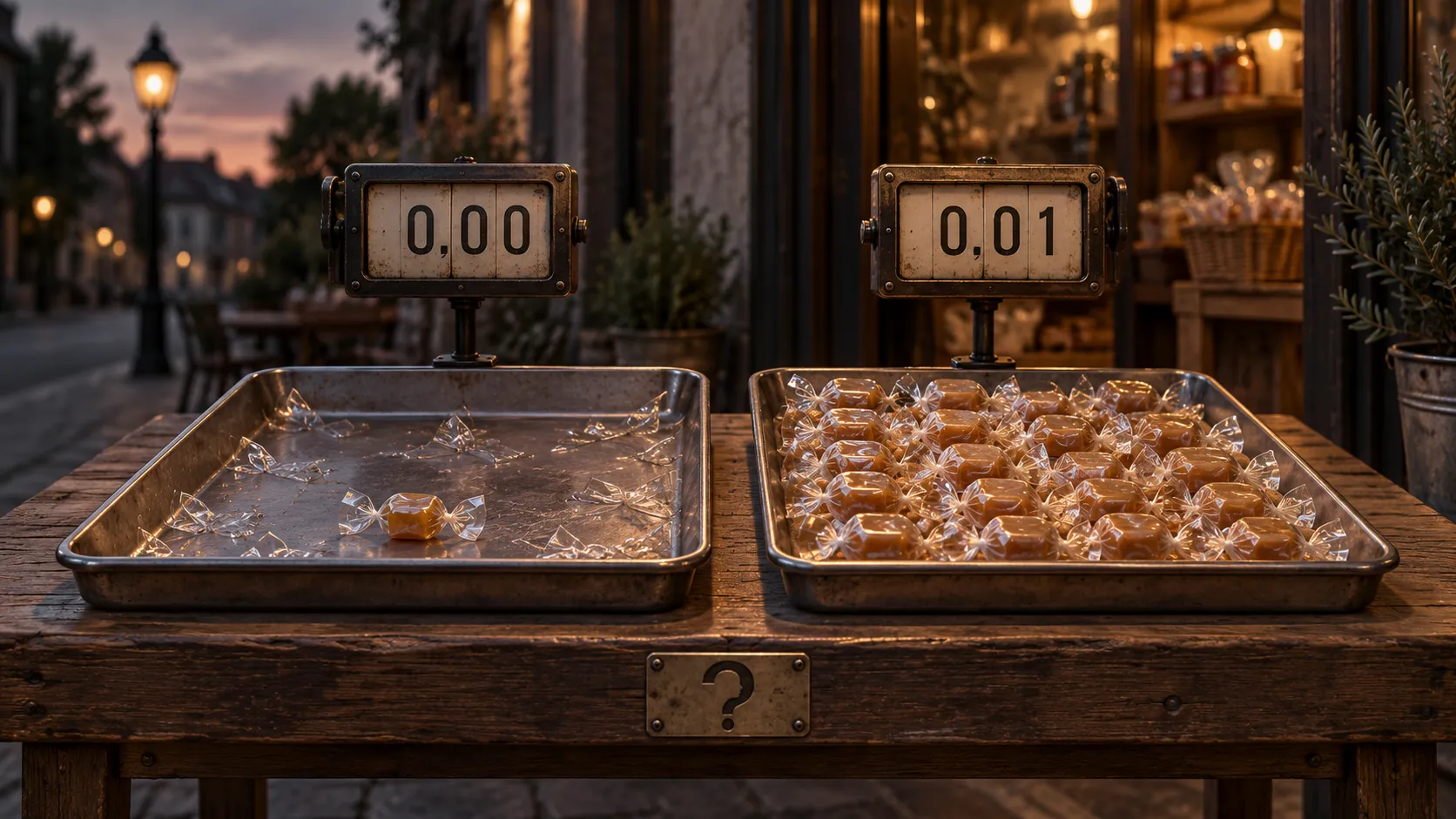
A price of zero is not treated as a very small price. Three accounts of the pull compete, and field studies show what follows the free item.
Answer to the question
Why is free so hard to resist?
A price of zero is treated differently from a very low price. In experiments by Shampanier, Mazar and Ariely (2007), more people chose the cheaper product when it was free, and the authors judged affect the likeliest cause. Ariely suggests avoided regret, and Palmeira and Srivastava (2013) point to the anchors people use at zero.
Key takeaways
- Shampanier, Mazar and Ariely (2007) moved the cheaper of two products from a low positive price to zero, and far more people chose it when it was free.
- The same paper tested social norms, mapping difficulty and affect, and its authors judged affect the most likely cause.
- Palmeira and Srivastava (2013) found that people would pay more for a product received free than for one received at a discount, and explained it through the anchors people use when the price is zero.
- A 1991 mall chocolate-store study found an immediate sales increase from a free sample, limited to small purchases and to varieties other than the one sampled.
- Yoganarasimhan and colleagues (2023) found that shorter free trials of software subscriptions generally did better than longer ones on acquisition, retention and profitability.
Free is hard to resist because zero does not behave like a very small price, and several accounts of the reason compete.
Why Zero Is Treated Differently From a Very Small Price
The central experiments are Kristina Shampanier, Nina Mazar and Dan Ariely's, published in Marketing Science. Their abstract describes pairs of products kept a fixed price gap apart. When the cheaper product moved from a low positive price to zero, far more people chose it. The standard cost-benefit view says people choose the option with the best gap between benefit and cost, with buying nothing as one of the options. On that view, cutting a price by the same amount should move demand by about the same amount wherever the cut falls. The authors reported something different.
When the cheaper product was free, far more people took it and far fewer chose the dearer one. They proposed that people do not simply subtract the cost of a free product. Zero seems to lower the perceived cost and to raise the perceived benefit as well.
Ariely reports the same programme in Predictably Irrational, where the products are a Lindt truffle and a Hershey's Kiss sold at a table. As he tells it, the step from two cents to one cent changed little, while the step from one cent to nothing changed a great deal. The gap between the two chocolates stayed the same throughout. That pattern points at zero itself and away from cheapness in general. Our piece Why Free Beats a Bargain goes through the other experiments in that chapter.
The book and the journal paper explain the pull differently. Ariely's reasoning in the book is tentative: a free item carries no visible chance of a bad choice, so nothing is lost if it disappoints, which is a loss-aversion account. The paper tested social norms, difficulty in mapping prices onto value, and affect, and its authors judged affect the most likely cause. On that view a free product simply feels better than its arithmetic says it should.
The two accounts are compatible in places and they are not the same claim. One locates the pull in avoided regret and the other in a warmer feeling towards the offer. Loss aversion is Ariely's suggestion in the book, and it is not among the explanations the abstract reports testing.
Both accounts concern the moment of choice, and the laboratory makes that moment easy to study: two products, one price gap, one decision. Real offers add a second moment, when the person has to live with what they took home. The field studies further down pick up there, and they show how much of the story lies after the first choice.
What Anchors Do Once the Offer Has Ended
Mauricio Palmeira and Joydeep Srivastava asked what happens to the value of a product once the offer has ended. Their 2013 paper in the Journal of Consumer Research found that people were willing to pay more for a product they had received free than for one they had received at a discount. Their explanation is selective accessibility. A promotional price acts as an anchor for judging worth. When the price is zero, people think less about what the product is worth and lean more on other anchors, such as the price of the purchase they had to make to qualify.
The abstract adds that a free offer does not devalue the product at all, or at least devalues it less than a low price does. Read alongside the chocolate experiments, this makes free an attention effect as well as a feeling. It changes what the person is thinking about when they decide.
| Account | Source | What it points to |
|---|---|---|
| Avoided regret | Ariely, Predictably Irrational | A free item carries no visible chance of a bad choice |
| Affect | Shampanier, Mazar and Ariely, 2007 | A free product feels better than its arithmetic suggests |
| Anchors | Palmeira and Srivastava, 2013 | At zero, people lean on other anchors when judging worth |
The Sample, the Shop and the Subscription
Field studies follow the free item into the shop and the subscription. A 1991 study in the Journal of Consumer Marketing put a free sample at the entrance of a chocolate store in a suburban mall for three days. Sales rose immediately, but the rise was restricted to small purchases and to varieties other than the one sampled.
Two field experiments on free sample promotions, reported in Marketing Science in 2004, distinguished acceleration, cannibalisation and expansion effects, and observed long-term sales effects up to twelve months after the promotion. Effectiveness varied widely, even between brands in one category. The same sampling logic runs through Reciprocity at the Sample Tray, which looks at the pull to repay a gift.
Hema Yoganarasimhan and colleagues studied free trials of software subscriptions in a field experiment, published in Management Science in 2023. Shorter trials generally did better than longer ones on acquisition, retention and profitability. The authors ruled out cannibalisation as the mechanism and found support for consumer learning, and long stretches of inactivity at the end of a trial were linked to lower conversion. What You Actually Pay for Free Apps takes up the other side of the exchange.
The three field studies measured different things in different settings: a store entrance, a run of sample promotions and a software sign-up. What happens after the free item arrives depends on the product and the setting, so the pull at the moment of choice is only the start of the story.
Common questions
Why is free so hard to resist?
A price of zero is treated differently from a very low price. Shampanier, Mazar and Ariely (2007) found that more people chose the cheaper product when it was free, and they judged affect the most likely cause. Ariely's book offers avoided regret, and Palmeira and Srivastava (2013) point to the anchors people use when the price is zero.
What is the zero price effect?
It is the finding that demand for a product rises more when its price falls to zero than when it falls by the same amount between two positive prices. Shampanier, Mazar and Ariely reported it in 2007, and Ariely describes it in Predictably Irrational.
Does a free sample increase sales?
It can. A 1991 study found an immediate sales increase in a mall chocolate store, limited to small purchases and to varieties other than the one sampled. Two field experiments reported in 2004 found effects that varied widely between brands, with sales effects observable up to twelve months later.
Sources
Ariely, D. (2008). Predictably Irrational. New York: HarperCollins. Seed book; vault hub Books/Predictably Irrational.
Shampanier, K., Mazar, N., & Ariely, D. (2007). “Zero as a Special Price: The True Value of Free Products.” Marketing Science, 26(6), 742-757. doi:10.1287/mksc.1060.0254 https://doi.org/10.1287/mksc.1060.0254
Palmeira, M. M., & Srivastava, J. (2013). “Free Offer ≠ Cheap Product: A Selective Accessibility Account on the Valuation of Free Offers.” Journal of Consumer Research, 40(4), 644-656. doi:10.1086/671565 https://doi.org/10.1086/671565
Lammers, H. B. (1991). “The effect of free samples on immediate consumer purchase.” Journal of Consumer Marketing, 8(2), 31-37. doi:10.1108/07363769110034992 https://doi.org/10.1108/07363769110034992
Bawa, K., & Shoemaker, R. (2004). “The effects of free sample promotions on incremental brand sales.” Marketing Science, 23(3), 345-363. doi:10.1287/mksc.1030.0052 https://doi.org/10.1287/mksc.1030.0052
Yoganarasimhan, H., Barzegary, E., & Pani, A. (2023). “Design and evaluation of optimal free trials.” Management Science, 69(6), 3220-3240. doi:10.1287/mnsc.2022.4507 https://doi.org/10.1287/mnsc.2022.4507