Alan Krueger
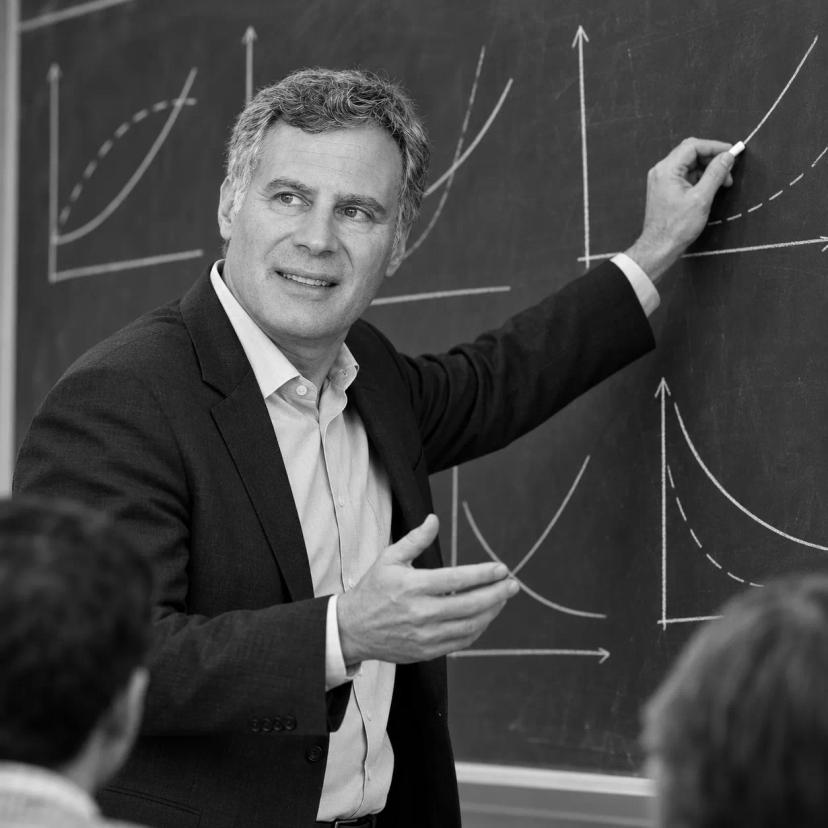
Alan B. Krueger (1960 to 2019) was a labour economist at Princeton University and an author, with Daniel Kahneman, David Schkade, Norbert Schwarz and Arthur Stone, of the 2006 Science paper Would you be happier if you were richer? A focusing illusion. He joined Princeton in 1987 as James Madison Professor of Political Economy, directed its Survey Research Center from its founding, and served in US government economic posts. Princeton's obituary notes that he died on 16 March 2019 at the age of 58.
Who they are
According to Princeton's obituary, Krueger was born in Livingston, New Jersey, took a bachelor's degree at Cornell's School of Industrial and Labor Relations in 1983 and a doctorate in economics at Harvard in 1987. He joined Princeton that year with a joint appointment in economics and the Woodrow Wilson School and was the founding director of the Princeton University Survey Research Center.
His public service was substantial. He was chief economist at the US Department of Labor in 1994 and 1995, assistant secretary for economic policy and chief economist at the Treasury from 2009 to 2010, and chairman of the Council of Economic Advisers from 2011 to 2013. He edited the Journal of Economic Perspectives from 1996 to 2002.
The obituary describes his research as covering the minimum wage, on which he worked with David Card and Lawrence Katz using fast-food data from New Jersey and Pennsylvania, and the economics of education. It also lists terrorism, unemployment, labour demand, income distribution, social insurance and the gig economy, and the link between inequality and intergenerational mobility known as the Great Gatsby Curve. He received the IZA Prize in Labor Economics with Card in 2006. The obituary does not mention happiness research, so his place in that literature rests on the papers listed below.
Key papers
Kahneman, D., Krueger, A. B., Schkade, D., Schwarz, N., & Stone, A. A. (2006). Would you be happier if you were richer? A focusing illusion. Science, 312(5782), 1908-1910. doi:10.1126/science.1129688. The samples were 909 employed women in Texas in 2004 and 810 women in Ohio in 2005. The authors wrote that the belief that high income goes with good mood is "widespread but mostly illusory."
Kahneman, D., Krueger, A. B., Schkade, D. A., Schwarz, N., & Stone, A. A. (2004). A survey method for characterizing daily life experience: The Day Reconstruction Method. Science, 306(5702), 1776-1780.
Key ideas
Income and daily mood. In the 2004 survey, respondents predicted that people earning under $20,000 would spend 32 per cent more time in a bad mood than people earning over $100,000. The measured gap was 12 per cent. In the Ohio survey, income correlated more weakly with moment-to-moment happiness than with overall life satisfaction.
How time is spent. Using time-use data, the authors found that higher earners spent more time on work, shopping and childcare, and less on passive leisure such as socialising and television. They warned that the focusing illusion may lead people to accept long commutes, among the worst parts of a day, and to give up socialising, among the best.
Method. The studies used the Day Reconstruction Method, in which participants record the previous day's activities and how they felt during each. The 2006 samples were women only, because the method was still being developed and the authors wanted a homogeneous group.
Sources
- Princeton University (2019). Alan B. Krueger, prominent labor economist and dedicated public servant, dies. News release, 19 March 2019.
- Princeton University (2006). Link between income and happiness is mainly an illusion. News release, 29 June 2006.
- Kahneman, D., Krueger, A. B., Schkade, D., Schwarz, N., & Stone, A. A. (2006). Science, 312(5782), 1908-1910. doi:10.1126/science.1129688.
Articles that cite Alan Krueger
- Will a New Car Make You Happier
A new car looms large while it is being chosen and recedes once it is owned. The California study, a football-fan experiment and a survey of working women show where that idea comes from and what…
Concepts on this site
- The Focusing Illusion
Daniel Kahneman's own one-sentence version, and he intended it to be quotable, is that nothing in life matters quite as much as you think it does while you are thinking about it. Direct attention at…