Bibb Latané
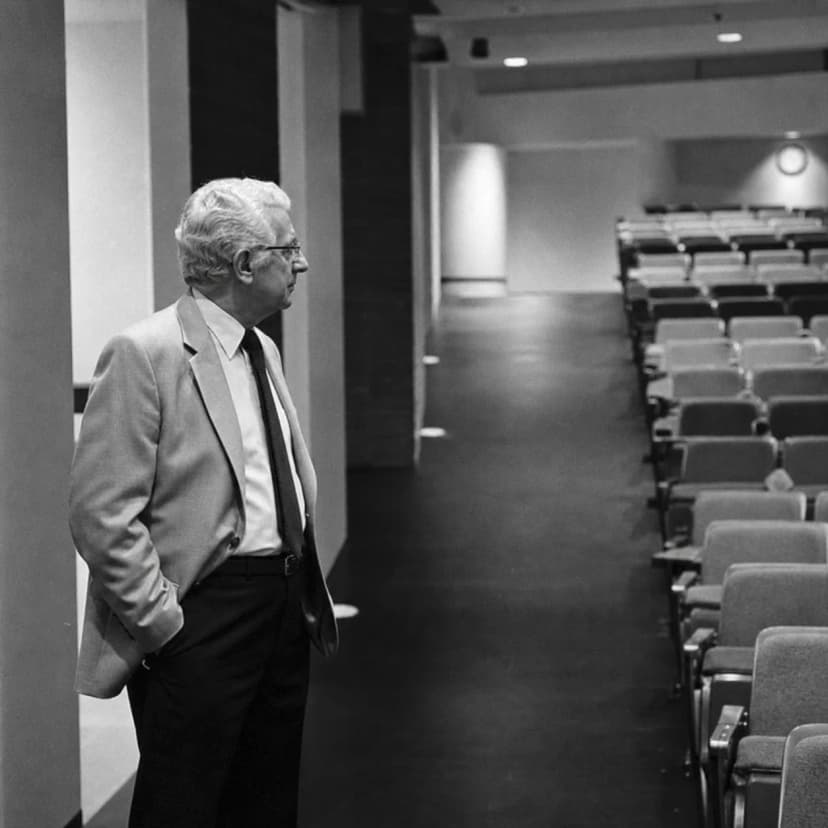
Bibb Latané is the social psychologist who, with John Darley, ran the bystander intervention experiments in the late 1960s, and who went on to build a general theory out of what those experiments implied. If the presence of other people dilutes the pressure on any one of them to act, that dilution ought to be describable, and social impact theory is his attempt to describe it: influence as a function of how strong the source is, how close it is, and how many of them there are. The bystander finding is one case of a wider arithmetic.
Who they are
Latané was born in 1937. He took his first degree at Yale in 1958 and his doctorate at the University of Minnesota in 1963, began teaching at Columbia in 1961, and later held positions at Ohio State University, the University of North Carolina at Chapel Hill and Florida Atlantic University. He directed the Institute for Research in Social Science at Chapel Hill in the 1980s and has since been associated with the Center for Human Science there.
The bystander work started at Columbia, prompted by the press coverage of the murder of Kitty Genovese. The experiments staged emergencies and varied one thing: how many other people the participant believed were present or listening. The probability that any given individual acted fell as that number rose. Latané and Darley proposed two mechanisms for it, responsibility diffusing across the people who could act, and each person reading the others' inaction as evidence that nothing was wrong.
Social impact theory, which he set out in 1981, generalises the pattern. Influence on a target is a function of the strength, the immediacy and the number of the sources acting on them, and crucially the effect of number is not linear: each additional person adds less than the one before. That formulation covers a wide range of results that had been treated separately, including social loafing, the finding with Kipling Williams and Stephen Harkins that individual effort declines as group size grows on a shared task.
Latané's name is attached to the bystander effect and it belongs there. What does not belong to him is the parable. The 1964 newspaper account that prompted the research was false in every load-bearing detail, as the 2007 archival reconstruction established, and that is a failure of journalism and of textbook writing rather than of his experiments.
Key papers
Darley, J. M., & Latané, B. (1968), "Bystander intervention in emergencies: Diffusion of responsibility," Journal of Personality and Social Psychology, 8(4), 377-383.
Latané, B., & Darley, J. M. (1970), The Unresponsive Bystander: Why Doesn't He Help?, Appleton-Century-Crofts.
Latané, B., Williams, K., & Harkins, S. (1979), "Many hands make light the work: The causes and consequences of social loafing," Journal of Personality and Social Psychology, 37(6), 822-832. With Kipling Williams.
Latané, B., & Nida, S. (1981), "Ten years of research on group size and helping," Psychological Bulletin, 89, 308-324. The first systematic review of the bystander literature.
Latané, B. (1981), "The psychology of social impact," American Psychologist. Social impact theory: strength, immediacy and number.
Key ideas
Diffusion of responsibility, developed jointly with John Darley.
Social impact theory: social influence scales with the strength, immediacy and number of sources, and the effect of number diminishes with each addition.
Social loafing is the same arithmetic applied to effort rather than to helping.
The laboratory effect is about the individual, and the number of people present changes what an individual is likely to do. It does not settle what a crowd, taken as a whole, is likely to produce.
Concepts on this site
Find them elsewhere
Both the website and the LinkedIn profile are linked from his own Social Psychology Network page. He is not deceased. No Scholar profile, X or Bluesky account exists, which fits a profile he last edited in 2010
Checked 2026-09-10. Handles and affiliations go out of date, so treat this block as a snapshot rather than a standing fact.
Sources
- Darley, J. M., & Latané, B. (1968), "Bystander intervention in emergencies: Diffusion of responsibility," Journal of Personality and Social Psychology, 8(4), 377-383.
- Latané, B., & Darley, J. M. (1970), The Unresponsive Bystander: Why Doesn't He Help?, Appleton-Century-Crofts.
- Latané, B., Williams, K., & Harkins, S. (1979), "Many hands make light the work: The causes and consequences of social loafing," Journal of Personality and Social Psychology, 37(6), 822-832.
- Latané, B., & Nida, S. (1981), "Ten years of research on group size and helping," Psychological Bulletin, 89, 308-324.
- Latané, B. (1981), "The psychology of social impact," American Psychologist.