Daniel Simons
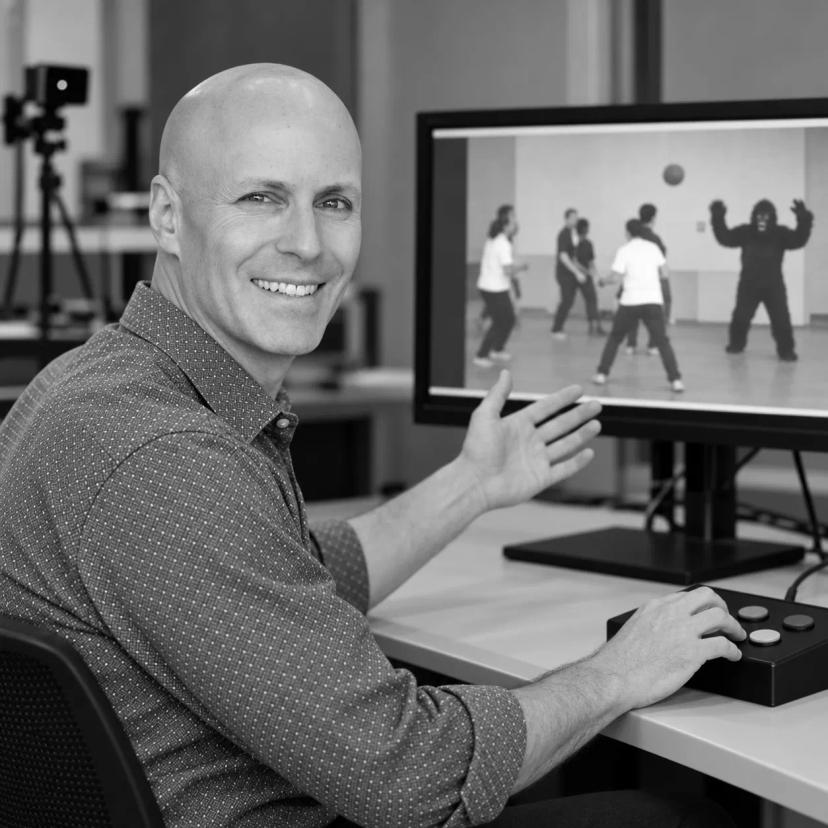
Daniel Simons is a professor of psychology at the University of Illinois at Urbana-Champaign who studies attention and awareness, and the first author of the 2016 review "Do 'brain-training' programs work?" in Psychological Science in the Public Interest. The review examined the peer-reviewed studies that leading brain training companies cite on their own websites, presumably the best evidence they had, and found extensive evidence of improvement on the trained tasks, less on closely related tasks, and little on distantly related tasks or everyday cognition. It remains the standard reference for the position this site takes on brain training.
Who they are
Simons runs the Visual Cognition Laboratory and holds an appointment at the Beckman Institute. His research concerns attention, awareness and the limits of both, with a focus on change blindness, the failure to notice large changes in a scene. He is best known to the public as a co-author, with Christopher Chabris, of The Invisible Gorilla, a New York Times bestseller built on the finding that people counting basketball passes often fail to see a person in a gorilla suit walk through the scene. He received the American Psychological Association's Early Career Award.
Key papers
Simons, D. J., Boot, W. R., Charness, N., Gathercole, S. E., Chabris, C. F., Hambrick, D. Z., & Stine-Morrow, E. A. L. (2016). "Do 'brain-training' programs work?" Psychological Science in the Public Interest, 17(3), 103 to 186.
The seven authors reviewed the peer-reviewed intervention studies cited on the websites of leading brain training companies. They reported three tiers of evidence. There was extensive evidence that training improves performance on the trained tasks. There was less evidence of improvement on tasks closely related to the trained ones, and little evidence that training improves performance on distantly related tasks. There was little evidence that it improves everyday cognitive performance. They also found that many of the studies had major flaws in design or analysis, and that none of the cited studies met all the best practices the authors identified as essential for showing benefits in daily activities.
Boot, W. R., Simons, D. J., Stothart, C., & Stutts, C. (2013). The pervasive problem with placebos in psychology. Perspectives on Psychological Science, 8(4), 445 to 454. Simons is the second author; credit Walter Boot.
Key ideas
Audit the best evidence, not the worst. By starting from the studies that the companies themselves cite, the review avoided the objection that it had chosen weak examples. Its finding is about the evidence base that supports the marketing.
A ladder of transfer. The three tiers give a simple way to read any training claim: trained task, close relatives, distant tasks and daily life. Each step up requires better evidence, and the commercial claims sit at the top step.
Method standards. The review set out practices a trial needs before a daily-life claim can be supported, among them adequate controls and attention to what participants expect. That emphasis is shared with the 2013 placebo paper.
What the review does not say. It does not say that no training study has ever shown a benefit. It says that the evidence cited does not reach the standard needed for the real-world claims, and that the trained-task improvements are well established. The ACTIVE trial in older adults, which found that some groups still performed above baseline on the trained ability ten years later, is consistent with that picture, because the benefit sat on the trained ability and the standard performance tests of everyday function showed no group differences.
Later work. Adrian Owen's 2010 trial of more than eleven thousand people and the 2019 meta-analysis by Giovanni Sala and Fernand Gobet point the same way. The book The Distracted Mind was published in 2016 and could not cite the review, though it cites Simons as second author of the placebo paper.
Sources
- Simons, D. J., Boot, W. R., Charness, N., Gathercole, S. E., Chabris, C. F., Hambrick, D. Z., & Stine-Morrow, E. A. L. (2016). Psychological Science in the Public Interest, 17(3), 103 to 186. doi:10.1177/1529100616661983. This site has read the published abstract, not the full review.
- Boot, W. R., Simons, D. J., Stothart, C., & Stutts, C. (2013). Perspectives on Psychological Science, 8(4), 445 to 454. doi:10.1177/1745691613491271.
- Noba Project author profile for Daniel Simons (position, research and prize).
Studies on this site by Simons
- Failure to detect changes to people during a real-world interaction
Simons (1998) · Psychonomic Bulletin & Review
- Gorillas in our midst: sustained inattentional blindness for dynamic events
Simons (1999) · Perception
- Change blindness: Theory and consequences
Simons (2005) · Current Directions in Psychological Science
- The effects of individual differences and task difficulty on inattentional blindness
Simons (2009) · Psychonomic Bulletin & Review
- brain-training
Simons (2016)
- Do "Brain-Training" Programs Work?
Simons (2016) · Psychological Science in the Public Interest
Articles that cite Daniel Simons
- The Big Changes We Never Notice
What flicker displays and a street conversation show about large changes that go unseen, why people are sure they would notice, and what helps.
- Consumer Psychology Guide (Free PDF)
Seven fields explain most of how people notice, remember, feel, shortcut, follow, repeat and choose. Each comes with one published study and a link to the full article.
- What is inattentional blindness?
The term comes from a 1998 book, the gorilla from a 1999 experiment, and the radiologists from a 2013 study. What each one showed, and what decides who notices.
- Is Neuroplasticity a Selling Point
Neuroplasticity is real, and the strongest evidence for it took years of a specific task. Products that cite it as proof of rewiring are making two further claims, and the game trials, a regulator's…
- Do Brain Training Games Work
Brain training reliably improves the game you practise. The largest trial found no carry-over to untrained tests, a flyer promising improvement was enough to produce a gain on two intelligence…
Concepts on this site
- Automatic vs Controlled Attention
There are two kinds of attention: the reflexive kind that is seized involuntarily by movement, colour or noise, and the deliberate kind a person chooses to direct. The distinction is one of the most…
- Cognitive Load
Cognitive load theory is John Sweller's account of why learning breaks down: working memory can only handle a small amount at once, so how material is presented changes how much of it is learned…
- Cognitive Training
Cognitive training is doing structured mental exercises, usually on a screen and usually adaptive so they get harder as you improve, in the hope of raising a general ability such as attention…
- Inattentional Blindness
Inattentional blindness is the failure to notice an unexpected object that is in plain view because attention is committed to another task. The observer is looking, the object is visible, and the…
- The Replication Crisis
Through the 2010s it became clear that a large share of published psychology, and plenty of work in medicine and economics, does not survive being run again with bigger samples and a pre-registered…
- Transfer
Transfer is the question of whether learning one thing improves your ability at another thing you did not train. Near transfer, improvement on tasks close to what was practised, is ordinary and…
- Working Memory
Working memory is the small, temporary store that holds whatever you are currently thinking about, and everything that reaches long-term memory passes through it first. That makes its size the…