John A. List
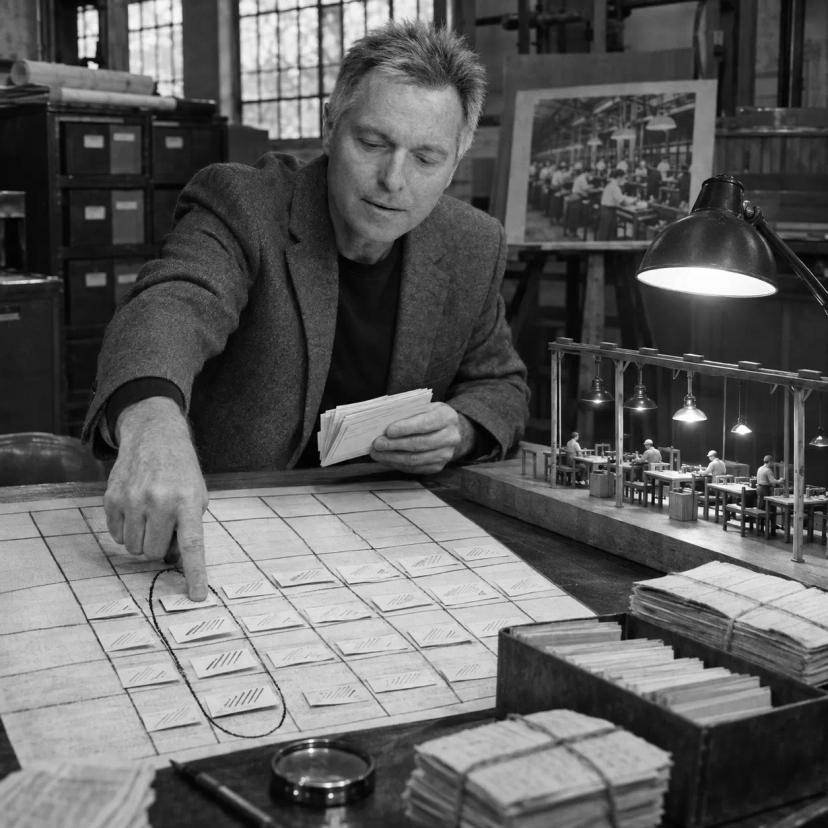
John A. List is an economist and the second author, with Steven Levitt, of the paper Was there really a Hawthorne effect at the Hawthorne plant? An analysis of the original illumination experiments. It reports on the recovered data of the Hawthorne lighting experiments and finds that the widely told pattern of rising output is not in the records.
Who they are
John A. List appears in this site's sources as an economist and as the second author of a 2011 paper in the American Economic Journal: Applied Economics, volume 3, issue 1, written with Steven Levitt. This page records what that paper reports. His affiliation has not been verified for this page, and no role or later work is attributed to him beyond the papers described on this site, which include his sole-authored 2003 paper Does Market Experience Eliminate Market Anomalies? in the Quarterly Journal of Economics.
Key papers
The paper analyses the original data of the lighting experiments run at Western Electric's Hawthorne plant from 1924 to 1927, in three departments of women who assembled relays or wound coils. The data had never been formally analysed and had been thought destroyed. The authors report that the widely repeated account, in which output rose with every change in the light, does not match the records.
Every lighting change began on a Monday, because the plant was closed on Sundays and the lights could be adjusted then. Output was generally higher on Mondays than on Fridays and Saturdays, and Monday output was about as high whether or not the light had been changed that day. The authors found hints of subtler Hawthorne-type effects, described the evidence for them as weak, and noted that the original experimental design was weak. The paper appeared first as NBER working paper 15016 in 2009.
Key ideas
The paper's central point is a method point: a pattern that looks like a response to an intervention can come from the calendar. Because every lighting change began on a Monday, the rise in output that followed could be read as a response to the light, when output on Mondays was higher in any case. The authors treat the records as the test of a story that had been repeated for decades in academic and popular accounts.
Sources
- Levitt, S. D., & List, J. A. (2011). Was there really a Hawthorne effect at the Hawthorne plant? An analysis of the original illumination experiments. American Economic Journal: Applied Economics, 3(1), 224-238. https://doi.org/10.1257/app.3.1.224
Studies on this site by List
- Does market experience eliminate market anomalies?
List (2003) · Quarterly Journal of Economics
Articles that cite John A. List
- Why Doing Harm Feels Worse Than Allowing It
Harm that follows an action is judged more harshly than the same harm that follows inaction. The research on omission bias shows where that comes from, why it can work as cover, and when it reverses.
- Why We Pay to Make Risk Zero
How a sure thing gets extra weight, what that does to the price of removing the last sliver of a risk, and which moves bring the choice back to size.
- The Tip Screen Problem
What a tip screen changes about the moment of choice, what presets do, and what research finds on whether screens raise tips.
- What is the MINDSPACE framework in behavioural science?
Where the nine-letter checklist came from, how field trials and a village pilot put it to work, and how design teams use it now.
- What is the Hawthorne effect?
The lighting records from the Hawthorne plant were thought lost. When economists found them, the story about workers who produced more under every change was not in the data.
Concepts on this site
- Endowment Effect
The endowment effect is Richard Thaler's 1980 observation that people demand more to give up a thing than they would have paid to acquire it. Kahneman, Knetsch and Thaler demonstrated it with coffee…
- Loss Aversion
Loss aversion is Daniel Kahneman and Amos Tversky's finding that people weigh losses more heavily than equivalent gains, first formalised inside prospect theory in 1979 and named as a standalone…
- Psychological Ownership
The feeling that something is yours, held whether or not it legally is. It raises what you think the thing is worth. It was the obvious candidate for what self-made objects gain once effort looked…
- Research Participation Effects
Research participation effects is the label proposed for changes in behaviour that arise from taking part in research. It was put forward in a 2014 systematic review, whose authors judged that the…
- The Hawthorne Effect
The Hawthorne effect is the idea that people change their behaviour because they know they are being observed. It takes its name from studies at Western Electric's Hawthorne plant in the early…
- Uncertainty Effect
The finding that a risky prospect can be valued below its worst possible outcome.