Laurens Debo
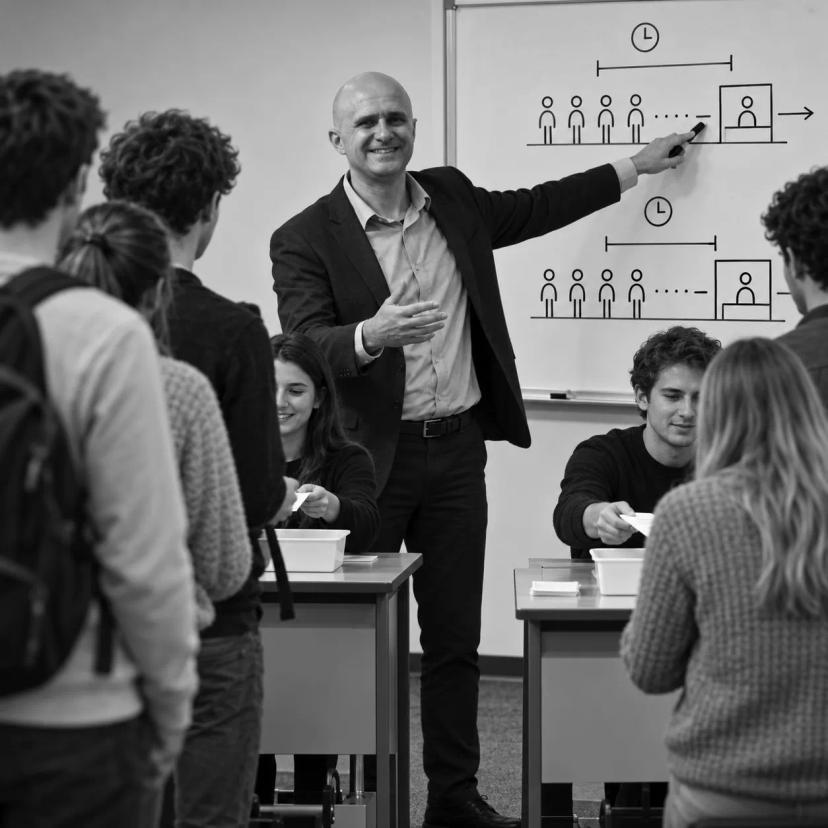
Laurens Debo writes on how queues and waiting times carry information. He is the co-author of two papers this site relies on: the 2009 model of why a customer might rationally join the longer line, with Senthil Veeraraghavan, and the 2016 paper in which a short wait reads as a warning, with Mirko Kremer.
Who they are
The Tuck School of Business at Dartmouth hosts a research-publications page for Debo. The 2012 Management Science paper he wrote with Christine Parlour and Uday Rajan lists him at the University of Chicago Booth School of Business at the time. This page holds nothing further about his career, and none is assumed.
Key papers
Veeraraghavan, S., & Debo, L. G. (2009). Joining longer queues: Information externalities in queue choice. Manufacturing & Service Operations Management, 11(4), 543-562.
Kremer, M., & Debo, L. G. (2016). Inferring quality from wait time. Management Science, 62(10), 3023-3038.
Debo, L. G., Parlour, C. A., & Rajan, U. (2012). Signaling quality via queues. Management Science, 58(5), 876-891. The abstract says the queue can act as a valuable signalling device for a high-quality firm. This paper is not discussed in the article, because two records gave it different titles; it is listed here as a related work whose abstract was read.
Key ideas
Across these papers a queue is treated as a message. In the 2009 model, customers with private information about quality may join the longer line because the line carries information from earlier customers, and which of two identical firms prospers can depend on the first arrival's signal. In the 2016 paper, informed customers choose the good product and make its waits long, so uninformed customers read a short wait as a sign of poor quality; the authors call the result empty restaurant syndrome.
The 2012 paper adds the supply side. In its model a high-quality firm may choose slower service than a low-quality one, so that the queue works as a signal, and the paper says the firm may do so even when speeding up costs nothing. The common thread is that waiting time is not only a cost to the customer. It is also something the customers, and sometimes the firm, produce for others to read. See Empty Restaurant Syndrome.
Sources
- Veeraraghavan & Debo (2009); Kremer & Debo (2016); Debo, Parlour & Rajan (2012). Abstract level for all three.
- Tuck School of Business at Dartmouth, research publications page for Laurens Debo, for the volume, issue and page numbers.
Articles that cite Laurens Debo
- Does a Long Queue Make People Want In
Nobody walking past a restaurant can taste the food, so they read the room: a long queue as a recommendation, an empty room as a warning. The research supports a narrower claim than the one a shop…
Concepts on this site
- Empty Restaurant Syndrome
Empty restaurant syndrome is Mirko Kremer and Laurens Debo's name for a pattern in which people who do not know a product's quality read a short wait as a warning and leave, even though there is no…