Does a Long Queue Make People Want In
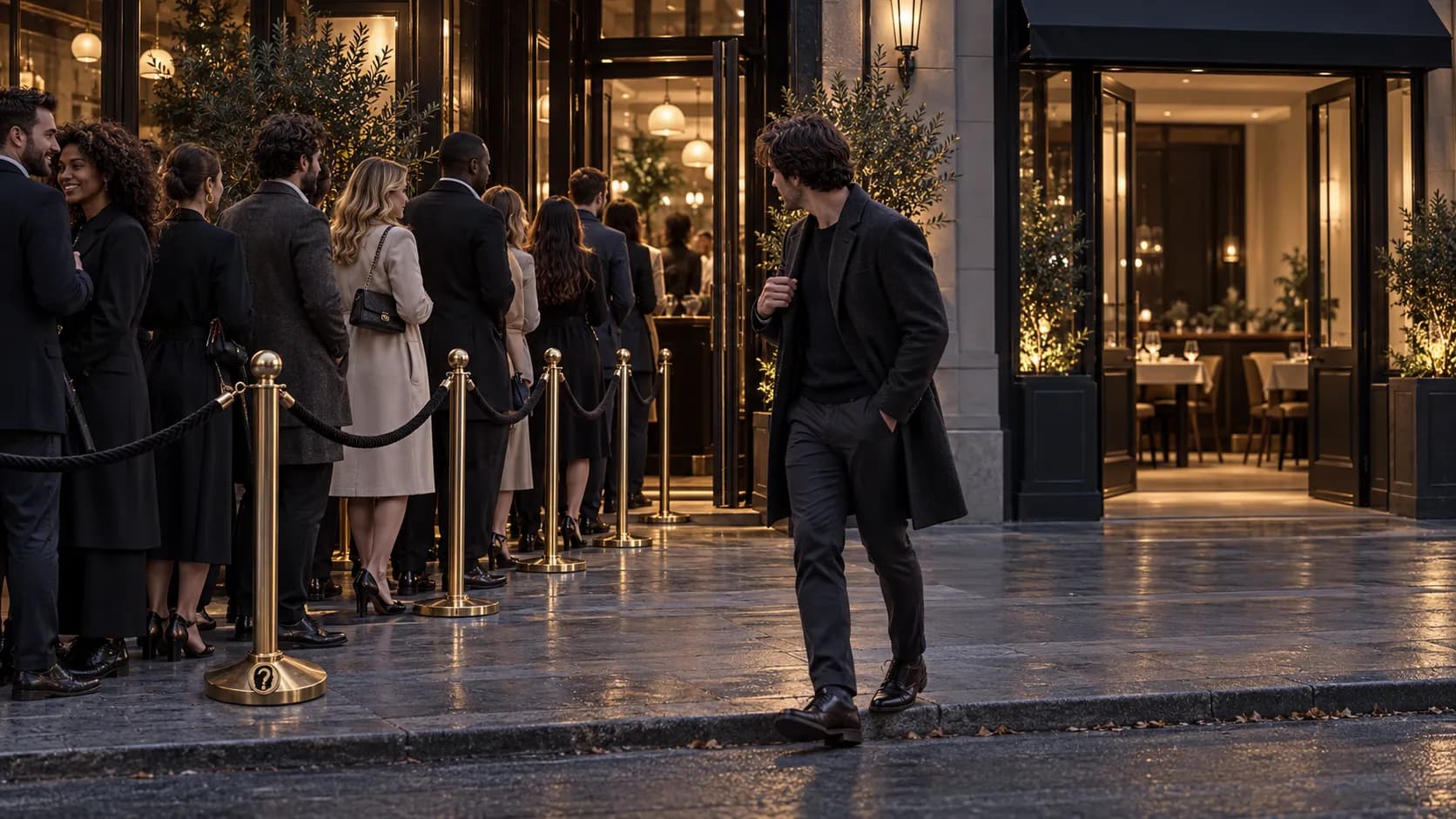
Nobody walking past a restaurant can taste the food, so they read the room: a long queue as a recommendation, an empty room as a warning. The research supports a narrower claim than the one a shop owner hopes for. A crowd draws looks, a long line can carry information about the product, and the line holds the people inside it by a different mechanism. None of it says that a long queue, by itself, makes people want in.
Answer to the question
Does a long queue make people want in?
Not by itself. A crowd makes passers-by look, as Milgram's 1969 street experiment showed. A long queue can also tell them that earlier customers judged the product good, which models treat as a rational inference when informed customers went first. It holds those already inside it more than it recruits new ones.
Key takeaways
- Milgram and colleagues (1969) had confederates stare up at a sixth-floor window on a New York street, and the more confederates there were, the more passers-by stopped and looked.
- Gallup and colleagues (2012) tracked 3,325 pedestrians and found that copying a glance saturated with group size and was too weak to produce a sudden, threshold-like spread.
- Veeraraghavan and Debo (2009) modelled customers who may rationally join the longer of two queues even when it holds one extra person, an effect that strengthens when better service is slower.
- Kremer and Debo (2016) found that once informed consumers are present, uninformed consumers buy less often at short waits, a pattern they call empty restaurant syndrome.
- Zhou and Soman (2003) found that the more people stood behind a consumer, the more positive the consumer's state and the less likely they were to leave the line; downward social comparison was their proposed explanation, not a measured one.
Take two restaurants serving the same food. One has forty people waiting outside and the other has none, and passers-by treat that as information.
The tempting rule for a shop owner is that a long queue sells, so build one. A long queue does read as a recommendation and an empty room as a warning, and the research says that reading is sometimes right. The studies behind it were run on different questions: where people look, what they infer, and how the wait feels from inside the line. Only one of those is about wanting.
A short wait warns and a long wait recommends
Uninformed consumers bought less often at short waits once informed consumers were present, according to a 2016 paper by Mirko Kremer and Laurens Debo, and a small share of informed consumers was enough to produce it. The mechanism is a signal. Where informed consumers choose the good product, popular products tend to carry longer waits, so a short wait starts to look like evidence of poor quality. The authors call the pattern empty restaurant syndrome. They also report that purchase frequency might even rise with the wait, and a replication archive at the University of Texas at Dallas lists the core result as a full replication.
The same message runs the other way. Michelle Baddeley's Copycats and Contrarians makes the restaurant version of the point: following the people already in a long queue is not necessarily irrational, because their choice may carry information (p. 21). The case for that reading is made in full in [When Copying Is the Rational Move](https://thewhyweproject.com/articles/when-copying-is-the-rational-move). This piece stays with the line itself.
The sharpest model of the line was published in 2009 by Senthil Veeraraghavan and Laurens Debo. Their customers hold private information about service quality and can see the queues, and a longer queue can mean heavier demand or slower service. With known, equal service rates, a customer may rationally join the longer queue even when it holds only one extra person, and which of two identical firms thrives can turn on the private signal of the first customer to arrive. The customers in the model have negligible waiting costs.
The effect strengthens when better service is slower, because length then reads as a recommendation. It weakens, and customers might even join the shorter queue, when better service is also faster. All the model results in this piece rest on abstracts and publisher records, and no full text of any of them was read. The Zhou and Soman paper was checked in a posted copy.
On this account the line is a message from earlier customers, and its value depends on how much those customers knew. A long queue built from people who knew nothing is long and uninformative.
On this account the line is a message from earlier customers, and its value depends on how much those customers knew.
Gary Becker's 1991 note gives the owner's side. Assume that a consumer's demand rises with the quantities other consumers demand, and several puzzles close at once: why a successful restaurant keeps its prices low under persistent excess demand, why supply does not expand to clear it, and why falling out of favour is easier than gaining favour. On that reading the line is part of the evidence for the product, which gives the owner a reason to let it stand.
A crowd draws looks, but looks cost nothing to give
A crowd will turn heads long before it changes anyone's mind. In 1969 Stanley Milgram and his colleagues had confederates stand on a busy New York pavement and stare up at a sixth-floor window, and the more confederates there were, the more passers-by stopped and looked.
A 2012 study led by Andrew Gallup tracked the head direction of 3,325 pedestrians in real crowds. The probability of copying rose with the size of the stimulus group and then saturated. Their model found the transfer of attention real but too weak to produce the sudden, threshold-like spread that earlier crowd models had predicted, and most of the visual interaction happened within about two metres. In a second experiment, two confederates behaved suspiciously, and the weak copying still helped people notice the relevant event.
What spread in both studies was a glance, and a glance costs nothing. A long queue asks for time, and a crowd on the pavement says nothing about whether the thing at the front is worth it. The scarcity cues that often sit beside a queue pull a different lever, covered in [Only Two Left in Stock](https://thewhyweproject.com/articles/only-two-left-in-stock).
Inside the line, the people behind hold you there
Everything above concerns people deciding whether to join. Those already in the line face a different problem. Rongrong Zhou and Dilip Soman reported in 2003 that as the number of people behind a consumer rose, the consumer was in a more positive state and less likely to renege. Their account of why centres on downward social comparison with the people behind. They did not measure that comparison directly, and they wrote that inferences about the service or about the wait ahead could not fully account for the effect. One study watched an ATM queue in Hong Kong. The other four used scenarios and photographs, mostly with no actual waiting.
A long queue may therefore hold its members by a mechanism with little to do with the one that recruits them, and the people at the back are doing part of the holding. How a wait is made tolerable is covered in [What Showing the Work Actually Does](https://thewhyweproject.com/articles/what-showing-the-work-actually-does). Baddeley's own example of the second kind of influence is 200 Ed Sheeran fans who "calmly and entirely voluntarily formed an orderly queue outside the venue without instructions" (p. 6). A line of that kind is a norm before anyone outside reads it as a message.
The models above treat the long queue as the honest sum of other people's choices, and a queue that counts demand looks identical from the pavement to a queue that stages it, which is the one case that none of these studies tests.
A queue that counts demand looks identical from the pavement to a queue that stages it.
Common questions
Does a long queue make people want in?
Not by itself. A crowd makes passers-by look, as Milgram's 1969 street experiment showed. A long queue can also tell them that earlier customers judged the product good, which models treat as a rational inference when informed customers went first. It holds those already inside it more than it recruits new ones.
What is empty restaurant syndrome?
The pattern Kremer and Debo describe in a 2016 paper: when informed customers choose the good product, a short wait reads as a sign of poor quality, so uninformed customers walk away even though there is no line. A small share of informed customers was enough to produce it.
Why do busy restaurants keep a queue instead of raising prices?
Gary Becker's 1991 note assumes that a consumer's demand rises with the quantities others demand. Under that assumption a successful restaurant may keep prices low despite persistent excess demand, and supply does not expand to clear it. The queue then works as evidence of demand.
Does having people behind you make a wait easier?
In Zhou and Soman's 2003 studies it did. As the number of people behind a consumer increased, the consumer was in a more positive state and less likely to leave the line. The authors expected downward social comparison to explain it but did not test that directly.
Sources
Milgram, S., Bickman, L., & Berkowitz, L. (1969). 'Note on the drawing power of crowds of different size.' Journal of Personality and Social Psychology, 13(2), 79-82. doi:10.1037/h0028070
Gallup, A. C., Hale, J. J., Sumpter, D. J. T., Garnier, S., Kacelnik, A., Krebs, J. R., & Couzin, I. D. (2012). 'Visual attention and the acquisition of information in human crowds.' Proceedings of the National Academy of Sciences, 109(19), 7245-7250. doi:10.1073/pnas.1116141109
Veeraraghavan, S., & Debo, L. G. (2009). 'Joining longer queues: Information externalities in queue choice.' Manufacturing & Service Operations Management, 11(4), 543-562. doi:10.1287/msom.1080.0239
Kremer, M., & Debo, L. G. (2016). 'Inferring quality from wait time.' Management Science, 62(10), 3023-3038. doi:10.1287/mnsc.2015.2264
Becker, G. S. (1991). 'A note on restaurant pricing and other examples of social influences on price.' Journal of Political Economy, 99(5), 1109-1116. doi:10.1086/261791
Zhou, R., & Soman, D. (2003). 'Looking back: Exploring the psychology of queuing and the effect of the number of people behind.' Journal of Consumer Research, 29(4), 517-530. doi:10.1086/346247